Category: Uncategorized

  • 10 Best Places to Sell Used Electronics for the Most Cash

    10 Best Places to Sell Used Electronics for the Most Cash


    We will receive a commission if you make a purchase through our affiliate link at no extra cost to you. Please read our disclosure policy for more information.

    I don’t know about you, but whenever Apple releases a new product, I get this itch to upgrade my devices to a better and faster model. However, is it really worth it? I am sure you must have asked yourself this question too, over and over again. Well, let me make this simpler for you by letting you in on a not-so-secret hack.

    Today, more and more people prefer buying pre-owned devices for a lower cost instead of new and expensive devices. In fact, the second-hand electronic products market is expected to grow at a compound annual growth rate (CAGR) of 3.4 percent from 2024 to 2034.

    So, why not sell used phones and laptops on Decluttr, eBay, and Craigslist? This way, you can make instant money from your old devices, whether it’s a phone or a laptop, and use it to pay your way through a new one.


    PIN THIS: I’ll be updating this post so make sure to pin this image here and save it to your Pinterest board. That way you’ll be able to come back to this page and learn about the best places to sell used electronics.

     

    best places to sell used electronicsbest places to sell used electronics


    1. Decluttr

    Decluttr is one of the best places to sell used electronics for many reasons. One of these reasons is that it facilitates the sale of a wide range of devices, including TVs, iPods, Apple computers, and accessories, Kindle e-readers, game consoles, wearables, and so on. It is one of the largest marketplaces for old devices, has a quick turnaround of 7 to 10 days, and pays through direct deposit or PayPal.

    Moreover, Decluttr does not charge any selling fees, and all you need to do is enter the item’s make, model, and condition. Based on this information, Decluttr will give you a price quote, list your device on its marketplace, and give you a free shipping label. With this shipping label, you can send the item directly to their warehouse, where they will inspect the device’s condition and pay you accordingly. Decluttr also accepts gadgets that are broken or water-damaged, in case putting your iPhone 12 into rice doesn’t work!


    2. eBay

    When you think about where to sell used electronics, the first name that might pop into your head is eBay. eBay had over 135 million active buyers in 2025, which further supports the fact that it is one of the best sites to sell any electronic device. By any, I mean any as you could sell anything from an old college laptop to a vacuum cleaner that hasn’t been used in ages.

    Have you ever heard of flipping? It is the process of selling old collectibles for a profit. In this case, you will be selling a collectible electronic device like a Sony Walkman. Now the fun part is that you can either sell your Walkman at a fixed price or auction it and start a bidding war! While eBay has higher selling fees and the sale might take longer, the global audience and the ability to set your own rates more than compensate for it.


    3. Facebook Marketplace

    Facebook Marketplace is much like eBay, where it’s possible to sell anything from a Samsung S23 Ultra to a PS5 or an Xbox. However, the biggest difference is while eBay has a global audience, Facebook Marketplace is better for selling locally and doesn’t charge any seller fees. Moreover, it’s convenient and easy to sell on Facebook Marketplace. All you need to do is take a few good pictures of the product, write a short description detailing its warranty (if any) and specifications, and set a price.

    It is one of your best options if you want to sell broken electronics like a cracked-screen iPad or something else directly to the customer in person and get paid cash or e-transfer. One important thing to remember when selling on Facebook Marketplace is your safety. Meet in a public place during daylight hours to avoid any scams. For example, some people ask to meet in a police department parking lot to make sure that everything is legit.


    4. Swappa

    If you prefer being in control of the sale and want to decide the price and the person you are selling to, check out Swappa. It is a platform specifically designed for items like Android phones, iPhones, Windows laptops, MacBooks, smartwatches, home technology, gaming consoles, cameras, and more.

    It is one of the best money-making apps to buy and sell new and old electronics without paying hefty seller fees. Besides, using Swappa is simple as it itself takes care of tedious tasks like packaging, shipping, and answering customer inquiries.

    Swappa is a trusted marketplace without any middleman, which means you will be selling directly to customers at your chosen prices. Swappa has strict shipping and payment timelines for all transactions and charges a 3% buyer fee to help keep things running smoothly. In exchange, Swappa guarantees customer satisfaction with timely payments and its super-friendly staff that can answer all your questions.


    5. OfferUp

    Yes, there are plenty of online sites to sell electronics. However, each one of them has pros and cons. For example, OfferUp gives you the complete freedom to sell anything from a Samsung TV to an older generation iPhone.

    Moreover, it’s an easy-to-use mobile platform with a rating system for both buyers and sellers that will help you screen potential scams. To sell your old gadgets on OfferUp, first, create a listing with photos and descriptions of the items you want to sell. Then the buyer can make a direct offer or ask you questions within the app.

    As OfferUp is a global marketplace, it allows you to sell internationally and locally. The only drawback here is that you will handle the shipping process individually. So, ideally, it is best to sell locally and meet the buyer in a public place.


    6. Craigslist

    No one likes the hassle of going through multiple steps for something simple like selling an old TV. Luckily, Craigslist comes to our rescue as a classic platform to sell anything from bulky electronics like a home theatre system to old Dell monitors, or even a refrigerator! What’s even better is that you should be able to confirm the sale within a day and make quick money. Additionally, Craigslist is a hassle-free platform without any hidden fees or the need to create an account. However, this can easily be a double-edged sword, where you have to do your own due diligence.

    As Craigslist does not vet any users on its platform, the likelihood of no-shows or scams is much higher. So, it’s best to add clear pictures, give honest details about the device’s condition, and meet in public spots to avoid any conflicts at the time of sale. In an ideal situation, the buyer will not haggle for the price. However, it’s better to be safe and price your listing to accommodate for last-minute haggling.


    7. Local Electronics Shops or Repair Stores

    Thanks to the online marketplaces, selling used electronics is easier than ever. However, if you are curious about how to sell old electronics for cash within your city, local electronics shops or repair stores are your best options. These stores often buy broken or used electronics to use their parts for repairs. For example, your battery-dead iPhone might still have a good screen that can be used on another iPhone. Or, they can use the RAM from your old MacBook to repair someone else’s device.

    These local electronics shops are best for selling broken or worn-down gadgets as they might not pay as much as online marketplaces for relatively new electronics. However, it’s fast, in-person, and there is no shipping involved, which counts as a win in my book!

    Alternatively, you can leverage these stores to get a quick quote for your used or broken electronics before listing them on Facebook Marketplace, eBay, or Craigslist.


    8. Apple Trade-In

    If you are looking for a hassle-free experience, why not trade in electronics for money with the Apple Trade-In program? These programs are best for trading in old iPhones, iPads, Macs, and Apple Watches for the latest models. According to Apple’s Website, your iPhone 15 Pro Max can be traded in for up to $630, while older models like an iPhone 14 Pro Max are valued at up to $450.

    To get started and receive a quote for your device, you’ll have to answer a few questions about the device’s condition on the Apple website. If you are happy with the quote, you can ship the item for free and get paid after inspection. The same process can also be done in a local Apple store, which is a faster way to exchange your iPhone for a gift card, Apple Store credit, or the latest model.

    Some Apple stores can even trade smartphones from other brands like a Google Pixel or a Samsung S-Series phone for store credit. In case your old device is too damaged, the store will recycle it for free.


    9. Best Buy Trade-In Program

    Similar to the Apple Trade-In program, Best Buy also offers a trade-in program for all types of smartphones (Android and iPhones), laptops (Microsoft Surface, Gaming laptops), and other electronic items like cameras, TV remotes, and MP3 players. Best Buy pays you a store credit or gift card that can be used on both offline and online stores to purchase anything within its store.

    Start by visiting Best Buy Online Estimator, and adding details of your device like brand, model, color, memory, etc. Then, you will need to answer some questions about the device’s condition to calculate its resale value. If you accept the quoted price, you will be given a shipping label or you can drop the item at a Best Buy store near you. The whole process usually takes around 7 to 9 days.


    10. Reddit (r/hardwareswap or r/appleswap)

    I sometimes wonder if we messed up shifting to cash and paper money from the age-old barter system. Anyway, if you want to swap your device as a barter, Reddit is the best platform to do so. While Reddit has a name for itself for its unhinged conversations, it is a handy platform if you know how to use it.

    You can use it to swap your gaming console with a computer or an iPhone for a MacBook using subreddits like r/hardwareswap and r/appleswap. You also have the choice to sell the product directly with subreddits like r/flipping. There are no hidden seller or buyer fees as you will be swapping or selling products to other Reddit users. Reddit is a global platform so you will find both local and international buyers. If you are selling internationally, mention the shipping fee separately. Or, sell within your city and arrange for a meetup in a public spot.

    As all Reddit users are completely anonymous, the trust and reputation of your account matter the most. Additionally, you must add the device’s photos with timestamps to prove that you are legit.


    Enjoyed this post? Don’t forget to pin the image below! Also, don’t forget to follow me on Pinterest over here! 🙂

    Source link

  • 8 Mother’s Day Gift Ideas That Feel Personal (Cute, DIY, Quick, and Truly Unique)

    8 Mother’s Day Gift Ideas That Feel Personal (Cute, DIY, Quick, and Truly Unique)


    Will Separation Save Your Marriage?

    In this thought-provoking YouTube video, Coach Lee delves deep into a question that many struggling couples often ponder: “Can Separation Save My Marriage?” With his wealth of experience and insightful […]


    Read More


    Source link

  • No Motivation? Try These 7 Micro Moves That Make Starting Feel Easy

    No Motivation? Try These 7 Micro Moves That Make Starting Feel Easy


    Want to try this at home? No worries! Download a copy of our SMART Goals PDF Worksheet.

    *****

    When motivation disappears, most people think they need more discipline or a perfect plan. In reality, what helps most is lowering the barrier to starting. Tiny actions can restart momentum and make progress possible even on low-energy days.

    These micro-moves work because they reduce friction. Instead of pushing yourself into big productivity bursts, you focus on small actions that are easy to begin and easy to repeat.

    Below are seven simple frameworks that make it easier to get moving again.

    Need some in depth help with goal settings, motivation or productivity ? Drop on by our directories choc full ofproductivity coaches,accountability coaches,and goal-setting coaches,and start reaching those goals! Or click here to have us match you to the best.

    Minimum Viable Day: The Tiny Baseline That Keeps You Consistent

    Some days simply don’t have the energy for a full routine. The Minimum Viable Day solves this by creating a tiny checklist of essential habits you can complete no matter what.

    By shrinking your expectations to the smallest possible actions, you avoid the common pattern of quitting routines when life gets busy or exhausting. Even small wins help maintain momentum and protect long-term consistency.

    Want more ideas about staying consistent on low-energy days? → Read the whole guide

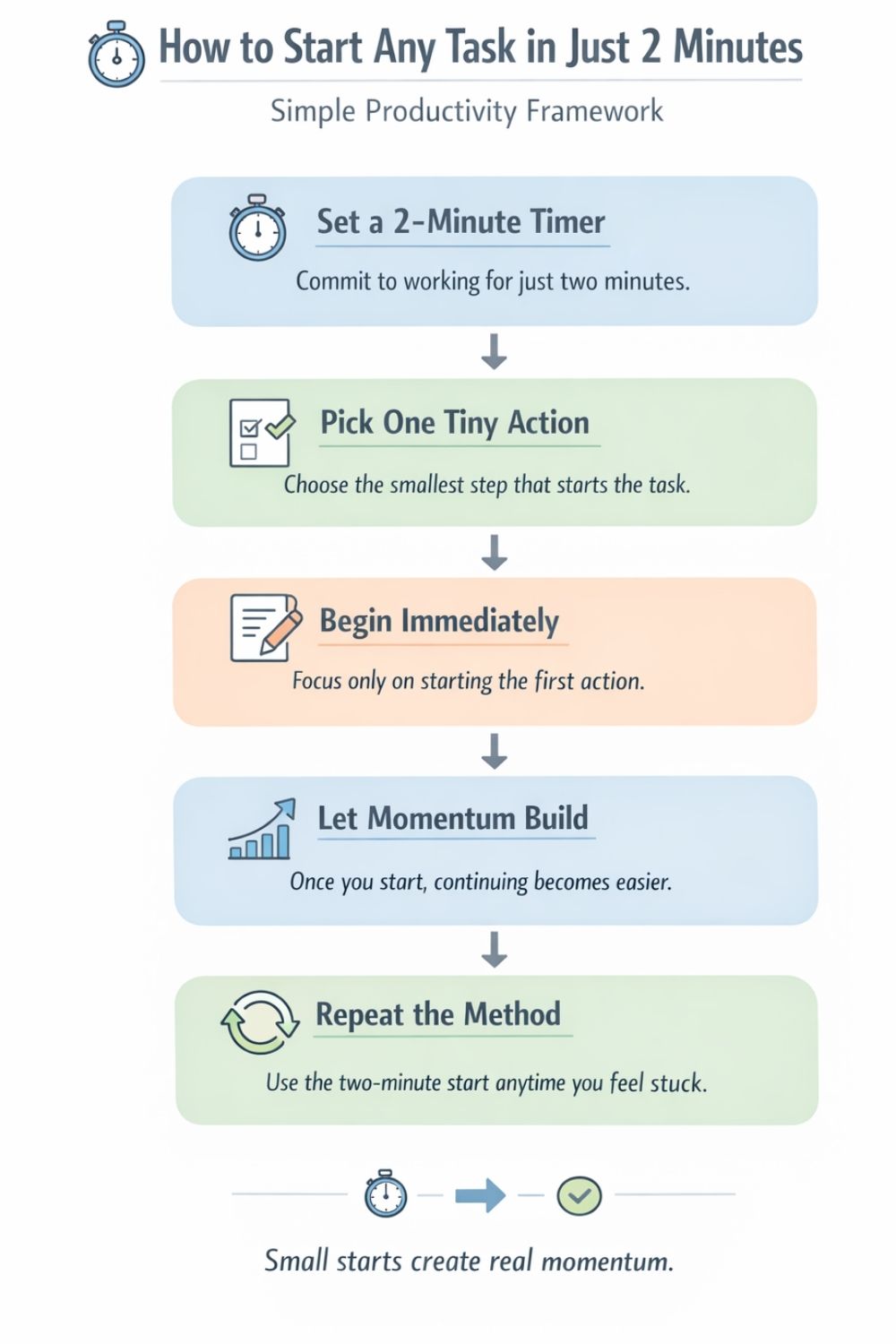
    The 2-Minute Start: A Simple Way to Begin When You Feel Stuck

    Starting is often the hardest part of any task. The 2-Minute Start removes that resistance by shrinking the beginning of a task to something you can do in just two minutes.

    Once movement begins, momentum tends to build naturally. Many people find that a tiny start turns hesitation into real progress.

    Want more ideas about breaking through procrastination and starting faster? → Read the whole guide

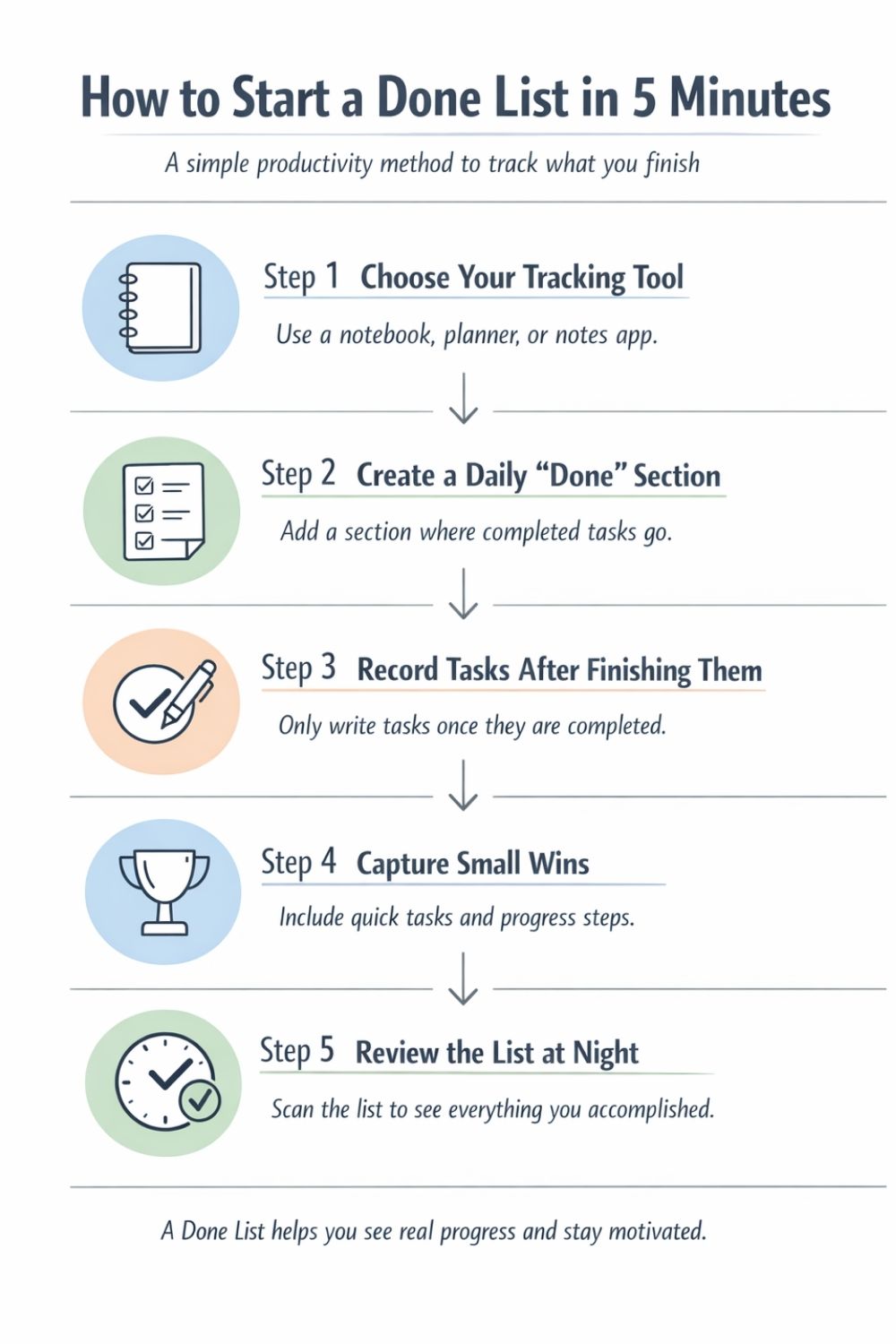
    The Done List: A Simple Way to Build Motivation by Tracking What You Finished

    Traditional to-do lists highlight everything left undone. A Done List flips that focus by tracking what you actually complete during the day.

    Recording finished actions creates visible proof of progress. Even small tasks start to build motivation because you can see forward movement happening in real time.

    Want more ideas about staying motivated through visible progress? → Read the whole guide

    One-Tiny-Task Promise: How to Start Anything by Finishing the Smallest Possible Task

    When a project feels overwhelming, committing to the entire task can stop you before you begin. The One-Tiny-Task Promise solves this by focusing on completing just one very small action.

    Finishing a tiny task creates a quick sense of progress and satisfaction. That small completion often sparks the motivation to continue.

    Want more ideas about starting tasks when your energy is low? → Read the whole guide

    The 1% Better Rule: The Tiny Habit That Quietly Changes Everything

    Big changes rarely stick because they rely on motivation and willpower. The 1% Better Rule focuses instead on tiny improvements repeated daily.

    A one-minute habit may seem small, but when it happens consistently it compounds into meaningful change over time.

    Want more ideas about building small habits that quietly reshape your routines? → Read the whole guide

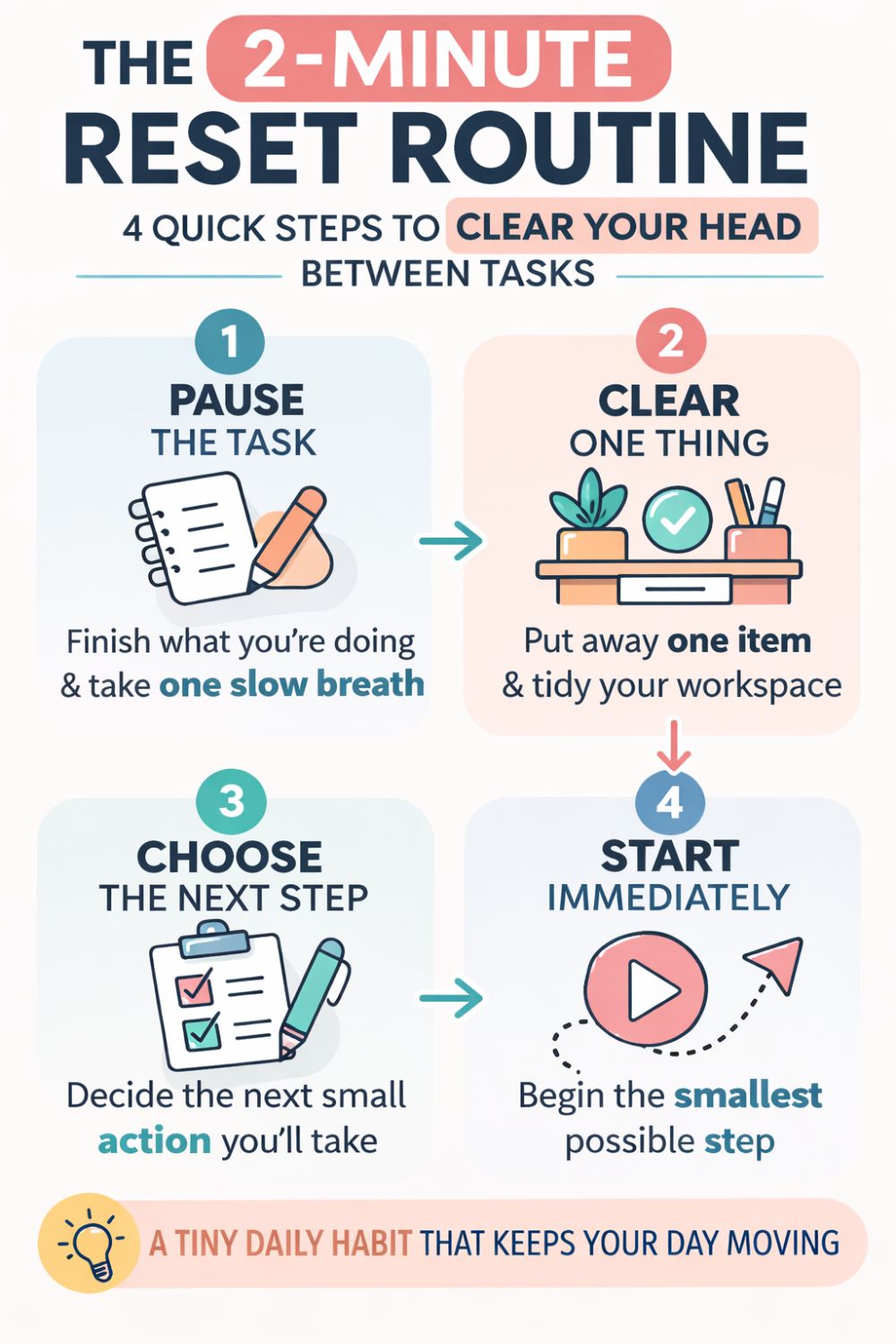
    Two-Minute Reset: The Tiny Routine That Helps You Regain Control Between Tasks

    Many people lose focus because tasks blend together during the day. The Two-Minute Reset creates a short pause between activities so you can clear mental clutter and refocus.

    In just a couple of minutes you tidy one small thing, reset your attention, and choose the next step intentionally.

    Want more ideas about staying focused and organized throughout the day? → Read the whole guide

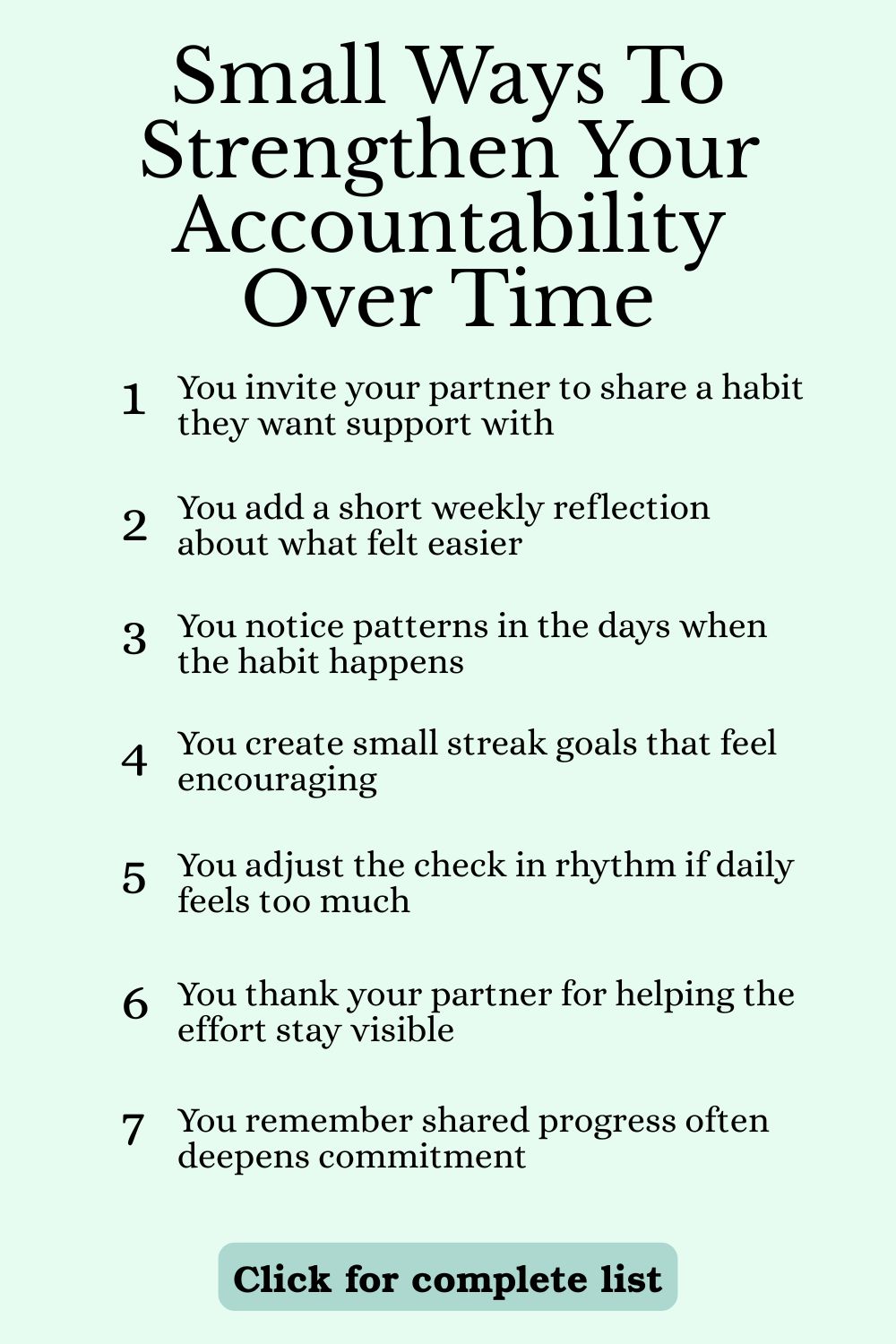
    Accountability Buddy Message: A 5-Minute Script That Helps You Actually Start

    Sometimes motivation improves simply by involving another person. A short accountability message makes your commitment visible and easier to follow through on.

    The key is keeping the system simple. A quick message and short check-ins can create enough structure to maintain consistency.

    Want more ideas about using accountability to stay consistent with habits? → Read the whole guide

    Small Moves Work Because They Lower Resistance

    Motivation is unreliable, but tiny actions are repeatable. When tasks become small enough to start easily, progress begins to happen almost automatically.

    These micro-moves all share the same principle: reduce pressure, shrink the first step, and focus on consistency instead of intensity.

    Over time, these small starts compound into meaningful progress.

    How to Choose the Right Micro-Move

    Different situations call for different tools.

    If you need consistency, the Minimum Viable Day works well. If the problem is starting tasks, the 2-Minute Start or One-Tiny-Task Promise can help. When motivation dips, tracking progress with a Done List often brings it back.

    The goal is not to use every system at once. Instead, choose one small framework that removes friction from your current routine.

    READ MORE

    Minimum Viable Day: The Tiny Baseline That Keeps You Consistent

    The 2-Minute Start: A Simple Way to Begin When You Feel Stuck

    The Done List: A Simple Way to Build Motivation by Tracking What You Finished

    One-Tiny-Task Promise: How to Start Anything by Finishing the Smallest Possible Task

    The 1% Better Rule: The Tiny Habit That Quietly Changes Everything

    Two-Minute Reset: The Tiny Routine That Helps You Regain Control Between Tasks

    Accountability Buddy Message: A 5-Minute Script That Helps You Actually Start

    Want to try this at home? No worries! Download a copy of our SMART Goals PDF Worksheet.

    *****

    Need some in depth help with goal settings, motivation or productivity ? Drop on by our directories choc full ofproductivity coaches,accountability coaches,and goal-setting coaches,and start reaching those goals! Or click here to have us match you to the best.

    The post No Motivation? Try These 7 Micro Moves That Make Starting Feel Easy appeared first on Life Coach Hub.


    Source link

  • How to Do a No-Spend Challenge and Reset Your Financial Health

    How to Do a No-Spend Challenge and Reset Your Financial Health


    I know. A “no-spend challenge” sounds about as fun as watching paint dry.

    But the results of a no-spend challenge can actually be fun. You might end up saving enough money for a vacation. Or money to start a small business and start making more money.

    A no-spend challenge is when you commit to cutting out all nonessential purchases for a set period of time, like a week or month, while still paying for basics like rent, groceries, and bills.

    Most people who complete a 30-day no-spend challenge save between $300 and $750, which can go straight toward your financial goals.

    It’s not about never spending money again. It’s about hitting pause on the extras to understand where your money really goes. And, to take a step towards financial freedom.

    You might think this sounds hard or extreme. But thousands of people have tried it and found that it actually makes managing money easier, not harder.

    The challenge helps you spot spending habits and money habits you didn’t even realize you had, like daily coffee runs or online shopping when you’re bored.

    Plus, it helps you start making and meeting your money goals.

    This guide walks you through everything you need to know to start your own no-spend challenge.

    You’ll learn exactly what counts as essential spending, how to set rules that work for your life, and ways to stay motivated when temptation hits.

    Whether you want to build emergency savings, pay off debt, or just reset your relationship with money, a no-spend challenge can help you get there.

    Other savings challenges:

    What Is a No Spend Challenge?

    ways to save $3,000 in 3 monthsways to save $3,000 in 3 months

    A no-spend challenge is a time period where you only pay for essential expenses like rent, groceries, and bills while cutting out all nonessential purchases.

    This money saving challenge can last anywhere from a single day to a full month, and it helps you save money quickly while breaking bad spending habits.

    Just make sure you put your savings into a high-yield savings account like this one that earns over 3% to earn interest on your savings.

    And helps you learn to live below your means.

    Earn Interest on Your Money

    CIT Bank: Make money while you sleep with a high yield Platinum Savings account. *

    *For complete list of account details and fees, see our Personal Account disclosures

    How a No Spend Savings Challenge Works

    You set a specific time period and commit to spending money only on must-have items during that window.

    Essential expenses include your rent or mortgage, utility bills, groceries, gas or bus fare, insurance payments, and any debt you need to pay.

    Everything else stops. You pause restaurant meals, coffee shop visits, online shopping, new clothes, entertainment purchases, and impulse buys of any kind.

    You might even cut expenses like streaming for a month to maximize saving money and really adopt frugal living tips.

    The money you would have spent on these items stays in your account. Most people save between $300 and $750 during a 30-day challenge, depending on their normal spending patterns.

    Before you start, you write down your rules. List what counts as essential for your situation and what you’re cutting out. This removes the guesswork when you’re tempted to buy something.

    Common Types of The No-Spend Savings Challenge: Day, Weekend, Week, Month

    A no-spend day works well when you’re just starting out. You commit to buying nothing except essentials for 24 hours. It’s short enough to feel easy but long enough to notice your spending urges.

    A no-spend weekend stretches the challenge to two or three days. You plan free activities and cook at home instead of going out. This type helps you see how much you typically spend during your days off.

    A no-spend week gives you seven days to break automatic spending patterns. You’ll face a full work week and weekend, which means dealing with lunch decisions, after-work habits, and social plans.

    A no-spend month (or 30-day no-spend challenge) is the most popular version. It runs long enough to create real behavior changes and generate significant savings. The first week feels hardest, but most people find weeks three and four easier as new routines set in.

    No Spend Challenge vs. No-Buy Challenge

    A no-spend challenge cuts out all nonessential purchases across every category. You’re not buying clothes, eating out, shopping online, or spending on entertainment.

    A no-buy challenge targets specific categories instead of everything. You might do a no-buy challenge for clothes, meaning you buy no new clothing items for 30 days but still allow yourself to eat at restaurants or buy other things.

    The no-buy approach works better if you have one problem spending category. If you spend too much on clothes but your restaurant budget is fine, a targeted no-buy challenge makes more sense.

    The full no-spend challenge (or spending freeze) creates faster results because you’re cutting multiple categories at once. It also reveals which types of spending are habits versus real choices.

    The Rules of a No Spend Challenge

    If you want to be successful with your no-spend money challenge, setting up clear rules from the beginning will help.

    You have to define what you can (essential expenses) and can’t buy (nonessential expenses), and you really need a lot in the “can’t buy” category to make a difference.

    It will help you figure out how to stop overspending money and quickly build up some savings at the same time.

    Related reading:

    Essential Expenses vs. Nonessential Spending

    Essential expenses are the costs you need to cover to maintain your basic needs and obligations.

    These include your rent or mortgage payment, utilities like electricity and water, basic groceries for meals at home, transportation costs to get to work, health care needs, and personal hygiene items like soap and shampoo.

    Nonessential spending covers everything else you can live without during your challenge. This means no coffee shop visits, restaurant meals, takeout orders, new clothing purchases, or streaming service subscriptions you just added.

    You should also skip hobby supplies, home decor items, and entertainment expenses like movie tickets or concerts.

    The line between essential and nonessential can vary based on your life. Your gym membership might be essential if it’s critical for your health and well-being.

    However, those extra fitness classes or workout gear purchases would fall into the nonessential category during your challenge.

    Defining No-Spend Challenge Rules

    Start by reviewing your last few months of spending to see where your money goes. Look at bank statements and credit card bills to identify patterns and problem areas.

    Next, write down your specific no-spend challenge rules. List which expenses count as essential and which ones you’ll cut.

    Be as detailed as possible so you don’t have to make difficult decisions in the moment when temptation strikes.

    Choose your challenge duration based on what feels realistic for your situation. You can start with a no-spend weekend to test the waters.

    A week-long challenge offers a good introduction without being overwhelming. Many people pick a full month because it’s long enough to create real impact but short enough to stay motivated.

    Think about using a no-spend challenge printable to track your progress and remind yourself of your rules. You can post it somewhere visible like your refrigerator or bathroom mirror.

    Setting Exceptions and Handling Unexpected Expenses

    Your no-spend month rules should include some flexibility for real life. You don’t want the challenge to create stress or force you to skip important events.

    The goal is to help you start saving money, not go through something tramautic!

    Set exceptions for preplanned occasions you committed to before starting. This includes weddings, birthday parties for close friends or family, or events where you already bought tickets.

    Just don’t use this as an excuse to add new social commitments during your challenge period.

    Unexpected expenses need their own category in your rules. If your laptop breaks and you need it for work, you have to replace it.

    The same goes for car repairs that affect your safety or medical needs that come up suddenly. These aren’t failures—they’re necessary spending that falls outside your control.

    If you’re doing a group challenge, decide together what happens when someone breaks the rules.

    One option is to extend the challenge by one extra day for each slip-up. This adds accountability without being too harsh.

    Tips for Success During the Money Challenge

    Success in a no-spend challenge comes down to planning your meals well, cutting out things that make you want to shop, finding fun things to do for free, and keeping track of how you’re doing.

    Setting Clear Savings Goals

    Pick a specific dollar amount you want to save during your challenge. Maybe it’s $200 in a week or $500 in a month.

    Having a number gives you something to aim for and keeps you motivated to stay on track.

    Think about what you want to do with the money you save. You might use it to pay off debt, build an emergency fund, or save for something special.

    Knowing your purpose makes it easier to say no to impulse purchases.

    Track your savings every few days. Seeing the number grow reminds you why you’re doing this. It also shows you how much progress you’re making toward your financial goals.

    Want to download and monitor your credit for free?

    If you want to check your credit report and score whenever you want to then download Credit Karma. This easy app lets you see your credit details whenever you want!

    Meal Planning and Managing Groceries

    Meal planning helps you save money quickly and avoid extra trips to the store. Before your challenge starts, look through your pantry, fridge, and freezer to see what you already have. Make a list of meals you can create with these items.

    Plan your meals for the entire week before you shop. This stops you from buying random items or ordering takeout when you don’t know what to cook.

    If your challenge allows some grocery spending, stick to a strict grocery list on a budget and only buy what you need for your planned meals.

    Try the pantry challenge during your no-spend time. This means using up food you already own before buying anything new.

    You might discover ingredients you forgot about or find creative ways to combine foods you wouldn’t normally put together.

    Keep easy meal ideas handy for busy days. Simple recipes with fewer ingredients help you avoid the temptation to order delivery when you’re tired.

    Removing Spending Triggers and Temptations

    Your environment plays a big role in whether you spend or save. Remove temptations by unsubscribing from store emails that fill your inbox with sales and deals.

    These messages are designed to make you buy things you don’t need.

    Unlink your credit card information from online shopping sites. This extra step between you and a purchase gives you time to think about whether you really need something.

    Delete shopping apps from your phone if you tend to browse and buy out of habit.

    Avoid places where you usually spend money. If you always grab coffee at a certain cafe, take a different route.

    Pay for gas at the pump instead of going inside the convenience store where you might grab snacks.

    Turn off notifications from shopping apps and social media ads. Many companies use targeted advertising to show you products based on your browsing history.

    You can opt out of some of this tracking through your browser and phone settings. It may sound extreme, but it can really help you do a no-spend challenge successfully.

    Creative Free Activities for Fun

    Finding free things to do keeps you from spending money out of boredom. Make a list of at least 10 free activities before your challenge starts. This gives you options when you need entertainment.

    Look through books you haven’t read yet or shows you’ve recorded but never watched. Use hobby supplies you already own, like craft materials, nail polish, or art supplies. Start that project you’ve been putting off for months.

    Get outside for free fun. Go for walks, hikes, or bike rides in your area. Visit free museums on community days or explore local parks you’ve never been to.

    Check out geocaching, where you use GPS to find hidden containers in your neighborhood.

    Invite friends over for game nights or potluck dinners instead of meeting at restaurants. Watch free outdoor movies or concerts if your town offers them.

    Work on organizing photos, updating your address book, or planning a future trip.

    Tracking Progress and Staying Motivated

    Write down every dollar you don’t spend and where it’s going instead. Seeing your savings grow keeps you motivated when the challenge gets hard.

    Use a simple notebook, spreadsheet, or budgeting app to track your progress.

    Set up a separate savings account for your challenge money. Watching this account balance increase gives you a visual reminder of why you’re doing this.

    Some people save $300 to $750 in just 30 days.

    Share your challenge with a friend or family member who can support you. Tell them your goal and ask them to check in on your progress.

    Some people find that doing a no-spend challenge together makes it easier to stick with it.

    Celebrate small wins along the way. When you make it through a week without spending, recognize that achievement.

    Take a moment each day to remind yourself why you started this challenge and what you’ll do with the money you save.

    Communicating and Holding Yourself Accountable

    Tell someone you trust about your challenge. This could be a friend, family member, or partner.

    When other people know your plan, you’re more likely to stick with it. They can also remind you of your goals when you’re tempted to break the rules.

    Join an online group or forum where others are doing the same challenge. Sharing your wins and struggles with people who understand makes the process easier. You can learn from their tips and stay motivated together.

    Check in with yourself daily or weekly. Ask if you followed your rules and what was hard. Write down what worked and what didn’t so you can adjust as needed.

    This helps you break bad spending habits and build better ones that last.

    Benefits and Results of a No Spend Challenge

    A no spend challenge creates real changes in your wallet and your way of thinking (or not thinking) about money.

    You’ll see immediate financial gains while building skills that reshape how you handle money for years to come.

    Financial and Budgeting Benefits

    The most obvious benefit is saving money. When you stop spending on nonessentials, that cash stays in your account instead of disappearing on impulse buys and forgotten subscriptions.

    Many people save hundreds of dollars during a month-long challenge. You might find $200 to $500 extra in your budget just by cutting out restaurant meals, coffee runs, and online shopping.

    This extra money gives you options. You can boost your savings account, work on debt payoff for high-interest credit cards, or build an emergency fund.

    Even a modest no-spend weekend can free up $50 to $100.

    The challenge also shows you exactly where your money goes. You’ll spot spending leaks you didn’t know existed. Those $5 purchases add up fast when you see them all together.

    Resetting and Improving Money Habits

    A no spend challenge acts like a reset button for your spending habits. You break the cycle of automatic purchases and mindless buying.

    You learn delayed gratification by waiting before you buy. That want for new shoes or the latest gadget becomes less urgent after a few days. Often, you realize you didn’t need it at all.

    Your money habits improve because you practice saying no. Each time you skip a purchase, you strengthen your ability to spend less. This skill sticks with you after the challenge ends.

    Check out these books on financial freedom for more education.

    You also become more creative with what you already own. You’ll use up pantry items, wear clothes you forgot about, and find free entertainment options.

    Long-Term Impacts on Spending

    The changes don’t stop when the challenge ends. You carry better money habits into your regular life.

    You become more intentional about every purchase. Before buying something, you ask if you really need it or just want it. This pause prevents impulse spending.

    Your relationship with shopping changes. You stop using retail therapy as entertainment or stress relief. Instead, you find other ways to feel good that don’t drain your bank account.

    Many people keep some challenge rules permanently. They might continue packing lunch instead of buying it or cancel subscriptions they don’t use. These small changes add up to big savings over time.

    Cut Your Phone Bill in Half!

    Consumer Cellular provides the same cell service as the big guys but with no contract. Plans as low as $20 a month! Make the switch today and save hundreds.

    Emotional and Lifestyle Benefits

    Beyond money, you’ll notice lifestyle improvements. Your home becomes less cluttered because you’re not bringing in new items constantly.

    You might be eating more better and could improve your health.

    You feel more in control of your finances. This confidence reduces money stress and anxiety. You know you can handle tight budgets if needed.

    The challenge also shifts your values. You appreciate what you have instead of always wanting more. Free activities like hiking, library books, and time with friends become more satisfying.

    You might even discover new hobbies that don’t cost money. Cooking at home, exercising outdoors, or learning skills from free online resources all enrich your life without spending.

    What to Do After Completing Your No Spend Challenge

    Your no spend challenge has ended, and now you need to decide where your savings go and how to keep your good habits alive.

    This is when you turn short-term wins into long-term financial health.

    Using Your Savings Effectively

    Put your challenge savings to work right away. If you don’t have an emergency fund yet, start one now.

    Aim to save at least $1,000 as a starter emergency fund, then work toward three to six months of basic expenses.

    Already have emergency savings? Pay down high-interest debt like credit cards or personal loans. Every dollar you put toward these balances saves you money on interest charges.

    You can also fund a specific goal you set before the challenge started. Maybe you wanted to save for a vacation, a new laptop, or holiday gifts.

    Move that money into a separate savings account so you won’t accidentally spend it on other things.

    Consider starting another savings challenge if you enjoyed the process. You could try a 52-week money challenge or a round-up savings plan to keep the momentum going.

    Applying Lessons to Future Budgeting

    Review what you learned during your challenge. Look at which spending categories were easiest to cut and which ones caused the most struggle.

    This tells you where your money actually matters to you. And is a budgeting tip that can help you into the future.

    Build these insights into your regular budget. If you realized you were spending $200 a month on restaurants but barely missed it during the challenge, maybe you only need to budget $50 for eating out.

    Track the spending patterns that led to impulse purchases before your challenge.

    Did you shop when bored? Stressed? After scrolling social media? Knowing your triggers helps you avoid them going forward.

    Set up automatic transfers to savings on payday. This makes saving a habit instead of an afterthought.

    Maintaining Healthy Spending Habits

    Keep some of your challenge rules as permanent habits. You don’t need to cut spending forever, but certain boundaries help.

    Unsubscribe from marketing emails that tempt you. Delete saved payment information from shopping sites. Wait 24 hours before buying non-essential items.

    Plan regular spending check-ins with yourself. Review your bank statements weekly or monthly to catch problem areas early.

    Give yourself permission to spend on things you truly value. The goal isn’t to never enjoy your money. It’s to spend intentionally instead of mindlessly.

    Consider doing mini challenges throughout the year. A no spend weekend each month or a weeklong challenge every quarter keeps your spending awareness sharp without the intensity of a full month.

    Final Thoughts

    When it comes to saving money, a no-spend challenge can jump-start your efforts! It is an easy savings challenge to help you stay on track.


    Source link

  • Two-Minute Reset: The Tiny Routine That Helps You Regain Control Between Tasks

    Two-Minute Reset: The Tiny Routine That Helps You Regain Control Between Tasks


    Want to try this at home? No worries! Download a copy of our SMART Goals PDF Worksheet.

    *****

    Some days don’t fall apart all at once. They unravel slowly.

    You finish one task, jump into another, answer a message, remember something else you forgot, and suddenly your brain feels crowded. Even if you’re technically getting things done, it starts to feel scattered.

    That’s the hidden problem with task switching.

    Your brain never fully closes the last task before opening the next one. The mental tabs stay open, the environment gets cluttered, and your attention gets stretched thin.

    The Two-Minute Reset is a tiny routine that solves this problem.

    It’s a short pause you take between tasks to clear space, reset your focus, and begin the next activity with intention. It doesn’t require planning, apps, or a complicated system.

    It simply creates a small boundary between one activity and the next.

    This matters because small routines are the foundation of daily habits. They create structure without requiring huge amounts of motivation.

    Instead of pushing through distraction or chaos, you create a moment of order.

    The Two-Minute Reset is also one of the easiest habits for a better life because it fits anywhere. You can use it between work sessions, household chores, creative projects, or even errands.

    The routine takes about two minutes, but the effect is larger than it sounds.

    You stop carrying the weight of the previous task into the next one.

    Over time, these tiny resets become daily habits to improve your life because they help your day feel more intentional and less overwhelming.

    And the best part is that it only takes a few small steps.

    Need some in depth help with goal settings, motivation or productivity ? Drop on by our directories choc full of productivity coaches, accountability coaches, and goal-setting coaches, and start reaching those goals! Or click here to have us match you to the best.

    Step 1: Clear the Physical and Mental Space

    The first part of the Two-Minute Reset focuses on clearing the environment around you.

    When your space feels cluttered, your brain treats those unfinished details like open loops. Even if you try to ignore them, your attention keeps drifting back.

    That’s why the reset begins with a quick physical reset.

    Stand up and shift your body: If you’ve been sitting or focused on a task for a while, simply standing up changes your mental state. Roll your shoulders, stretch your arms, or take a small step away from your workspace.

    This signals that the previous task is finished.

    Clear one small piece of your environment: Don’t aim for a full cleanup. Instead, choose one tiny action like stacking papers, putting away a tool, or moving a dish to the sink.

    One small act of order is enough.

    Close or organize what you were using: If you were working on a computer, close unnecessary tabs or save your file. If you were cooking or cleaning, wipe the counter or return one item to its place.

    This creates closure.

    Take one slow breath before continuing: After clearing a small part of your space, pause for a single deep breath. This helps your nervous system slow down before you move forward.

    These steps may sound small, but they create a psychological shift.

    Instead of rushing into the next task while still carrying mental clutter, you create a clean starting point.

    Practicing this regularly strengthens daily habits that support focus and calm transitions.

    And over time, this tiny ritual becomes one of those daily habits to improve your life that quietly keeps your day organized.

    Step 2: Reset Your Attention Before Starting the Next Task

    Once your space is cleared, the second step of the Two-Minute Reset focuses on your attention.

    Many people start the next task automatically, without deciding what they’re actually doing. This leads to wandering focus and procrastination.

    A brief attention reset solves that.

    Decide what the next task is: Instead of thinking vaguely about what comes next, name the action clearly. For example, “write one paragraph,” “reply to two messages,” or “start folding the laundry.”

    Clarity reduces hesitation.

    Choose the smallest starting point: Large tasks can feel heavy when you’re tired. Instead of focusing on the entire job, focus on the first tiny step.

    Opening the document, laying out materials, or gathering supplies is enough.

    Create a starting cue: A cue can be anything simple—a timer, a sip of water, or adjusting your chair. When repeated often, this cue becomes a signal that it’s time to begin again.

    Start before motivation appears: Motivation often follows action, not the other way around. By starting the smallest step immediately, you bypass the resistance that delays progress.

    This moment of focus helps you move forward with purpose.

    Instead of drifting through your day, you choose the next action intentionally.

    That’s why the Two-Minute Reset supports habits for a better life. It replaces scattered effort with deliberate attention.

    When repeated regularly, this small transition becomes one of the most reliable daily habits you can build.

    And over time, it becomes a powerful example of daily habits to improve your life because it keeps your day moving forward smoothly.

    Step 3: Build the Two-Minute Reset Into Your Day

    The real strength of the Two-Minute Reset appears when it becomes a consistent routine.

    Instead of using it occasionally, you begin using it between many of your daily activities. Each reset becomes a small checkpoint that keeps your day organized.

    Attach the reset to natural transitions: The best way to build the habit is by linking it to moments that already exist. Finishing a work session, completing a chore, or closing your laptop are perfect triggers.

    The reset becomes the bridge between tasks.

    Keep the routine extremely simple: The entire reset should remain small enough that you never resist it. Stand up, clear one thing, take a breath, and choose the next task.

    That’s enough.

    Use the same order every time: Repeating the same sequence trains your brain to recognize the routine automatically. Over time, you won’t need to think about it.

    The pattern becomes familiar.

    Practice it on both calm and busy days: Habits grow through repetition. Even when your day feels easy, running the reset keeps the routine strong.

    Eventually, it becomes second nature.

    When practiced regularly, this routine strengthens daily habits that support consistency.

    Instead of relying on bursts of motivation, you rely on simple systems.

    This is exactly how habits for a better life develop. They’re not dramatic changes.

    They’re small patterns that make your day run more smoothly.

    And the Two-Minute Reset is one of the easiest daily habits to improve your life because it fits naturally into the flow of everyday activities.

    Step 4: Turn Tiny Resets Into a Consistency System

    The final step is recognizing how powerful these small resets become over time.

    One Two-Minute Reset might seem insignificant. But several resets throughout the day create a rhythm that keeps you steady and focused.

    Use resets as boundaries between tasks: Instead of letting your day blend into a blur of activity, each reset creates a clear ending and a clear beginning.

    This helps your brain transition smoothly.

    Prevent tasks from stacking mentally: Many people feel overwhelmed because unfinished tasks pile up in their mind. The reset closes one mental loop before opening another.

    That sense of closure reduces stress.

    Protect your energy on low-motivation days: When you’re tired, complicated systems fall apart. But the Two-Minute Reset still works because it requires almost no effort.

    Standing, clearing one item, and choosing the next step is manageable even on slow days.

    Notice the compound effect: Five or ten resets in a single day create multiple moments of clarity. Instead of drifting through tasks, you move through the day with small intentional pauses.

    That rhythm adds up.

    This is why routines like the Two-Minute Reset become powerful daily habits.

    They don’t require perfect discipline. They simply create structure where chaos might otherwise appear.

    Over time, these small transitions build habits for a better life because they keep your day calm, focused, and intentional.

    And that’s exactly how the simplest daily habits to improve your life begin—with one small reset at a time.

    Want to try this at home? No worries! Download a copy of our SMART Goals PDF Worksheet.

    *****

    Need some in depth help with goal settings, motivation or productivity ? Drop on by our directories choc full of productivity coaches, accountability coaches, and goal-setting coaches, and start reaching those goals! Or click here to have us match you to the best.

    The post Two-Minute Reset: The Tiny Routine That Helps You Regain Control Between Tasks appeared first on Life Coach Hub.


    Source link

  • Accountability Buddy Message: A 5-Minute Script That Helps You Actually Start

    Accountability Buddy Message: A 5-Minute Script That Helps You Actually Start


    How to Reclaim Your Power in 2023

    Why in 2023? Because in this year, we are entering a deeper process of individuation. We are becoming more self-realized. After experiencing the storms and becoming aware of our traumas; […]


    Read More


    Source link

  • The 2-Minute Start: A Simple Way to Begin When You Feel Stuck

    The 2-Minute Start: A Simple Way to Begin When You Feel Stuck


    There’s a moment most people recognize.

    You know what you should be doing. The task is clear. The goal matters. But somehow you’re still not starting.

    You open a tab, check something small, rearrange your desk, or promise yourself you’ll begin “in a minute.” Before you realize it, the delay becomes a pattern.

    Procrastination rarely happens because the task is impossible. It usually happens because starting feels mentally heavy.

    When your brain sees a large task, it interprets it as effort, pressure, and commitment. That creates resistance. And resistance leads to avoidance.

    The 2-Minute Start solves this problem by shrinking the beginning of any task into something incredibly small.

    Instead of committing to the entire project, you only commit to the first two minutes.

    Two minutes of writing.
    Two minutes of organizing.
    Two minutes of planning.

    That tiny commitment lowers the psychological barrier that usually stops people from beginning.

    Once you start moving, something interesting happens. The task often feels easier than you expected. Your brain switches from resistance to engagement.

    Momentum replaces hesitation.

    This is why many productivity experts consider starting the most important moment of any task. Action creates energy. Movement builds motivation.

    If you want to be more productive, build self motivation, and use practical productivity hacks that work even on low-energy days, the 2-Minute Start is a simple framework that can change how you approach work.

    You don’t have to feel ready.

    You just have to begin.

    The 2-Minute Start Framework

    Why starting small breaks procrastination

    Most people assume procrastination comes from laziness or lack of discipline.

    In reality, procrastination is usually a response to mental overload.

    When a task feels too big or undefined, your brain searches for ways to delay it. The larger the project appears, the stronger the resistance becomes.

    The 2-Minute Start works because it removes that pressure.

    Instead of focusing on the entire project, you only focus on the smallest possible action.

    The brain sees a small task very differently from a large one.

    Shrink the task to the smallest possible action:

    Take the project you’ve been avoiding and reduce it to something you can begin immediately. If you need to write an article, your two-minute action might be opening the document and writing one sentence. If you need to organize your workspace, your two-minute action might be clearing one small area.

    Set a simple two-minute timer:

    Use a timer to make the commitment clear. Two minutes feels manageable, even on days when energy is low. Knowing the session is short helps remove internal resistance.

    Focus only on the first visible step:

    Do not think about the entire project. Ignore the outcome and focus only on the next action in front of you. This keeps your attention simple and manageable.

    Allow momentum to develop naturally:

    Once the timer ends, decide whether you want to continue. Many times you will keep working because the hardest part—the start—is already done.

    Repeat the method when you stall again:

    If resistance returns later, restart the system. Choose another two-minute action and begin again.

    This framework transforms starting from something intimidating into something simple and repeatable.

    How to Turn the 2-Minute Start Into a Daily Productivity Habit

    Making small starts part of your routine

    The real power of the 2-Minute Start appears when it becomes part of your daily workflow.

    Instead of waiting for motivation to appear, you use small starts as your default strategy for beginning tasks.

    Over time, this trains your brain to associate work with ease rather than pressure.

    Identify your most common starting blocks:

    Notice where procrastination tends to appear in your day. It might happen when you sit down to begin work, start a creative project, reply to emails, or tackle a large goal. These moments are perfect opportunities to use the two-minute rule.

    Create a “start list” for your tasks:

    Instead of writing large tasks like “finish report” or “clean office,” write the smallest first action required to begin. This could be “open the spreadsheet,” “outline three ideas,” or “clear the desk surface.”

    Start before motivation shows up:

    One of the biggest productivity myths is that you need motivation before you begin. In reality, motivation often appears after action starts. The two-minute commitment helps you bypass the waiting stage.

    Reward the act of starting:

    Most people only celebrate completed work. Instead, acknowledge the moment you begin. Starting consistently builds trust in yourself and strengthens self motivation.

    Use the rule across different areas of life:

    The 2-Minute Start works for writing, studying, organizing, exercising, planning, and creative projects. Any goal becomes easier when the entry point is small.

    As you repeat this pattern daily, starting becomes automatic.

    You stop negotiating with yourself and begin moving forward.

    Using the 2-Minute Start When Your Energy Is Low

    Beginning even when you feel mentally drained

    Some days the challenge isn’t procrastination.

    It’s exhaustion.

    When energy is low, even simple tasks can feel overwhelming. Your brain wants to conserve effort, which makes starting feel difficult.

    The 2-Minute Start is especially useful on these days because it reduces the amount of energy required to begin.

    Instead of forcing yourself through a long work session, you only focus on the smallest possible action.

    Choose the lowest-effort entry point:

    When energy is low, adjust your starting step. Instead of aiming for productivity perfection, choose the easiest version of the task. Brainstorm ideas instead of writing a full page. Review notes instead of building a complete plan.

    Prepare your environment first:

    Small environmental adjustments can make starting easier. Open the document you need, clear your desk, or place materials within reach. These small changes remove friction from the beginning of the task.

    Focus on movement instead of results:

    On low-energy days, the goal is not maximum output. The goal is motion. Even small progress keeps the task alive and prevents it from becoming overwhelming later.

    Let the work session grow naturally:

    Sometimes the two-minute start turns into a longer work session. Other times you may stop when the timer ends. Both outcomes are productive because you honored the commitment to begin.

    Use the system to restart stalled days:

    If your day feels off track, a two-minute action can reset momentum. Starting one task often unlocks the motivation to continue with the next.

    Small actions are surprisingly powerful when your energy is limited.

    They keep progress moving forward.

    Combining the 2-Minute Start With Other Productivity Hacks

    Turning tiny actions into meaningful progress

    The 2-Minute Start is powerful on its own, but it becomes even more effective when paired with other productivity strategies.

    Once the starting barrier is removed, you can build additional structure that keeps momentum moving.

    Extend the start into a focused time block:

    After your two minutes are complete, consider expanding the session into a short focus block. Many people move into a 15 or 25 minute work period once they’re already engaged.

    Use momentum to complete quick wins:

    Once you’ve started working, look for small tasks that can be finished quickly. Completing these builds confidence and reinforces the feeling of progress.

    Stack multiple two-minute starts together:

    You can use the method across several tasks in one work session. Start the email draft, outline your report, organize a document, and review your calendar. Several small starts can move your entire day forward.

    Track small progress throughout the day:

    Recording small wins helps you see how much work you actually accomplish. Even simple actions contribute to larger goals over time.

    Prepare tomorrow with a two-minute finish:

    Before ending your day, spend two minutes setting up your first task for tomorrow. Open the document, write a note, or outline the next step. This makes it easier to begin the next morning.

    The secret to productivity isn’t working harder.

    It’s making starting easier.

    And sometimes, two minutes is all it takes to turn hesitation into momentum.

    The post The 2-Minute Start: A Simple Way to Begin When You Feel Stuck appeared first on Life Coach Hub.


    Source link

  • The 1% Better Rule: The Tiny Habit That Quietly Changes Everything

    The 1% Better Rule: The Tiny Habit That Quietly Changes Everything


    Most people try to improve their lives by making big, dramatic changes. They set huge goals, design complicated routines, and expect motivation to carry them through.

    But lasting progress rarely works that way.

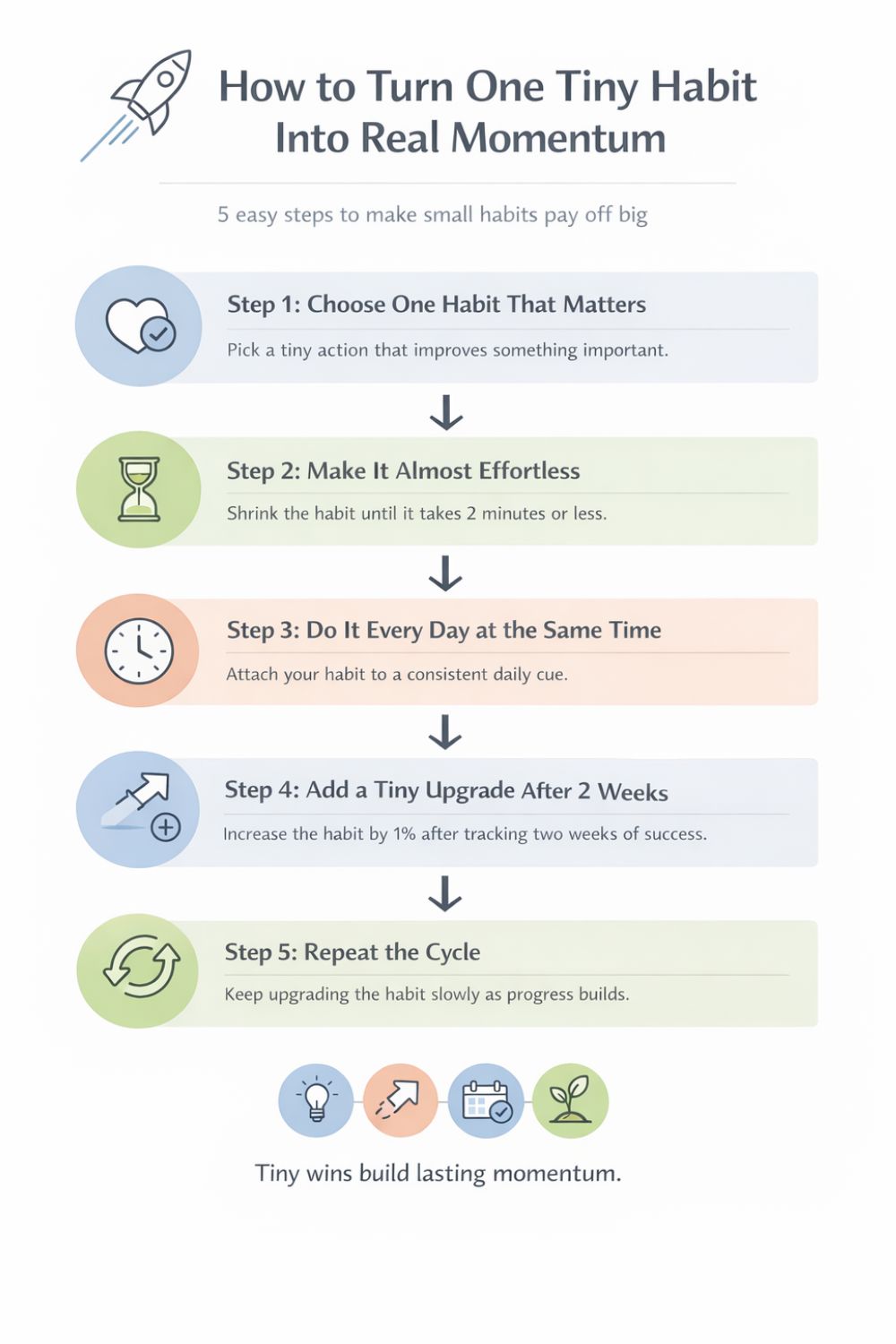
    The 1% Better Rule is a simple idea: instead of trying to transform everything at once, you focus on the smallest improvement you can repeat every day. One tiny upgrade. One small action. One simple habit that nudges you forward.

    This approach works because consistency beats intensity. Small actions feel manageable even when energy is low. And when those actions repeat daily, they slowly compound into real progress.

    You may have heard similar ideas in discussions about atomic habits, where the focus is on small systems rather than dramatic change. The difference with the 1% Better Rule is its simplicity. You’re not trying to optimize your entire life.

    You’re just getting a little better today than you were yesterday.

    That tiny improvement might be reading one page, organizing one item on your desk, walking for two minutes, or writing one sentence toward a goal. It may feel insignificant in the moment, but repetition turns it into momentum.

    Over time, these small actions create powerful daily habits to improve your life. They reduce overwhelm, build confidence, and help you follow through consistently.

    Instead of waiting for the perfect plan or the perfect mood, you simply begin with the smallest possible step.

    And that’s where real change begins.

    Choose the Smallest Possible Improvement

    Most people struggle with habits because they start too big. They try to redesign their entire routine overnight, which quickly leads to frustration and burnout.

    The 1% Better Rule begins with shrinking the habit until it feels almost effortless.

    Pick a micro-upgrade: Identify the smallest possible action that moves you in the right direction. If your goal is to read more, start with one page. If you want to improve your health, begin with one stretch or one minute of movement.

    Make the habit easy to repeat: A habit should feel so manageable that you can do it even on your busiest day. The goal is not intensity. The goal is repetition.

    Connect the habit to something you already do: Attach the improvement to an existing routine. For example, write one sentence in your journal after opening your laptop each morning or review one task on your to-do list after pouring your coffee.

    Lower the barrier to starting: Remove anything that slows you down. Keep the book on your desk, the notebook open, or the habit tracker visible.

    Stop before it feels difficult: Ending while the habit still feels easy increases the chances you’ll repeat it tomorrow.

    This approach may feel almost too simple, but that’s exactly why it works.

    When habits are small, the brain doesn’t resist them. They don’t trigger the same internal pushback as major life changes.

    Instead, they quietly slip into your routine.

    And once a habit becomes part of your day, it becomes far easier to build on it.

    Turn Tiny Actions Into Automatic Habits

    Once you choose your small improvement, the next step is turning it into something automatic.

    Habits become powerful when they stop requiring constant decisions.

    Instead of relying on motivation every day, you build a simple system that guides your behavior.

    Create a clear trigger: Every habit needs a cue. This could be a time of day, a location, or an existing action. For example, begin your habit right after opening your work computer.

    Keep the action extremely short: Tiny habits are easier to repeat because they don’t drain energy. Even a two-minute action can build momentum.

    Track your consistency: Use a habit tracker, calendar, or checklist. Marking each completed day reinforces progress and helps you stay aware of your streak.

    Celebrate completion quickly: A simple checkmark or small acknowledgment tells your brain the habit is rewarding.

    Focus on one improvement at a time: Trying to build several habits simultaneously often leads to inconsistency. One habit practiced daily is far more powerful than five habits attempted occasionally.

    Over time, your brain begins to expect the routine.

    You sit down at your desk and automatically review your task list. You finish breakfast and naturally open your notebook. You end your workday and take a short walk without thinking about it.

    This is how strong habits for a better life are formed.

    They stop feeling like tasks and start feeling like part of your normal rhythm.

    And once a habit becomes automatic, maintaining it requires very little effort.

    Let Small Wins Compound Over Time

    The real strength of the 1% Better Rule comes from compounding.

    One small action may not seem impressive today, but daily repetition creates remarkable results over time.

    Trust gradual progress: Tiny habits accumulate quietly. One page a day becomes multiple books per year. One short walk becomes hours of movement across a month.

    Allow the habit to grow naturally: Once the habit feels effortless, expansion often happens on its own. One page becomes three. One push-up becomes five.

    Use momentum to increase effort slowly: When the routine feels stable, add a small upgrade. The key is gradual improvement rather than sudden leaps.

    Protect your streak whenever possible: Missing a day occasionally is normal. But try not to miss two days in a row, which can interrupt the rhythm.

    Focus on identity instead of output: Every repeated habit reinforces the identity of someone who follows through.

    Instead of asking, “Did I accomplish something big today?” you begin asking, “Did I keep my promise to myself?”

    That shift in perspective is powerful.

    Over time, the habit stops being something you’re trying to maintain. It becomes part of who you are.

    And that identity shift is where real transformation begins.

    Where to Apply the 1% Better Rule First

    The best place to start using the 1% Better Rule is in an area that already matters to you.

    Choose something meaningful, but keep the improvement extremely small.

    Morning routines: Add one tiny action that improves the start of your day, such as drinking water, writing one intention, or reviewing your top priority.

    Work productivity: Improve your workflow by clearing one item from your inbox or organizing one document each day.

    Learning and skill-building: Read one page, practice a skill for two minutes, or watch a short educational video daily.

    Health habits: Stretch for one minute, take a brief walk, or do a single mobility exercise.

    Home organization: Put away one item, wipe one surface, or tidy one small area each day.

    Starting with small improvements reduces resistance.

    You’re not trying to completely redesign your schedule. You’re simply creating a small pattern of progress.

    As that pattern repeats, the habit becomes easier to maintain.

    And once a habit feels normal, expanding it requires very little effort.

    The key is remembering that the smallest action counts.

    Consistency matters far more than size.

    How the 1% Rule Prevents Burnout

    Many self-improvement systems fail because they demand too much energy.

    People start with excitement but quickly become exhausted trying to maintain ambitious routines.

    The 1% Better Rule avoids this problem entirely.

    Tiny habits require minimal effort: Even on difficult days, a small improvement is manageable.

    Consistency builds confidence: Each completed habit strengthens your sense of reliability.

    Momentum replaces motivation: Instead of waiting to feel inspired, you simply follow the routine.

    Progress feels calm rather than stressful: Small improvements create steady movement without emotional pressure.

    Your identity slowly changes: Over time, you begin to see yourself as someone who follows through.

    This is one of the most powerful benefits of the 1% approach.

    You no longer rely on bursts of motivation or strict discipline. Your progress becomes quieter and more sustainable.

    Even on days when energy is low, the habit remains possible.

    And when those small actions repeat consistently, they build a foundation of steady growth.

    That’s the quiet power behind the 1% Better Rule.

    Tiny improvements may seem insignificant at first. But over time, they transform the way you live, work, and move toward your goals.

    The post The 1% Better Rule: The Tiny Habit That Quietly Changes Everything appeared first on Life Coach Hub.


    Source link

  • The Cozy Night-In Basket for Mother’s Day

    The Cozy Night-In Basket for Mother’s Day


    Mother’s Day gifts often end up being beautiful but forgettable. Flowers fade, candles burn down, and many gifts don’t create a real moment for her to enjoy.

    A cozy night-in basket changes that. Instead of giving her just an item, you’re giving her a full evening.

    This basket is built around a simple formula that feels instantly comforting: a soft blanket, a good book, and a warm cup of tea. When these pieces are thoughtfully chosen and styled together, they create an experience rather than a random assortment of gifts.

    The goal isn’t to overwhelm the basket with dozens of items. It’s to build a quiet scene that invites her to slow down.

    Soft colors, layered textures, and a few comforting extras make the basket feel intentional and calming. The moment she sees it, she should immediately imagine curling up with it later that evening.

    The best part is that this type of basket is incredibly flexible. You can adjust the book, tea, or color palette to match her personality while still keeping the cozy theme.

    This guide will walk you through building the basket step by step. From choosing a calming color palette to layering the blanket, book, and tea formula, every element helps create a gift that feels thoughtful and beautifully put together.

    By the end, you’ll have a basket that doesn’t just sit on a table. It becomes a full evening waiting for her.

    Need some relationship guidance? Drop on by our directories choc full of relationship coaches and dating coaches to help make your love life the best it can be.  Or click here to have us match you to the best.

    Start With the Cozy Color Palette

    Before selecting any items for the basket, begin with the color palette. This simple step makes the entire gift look intentional instead of random.

    When every item shares a similar tone, the basket instantly feels more curated and visually calming.

    Choose a calming palette: Pick two or three soft tones such as cream, warm beige, sage green, dusty rose, or light gray. These gentle colors naturally create a relaxing atmosphere and help the basket feel cozy the moment someone sees it.

    Neutral palettes work especially well because they let textures stand out. A knitted blanket, linen napkin, or ceramic mug looks even more inviting when the colors are soft and understated.

    Match items within the palette: As you shop, keep your chosen colors in mind. Look for tea packaging, book covers, mugs, and snacks that loosely match the same tones.

    You don’t need everything to be identical. The goal is simply to avoid clashing colors so the basket feels harmonious.

    Use the basket as a design element: The container itself should fit the cozy theme. A woven basket, wooden crate, or neutral fabric bin helps anchor the palette and adds natural texture.

    A warm wicker basket paired with soft fabrics immediately communicates comfort.

    Once the color palette is established, the rest of the basket becomes much easier to build. Instead of wondering what to add, you’ll naturally choose items that belong together visually.

    This small planning step turns the entire basket into a calm, cohesive gift that feels beautifully thought out.

    Build the Blanket + Book + Tea Formula

    With your color palette decided, it’s time to build the heart of the basket. The cozy night-in formula is simple but incredibly effective.

    A soft blanket, a comforting book, and a warm cup of tea create the foundation for a relaxing evening.

    Choose the blanket as the anchor item: Start with a throw blanket that fits your color palette and feels soft and inviting. A knit, fleece, or waffle-textured throw works especially well.

    Fold the blanket loosely so it fills the back of the basket and creates height. This becomes the visual centerpiece of the entire gift.

    The blanket instantly signals comfort. It’s the item that makes the basket feel warm and inviting before anything else is even noticed.

    Add a relaxing book she’ll enjoy: Next, choose a book that matches how she likes to unwind. Some moms love uplifting novels, while others prefer cookbooks, inspirational reads, or beautifully photographed coffee-table books.

    The key is choosing something easy to sink into rather than something demanding.

    Stand the book upright in front of the folded blanket so the cover is visible. This makes the basket feel fuller while keeping the book protected.

    Pair the book with a tea moment: A warm drink completes the cozy formula. Include a box of herbal tea, loose-leaf tea in a small jar, or individually wrapped tea sachets.

    Chamomile, vanilla rooibos, lavender mint, and honey ginger blends all feel perfect for relaxing evenings.

    You can also add a simple mug or tea infuser so she has everything she needs for that first cup. When she sees the basket, the scene becomes obvious—blanket, book, tea, and quiet time.

    This trio transforms the basket into an experience rather than just a collection of items.

    Layer Small Comfort Extras

    Once the main blanket-book-tea formula is in place, you can add a few small extras that deepen the cozy feeling.

    These additions should enhance the evening rather than overcrowd the basket.

    Think of them as little details that make the moment feel complete.

    Include a comforting snack: A small treat pairs beautifully with tea and reading time. Shortbread cookies, chocolate truffles, biscotti, or a gourmet chocolate bar are all simple options.

    Choose packaging that matches your color palette whenever possible. Even a simple kraft paper wrap tied with twine can make the snack feel intentional.

    Snacks help the basket feel indulgent. They turn the evening into a tiny retreat rather than just a quiet moment.

    Add one calming sensory detail: A small candle, lavender sachet, or gentle room spray helps set the mood.

    Soft scents like vanilla, lavender, sandalwood, or honey are especially fitting for a relaxing evening.

    When the candle is lit and the blanket is wrapped around her shoulders, the entire scene becomes more immersive.

    Use soft packaging touches: Small details can make a big difference in presentation. Tuck items into a folded linen napkin, wrap tea in parchment paper, or tie ribbons in soft neutral tones.

    These touches keep the basket visually calm and cohesive.

    The goal isn’t to add as many items as possible. It’s to create a layered feeling of comfort.

    By choosing just a few thoughtful extras, the basket stays simple while still feeling abundant.

    Style the Basket for a Layered Look

    Presentation plays a huge role in how the gift feels when she first sees it.

    Even simple items can look beautiful when they are layered thoughtfully.

    Create a soft base layer: Start by lining the basket with the blanket or a folded cloth. This base layer gives the basket a plush foundation and keeps smaller items from shifting.

    It also adds a sense of fullness right away.

    Place taller items toward the back: Position the folded blanket at the back and lean the book slightly against it. This creates natural height and frames the basket visually.

    The eye should immediately notice these anchor pieces.

    This layering technique makes the basket feel abundant even with just a few items.

    Arrange smaller items in the front: Place the tea, mug, candle, and snacks in the front area. Let them overlap slightly rather than spacing everything apart.

    A relaxed arrangement looks far more natural than perfectly spaced rows.

    Tuck tissue paper, dried flowers, or a soft napkin between items if small gaps appear.

    The finished basket should look inviting and effortless—like a cozy evening already waiting for her.

    Turn the Basket Into a Full Evening Experience

    To make the basket even more memorable, add one small element that guides how the evening will unfold.

    This transforms the gift from a collection of items into a thoughtful plan.

    Include a “Tonight’s Plan” card: Write a small card that outlines the cozy evening ahead. Something simple like “Blanket. Tea. Book. Relax.” is enough.

    This playful detail makes the basket feel intentional.

    It also gives her permission to actually take the time for herself.

    Add a meaningful bookmark: Slip a handwritten note into the book or attach it to a bookmark.

    A short message thanking her for everything she does can turn the moment into something deeply personal.

    This small touch often becomes the most memorable part of the gift.

    Make the setup easy to use: If possible, place the items on a small tray inside the basket. That way she can carry everything to the couch or bed in one trip.

    When she unwraps the basket, she should immediately imagine how the evening will look.

    A cozy blanket around her shoulders, tea steaming nearby, and a quiet moment with a good book.

    The basket becomes more than a gift. It becomes a peaceful pause she didn’t have to plan herself.

    Easy Variations of the Cozy Night-In Basket

    Need some relationship guidance? Drop on by our directories choc full of relationship coaches and dating coaches to help make your love life the best it can be.  Or click here to have us match you to the best.

    Once you know the core formula, it’s easy to adjust the basket to fit different personalities and preferences.

    The structure stays the same while the details change.

    Create a spa-inspired version: Replace the book with a journal or relaxation guide. Add bath salts, a face mask, or a soft headband to turn the evening into a quiet spa night.

    The blanket and tea still anchor the basket.

    Build a reader’s escape basket: Choose two books instead of one and include a reading light or bookmark set. This version is perfect for moms who love getting lost in a story.

    A warm drink and soft blanket make it even better.

    Make a dessert-and-tea version: Swap the savory snacks for sweet treats like macarons, chocolate truffles, or biscotti.

    Pair them with a flavored tea blend for a cozy dessert moment.

    No matter which variation you choose, the purpose stays the same.

    The basket isn’t just about the items inside. It’s about creating a quiet, comforting evening that feels like it was planned just for her.

    The post The Cozy Night-In Basket for Mother’s Day appeared first on Life Coach Hub.


    Source link

  • The Done List: A Simple Way to Build Motivation by Tracking What You Finished

    The Done List: A Simple Way to Build Motivation by Tracking What You Finished


    Most productivity systems revolve around what still needs to be done.

    You make a to-do list in the morning, cross off a few tasks, and by the end of the day the list still looks unfinished. Even when you’ve been busy all day, it can feel like you didn’t accomplish enough.

    That feeling slowly drains motivation.

    A Done List solves this problem by flipping the focus. Instead of tracking what remains unfinished, you record what you actually completed. Every action—big or small—becomes visible proof that you’re moving forward.

    This approach changes how you experience your workday.

    Instead of ending the day focused on what’s missing, you see evidence of progress. Small actions add up. Momentum becomes visible. Motivation grows naturally.

    The best part is how simple the system is.

    A Done List takes about five minutes to maintain. There’s no complicated planning system, no elaborate productivity framework, and no pressure to structure your entire day.

    You simply capture what you finished.

    Over time, this small shift can make a surprising difference in how productive you feel and how consistently you show up for your goals.

    Start a Simple Done List System

    The strength of the Done List comes from its simplicity. If the system is too complicated, you’ll eventually stop using it.

    The goal is to create something you can maintain every day, even when your energy is low.

    Choose a simple place to track it:
    Use something you already open regularly. A notebook, planner, notes app, or digital document all work well. The easier it is to access, the more likely you are to maintain the habit.

    Create a clear daily section:
    At the start of each day, write the date and leave space beneath it. This becomes the area where you’ll record completed tasks throughout the day.

    Write tasks down after finishing them:
    The Done List works best when entries are recorded only after the action is complete. This prevents the list from turning into another to-do list.

    Include both big and small actions:
    Finishing a project matters, but so does sending an email, organizing a file, or making a quick phone call. Small actions often move work forward more than we realize.

    Keep entries short and specific:
    Write tasks clearly so they represent a real action. For example: “Finished client presentation,” “Scheduled meeting,” or “Updated spreadsheet.”

    By the end of the day, you’ll have a visible record of your progress.

    Even on slower days, the list often reveals that you accomplished far more than you initially thought.

    Capture Momentum Throughout the Day

    The Done List becomes most powerful when it’s updated throughout the day.

    Instead of waiting until the evening, record actions as they happen. This helps reinforce the feeling of progress while you’re still working.

    Momentum builds faster when it’s visible.

    Write tasks immediately after completing them:
    When you finish something, pause for a moment and add it to your list. This small pause reinforces the habit of recognizing progress.

    Break larger tasks into visible steps:
    Instead of writing something vague like “worked on report,” capture the specific actions. You might list “researched data,” “wrote outline,” and “edited introduction.”

    This makes progress easier to see.

    Add unexpected tasks you handled:
    Many productive actions happen outside your planned schedule. Helping a coworker, fixing a small problem, or responding to an urgent request all count.

    Recording them helps your list reflect reality.

    Track effort-based work as well:
    Some work doesn’t produce immediate results. Brainstorming ideas, researching options, or preparing materials still represent forward movement.

    These steps deserve a place on the list.

    Let the list grow naturally:
    There’s no correct number of entries. Some days might have five items, while others may have twenty.

    What matters is that each entry represents a completed action.

    Over time, the Done List helps you realize that progress happens in small pieces, not just big milestones.

    Use the Done List to Build Motivation

    The Done List changes the way your brain interprets productivity.

    Instead of focusing on unfinished tasks, it trains you to notice what you’ve accomplished. This small shift has a powerful effect on motivation.

    Progress becomes visible.

    Review your list at the end of the day:
    Take one minute to scan everything you completed. This quick reflection helps close the day with a sense of accomplishment.

    Highlight meaningful progress:
    Some actions directly support your bigger goals. Circle or mark those entries so they stand out.

    Seeing them reinforces that your daily effort matters.

    Notice how much you actually handled:
    Many people underestimate their productivity because they forget small actions. The Done List captures these moments and shows the full picture.

    Celebrate consistency, not perfection:
    Some days will be extremely productive while others will be slower. What matters most is that you continue showing up.

    Small consistent actions build long-term progress.

    Move unfinished tasks forward calmly:
    If something remains incomplete, simply move it to your next to-do list. Your Done List ensures the day still feels productive.

    Over time, this habit strengthens motivation because you see proof of progress every single day.

    Turn Your Done List Into a Weekly Motivation Log

    A daily Done List is helpful on its own, but reviewing several days together can reveal even more insight.

    At the end of the week, spend a few minutes scanning your previous lists.

    Patterns quickly begin to appear.

    Review everything you completed during the week:
    When you look at five or six days together, the amount of work becomes much more visible. Small daily actions accumulate into meaningful progress.

    Group related accomplishments together:
    You might notice categories like planning tasks, communication work, creative work, or administrative tasks. These clusters reveal how your time is actually being used.

    Identify progress toward bigger goals:
    Circle tasks that directly contributed to major projects or personal goals. This shows how daily effort supports long-term progress.

    Look for productivity patterns:
    You may notice that certain days are naturally more productive. Others might contain more interruptions.

    These patterns help you plan your schedule more effectively.

    Use the insights to guide the next week:
    Instead of guessing where to focus your energy, let your Done List show you what’s already working.

    This weekly reflection turns the Done List into more than just a tracking tool. It becomes a record of consistent effort and growth.

    Use the Done List on Low-Energy Days

    Some days motivation is strong. Other days it’s difficult just to get started.

    The Done List works especially well during low-energy periods because it encourages small actions instead of perfection.

    Progress stays possible even on difficult days.

    Start with the smallest possible task:
    Choose something that takes only a few minutes. Reply to one email, organize a document, or review a short note.

    Completing one task often breaks the feeling of inertia.

    Write down every completed action:
    Even tiny accomplishments deserve a place on the list. Recording them reinforces the idea that effort counts.

    Small wins build momentum.

    Focus on movement rather than perfection:
    Low-energy days are not about maximum productivity. They’re about keeping the habit of progress alive.

    Small steps still move your goals forward.

    Let the list motivate the next step:
    Once you see a few completed tasks on the page, it often becomes easier to add another.

    Momentum grows naturally.

    End the day with visible proof of effort:
    Even if the day felt slow, the Done List shows that you kept moving forward.

    That simple reminder can make it easier to begin again tomorrow.

    The post The Done List: A Simple Way to Build Motivation by Tracking What You Finished appeared first on Life Coach Hub.


    Source link