Blog

  • Two-Minute Reset: The Tiny Routine That Helps You Regain Control Between Tasks

    Two-Minute Reset: The Tiny Routine That Helps You Regain Control Between Tasks


    Want to try this at home? No worries! Download a copy of our SMART Goals PDF Worksheet.

    *****

    Some days don’t fall apart all at once. They unravel slowly.

    You finish one task, jump into another, answer a message, remember something else you forgot, and suddenly your brain feels crowded. Even if you’re technically getting things done, it starts to feel scattered.

    That’s the hidden problem with task switching.

    Your brain never fully closes the last task before opening the next one. The mental tabs stay open, the environment gets cluttered, and your attention gets stretched thin.

    The Two-Minute Reset is a tiny routine that solves this problem.

    It’s a short pause you take between tasks to clear space, reset your focus, and begin the next activity with intention. It doesn’t require planning, apps, or a complicated system.

    It simply creates a small boundary between one activity and the next.

    This matters because small routines are the foundation of daily habits. They create structure without requiring huge amounts of motivation.

    Instead of pushing through distraction or chaos, you create a moment of order.

    The Two-Minute Reset is also one of the easiest habits for a better life because it fits anywhere. You can use it between work sessions, household chores, creative projects, or even errands.

    The routine takes about two minutes, but the effect is larger than it sounds.

    You stop carrying the weight of the previous task into the next one.

    Over time, these tiny resets become daily habits to improve your life because they help your day feel more intentional and less overwhelming.

    And the best part is that it only takes a few small steps.

    Need some in depth help with goal settings, motivation or productivity ? Drop on by our directories choc full of productivity coaches, accountability coaches, and goal-setting coaches, and start reaching those goals! Or click here to have us match you to the best.

    Step 1: Clear the Physical and Mental Space

    The first part of the Two-Minute Reset focuses on clearing the environment around you.

    When your space feels cluttered, your brain treats those unfinished details like open loops. Even if you try to ignore them, your attention keeps drifting back.

    That’s why the reset begins with a quick physical reset.

    Stand up and shift your body: If you’ve been sitting or focused on a task for a while, simply standing up changes your mental state. Roll your shoulders, stretch your arms, or take a small step away from your workspace.

    This signals that the previous task is finished.

    Clear one small piece of your environment: Don’t aim for a full cleanup. Instead, choose one tiny action like stacking papers, putting away a tool, or moving a dish to the sink.

    One small act of order is enough.

    Close or organize what you were using: If you were working on a computer, close unnecessary tabs or save your file. If you were cooking or cleaning, wipe the counter or return one item to its place.

    This creates closure.

    Take one slow breath before continuing: After clearing a small part of your space, pause for a single deep breath. This helps your nervous system slow down before you move forward.

    These steps may sound small, but they create a psychological shift.

    Instead of rushing into the next task while still carrying mental clutter, you create a clean starting point.

    Practicing this regularly strengthens daily habits that support focus and calm transitions.

    And over time, this tiny ritual becomes one of those daily habits to improve your life that quietly keeps your day organized.

    Step 2: Reset Your Attention Before Starting the Next Task

    Once your space is cleared, the second step of the Two-Minute Reset focuses on your attention.

    Many people start the next task automatically, without deciding what they’re actually doing. This leads to wandering focus and procrastination.

    A brief attention reset solves that.

    Decide what the next task is: Instead of thinking vaguely about what comes next, name the action clearly. For example, “write one paragraph,” “reply to two messages,” or “start folding the laundry.”

    Clarity reduces hesitation.

    Choose the smallest starting point: Large tasks can feel heavy when you’re tired. Instead of focusing on the entire job, focus on the first tiny step.

    Opening the document, laying out materials, or gathering supplies is enough.

    Create a starting cue: A cue can be anything simple—a timer, a sip of water, or adjusting your chair. When repeated often, this cue becomes a signal that it’s time to begin again.

    Start before motivation appears: Motivation often follows action, not the other way around. By starting the smallest step immediately, you bypass the resistance that delays progress.

    This moment of focus helps you move forward with purpose.

    Instead of drifting through your day, you choose the next action intentionally.

    That’s why the Two-Minute Reset supports habits for a better life. It replaces scattered effort with deliberate attention.

    When repeated regularly, this small transition becomes one of the most reliable daily habits you can build.

    And over time, it becomes a powerful example of daily habits to improve your life because it keeps your day moving forward smoothly.

    Step 3: Build the Two-Minute Reset Into Your Day

    The real strength of the Two-Minute Reset appears when it becomes a consistent routine.

    Instead of using it occasionally, you begin using it between many of your daily activities. Each reset becomes a small checkpoint that keeps your day organized.

    Attach the reset to natural transitions: The best way to build the habit is by linking it to moments that already exist. Finishing a work session, completing a chore, or closing your laptop are perfect triggers.

    The reset becomes the bridge between tasks.

    Keep the routine extremely simple: The entire reset should remain small enough that you never resist it. Stand up, clear one thing, take a breath, and choose the next task.

    That’s enough.

    Use the same order every time: Repeating the same sequence trains your brain to recognize the routine automatically. Over time, you won’t need to think about it.

    The pattern becomes familiar.

    Practice it on both calm and busy days: Habits grow through repetition. Even when your day feels easy, running the reset keeps the routine strong.

    Eventually, it becomes second nature.

    When practiced regularly, this routine strengthens daily habits that support consistency.

    Instead of relying on bursts of motivation, you rely on simple systems.

    This is exactly how habits for a better life develop. They’re not dramatic changes.

    They’re small patterns that make your day run more smoothly.

    And the Two-Minute Reset is one of the easiest daily habits to improve your life because it fits naturally into the flow of everyday activities.

    Step 4: Turn Tiny Resets Into a Consistency System

    The final step is recognizing how powerful these small resets become over time.

    One Two-Minute Reset might seem insignificant. But several resets throughout the day create a rhythm that keeps you steady and focused.

    Use resets as boundaries between tasks: Instead of letting your day blend into a blur of activity, each reset creates a clear ending and a clear beginning.

    This helps your brain transition smoothly.

    Prevent tasks from stacking mentally: Many people feel overwhelmed because unfinished tasks pile up in their mind. The reset closes one mental loop before opening another.

    That sense of closure reduces stress.

    Protect your energy on low-motivation days: When you’re tired, complicated systems fall apart. But the Two-Minute Reset still works because it requires almost no effort.

    Standing, clearing one item, and choosing the next step is manageable even on slow days.

    Notice the compound effect: Five or ten resets in a single day create multiple moments of clarity. Instead of drifting through tasks, you move through the day with small intentional pauses.

    That rhythm adds up.

    This is why routines like the Two-Minute Reset become powerful daily habits.

    They don’t require perfect discipline. They simply create structure where chaos might otherwise appear.

    Over time, these small transitions build habits for a better life because they keep your day calm, focused, and intentional.

    And that’s exactly how the simplest daily habits to improve your life begin—with one small reset at a time.

    Want to try this at home? No worries! Download a copy of our SMART Goals PDF Worksheet.

    *****

    Need some in depth help with goal settings, motivation or productivity ? Drop on by our directories choc full of productivity coaches, accountability coaches, and goal-setting coaches, and start reaching those goals! Or click here to have us match you to the best.

    The post Two-Minute Reset: The Tiny Routine That Helps You Regain Control Between Tasks appeared first on Life Coach Hub.


    Source link

  • Accountability Buddy Message: A 5-Minute Script That Helps You Actually Start

    Accountability Buddy Message: A 5-Minute Script That Helps You Actually Start


    How to Reclaim Your Power in 2023

    Why in 2023? Because in this year, we are entering a deeper process of individuation. We are becoming more self-realized. After experiencing the storms and becoming aware of our traumas; […]


    Read More


    Source link

  • The 2-Minute Start: A Simple Way to Begin When You Feel Stuck

    The 2-Minute Start: A Simple Way to Begin When You Feel Stuck


    There’s a moment most people recognize.

    You know what you should be doing. The task is clear. The goal matters. But somehow you’re still not starting.

    You open a tab, check something small, rearrange your desk, or promise yourself you’ll begin “in a minute.” Before you realize it, the delay becomes a pattern.

    Procrastination rarely happens because the task is impossible. It usually happens because starting feels mentally heavy.

    When your brain sees a large task, it interprets it as effort, pressure, and commitment. That creates resistance. And resistance leads to avoidance.

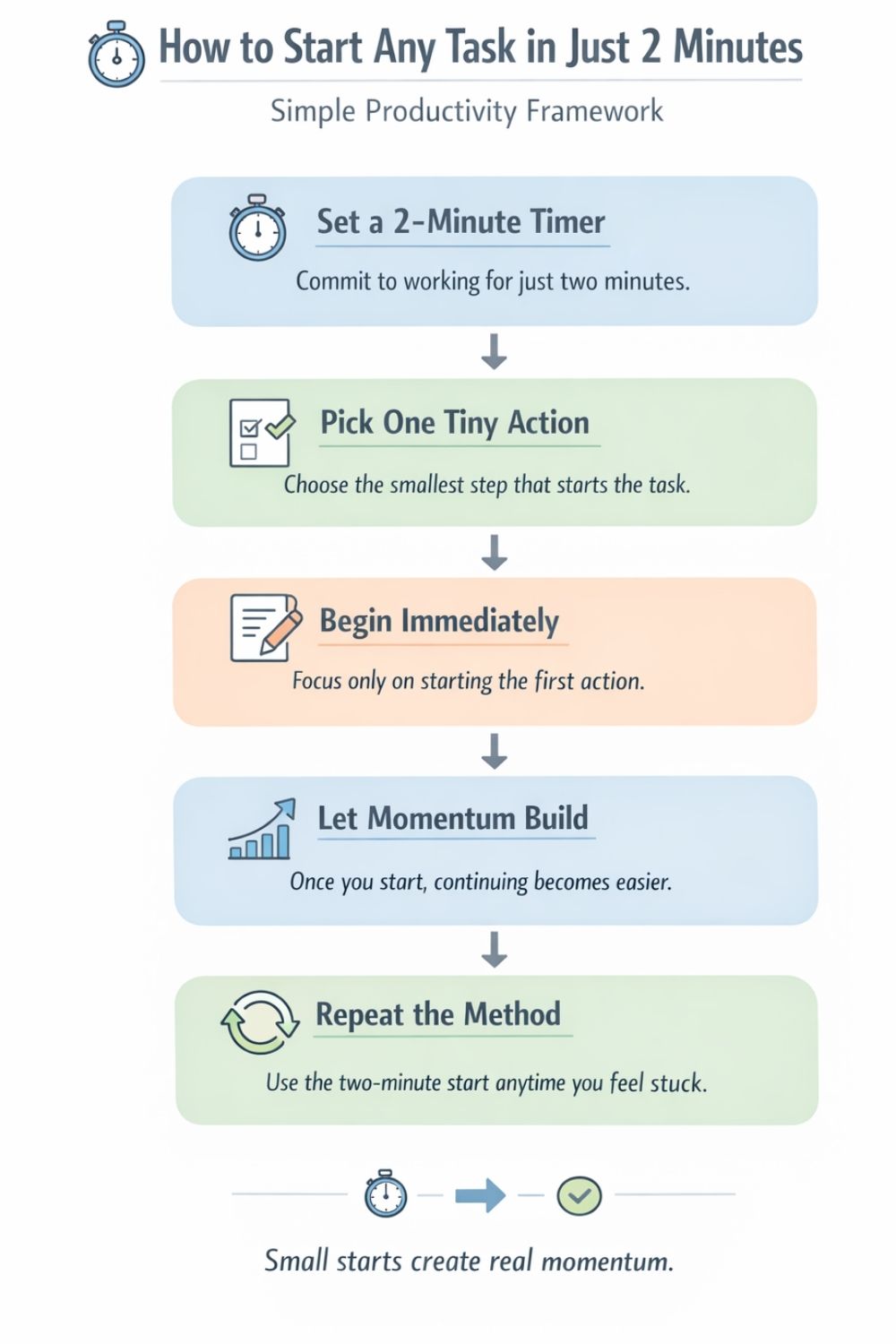
    The 2-Minute Start solves this problem by shrinking the beginning of any task into something incredibly small.

    Instead of committing to the entire project, you only commit to the first two minutes.

    Two minutes of writing.
    Two minutes of organizing.
    Two minutes of planning.

    That tiny commitment lowers the psychological barrier that usually stops people from beginning.

    Once you start moving, something interesting happens. The task often feels easier than you expected. Your brain switches from resistance to engagement.

    Momentum replaces hesitation.

    This is why many productivity experts consider starting the most important moment of any task. Action creates energy. Movement builds motivation.

    If you want to be more productive, build self motivation, and use practical productivity hacks that work even on low-energy days, the 2-Minute Start is a simple framework that can change how you approach work.

    You don’t have to feel ready.

    You just have to begin.

    The 2-Minute Start Framework

    Why starting small breaks procrastination

    Most people assume procrastination comes from laziness or lack of discipline.

    In reality, procrastination is usually a response to mental overload.

    When a task feels too big or undefined, your brain searches for ways to delay it. The larger the project appears, the stronger the resistance becomes.

    The 2-Minute Start works because it removes that pressure.

    Instead of focusing on the entire project, you only focus on the smallest possible action.

    The brain sees a small task very differently from a large one.

    Shrink the task to the smallest possible action:

    Take the project you’ve been avoiding and reduce it to something you can begin immediately. If you need to write an article, your two-minute action might be opening the document and writing one sentence. If you need to organize your workspace, your two-minute action might be clearing one small area.

    Set a simple two-minute timer:

    Use a timer to make the commitment clear. Two minutes feels manageable, even on days when energy is low. Knowing the session is short helps remove internal resistance.

    Focus only on the first visible step:

    Do not think about the entire project. Ignore the outcome and focus only on the next action in front of you. This keeps your attention simple and manageable.

    Allow momentum to develop naturally:

    Once the timer ends, decide whether you want to continue. Many times you will keep working because the hardest part—the start—is already done.

    Repeat the method when you stall again:

    If resistance returns later, restart the system. Choose another two-minute action and begin again.

    This framework transforms starting from something intimidating into something simple and repeatable.

    How to Turn the 2-Minute Start Into a Daily Productivity Habit

    Making small starts part of your routine

    The real power of the 2-Minute Start appears when it becomes part of your daily workflow.

    Instead of waiting for motivation to appear, you use small starts as your default strategy for beginning tasks.

    Over time, this trains your brain to associate work with ease rather than pressure.

    Identify your most common starting blocks:

    Notice where procrastination tends to appear in your day. It might happen when you sit down to begin work, start a creative project, reply to emails, or tackle a large goal. These moments are perfect opportunities to use the two-minute rule.

    Create a “start list” for your tasks:

    Instead of writing large tasks like “finish report” or “clean office,” write the smallest first action required to begin. This could be “open the spreadsheet,” “outline three ideas,” or “clear the desk surface.”

    Start before motivation shows up:

    One of the biggest productivity myths is that you need motivation before you begin. In reality, motivation often appears after action starts. The two-minute commitment helps you bypass the waiting stage.

    Reward the act of starting:

    Most people only celebrate completed work. Instead, acknowledge the moment you begin. Starting consistently builds trust in yourself and strengthens self motivation.

    Use the rule across different areas of life:

    The 2-Minute Start works for writing, studying, organizing, exercising, planning, and creative projects. Any goal becomes easier when the entry point is small.

    As you repeat this pattern daily, starting becomes automatic.

    You stop negotiating with yourself and begin moving forward.

    Using the 2-Minute Start When Your Energy Is Low

    Beginning even when you feel mentally drained

    Some days the challenge isn’t procrastination.

    It’s exhaustion.

    When energy is low, even simple tasks can feel overwhelming. Your brain wants to conserve effort, which makes starting feel difficult.

    The 2-Minute Start is especially useful on these days because it reduces the amount of energy required to begin.

    Instead of forcing yourself through a long work session, you only focus on the smallest possible action.

    Choose the lowest-effort entry point:

    When energy is low, adjust your starting step. Instead of aiming for productivity perfection, choose the easiest version of the task. Brainstorm ideas instead of writing a full page. Review notes instead of building a complete plan.

    Prepare your environment first:

    Small environmental adjustments can make starting easier. Open the document you need, clear your desk, or place materials within reach. These small changes remove friction from the beginning of the task.

    Focus on movement instead of results:

    On low-energy days, the goal is not maximum output. The goal is motion. Even small progress keeps the task alive and prevents it from becoming overwhelming later.

    Let the work session grow naturally:

    Sometimes the two-minute start turns into a longer work session. Other times you may stop when the timer ends. Both outcomes are productive because you honored the commitment to begin.

    Use the system to restart stalled days:

    If your day feels off track, a two-minute action can reset momentum. Starting one task often unlocks the motivation to continue with the next.

    Small actions are surprisingly powerful when your energy is limited.

    They keep progress moving forward.

    Combining the 2-Minute Start With Other Productivity Hacks

    Turning tiny actions into meaningful progress

    The 2-Minute Start is powerful on its own, but it becomes even more effective when paired with other productivity strategies.

    Once the starting barrier is removed, you can build additional structure that keeps momentum moving.

    Extend the start into a focused time block:

    After your two minutes are complete, consider expanding the session into a short focus block. Many people move into a 15 or 25 minute work period once they’re already engaged.

    Use momentum to complete quick wins:

    Once you’ve started working, look for small tasks that can be finished quickly. Completing these builds confidence and reinforces the feeling of progress.

    Stack multiple two-minute starts together:

    You can use the method across several tasks in one work session. Start the email draft, outline your report, organize a document, and review your calendar. Several small starts can move your entire day forward.

    Track small progress throughout the day:

    Recording small wins helps you see how much work you actually accomplish. Even simple actions contribute to larger goals over time.

    Prepare tomorrow with a two-minute finish:

    Before ending your day, spend two minutes setting up your first task for tomorrow. Open the document, write a note, or outline the next step. This makes it easier to begin the next morning.

    The secret to productivity isn’t working harder.

    It’s making starting easier.

    And sometimes, two minutes is all it takes to turn hesitation into momentum.

    The post The 2-Minute Start: A Simple Way to Begin When You Feel Stuck appeared first on Life Coach Hub.


    Source link

  • The 1% Better Rule: The Tiny Habit That Quietly Changes Everything

    The 1% Better Rule: The Tiny Habit That Quietly Changes Everything


    Most people try to improve their lives by making big, dramatic changes. They set huge goals, design complicated routines, and expect motivation to carry them through.

    But lasting progress rarely works that way.

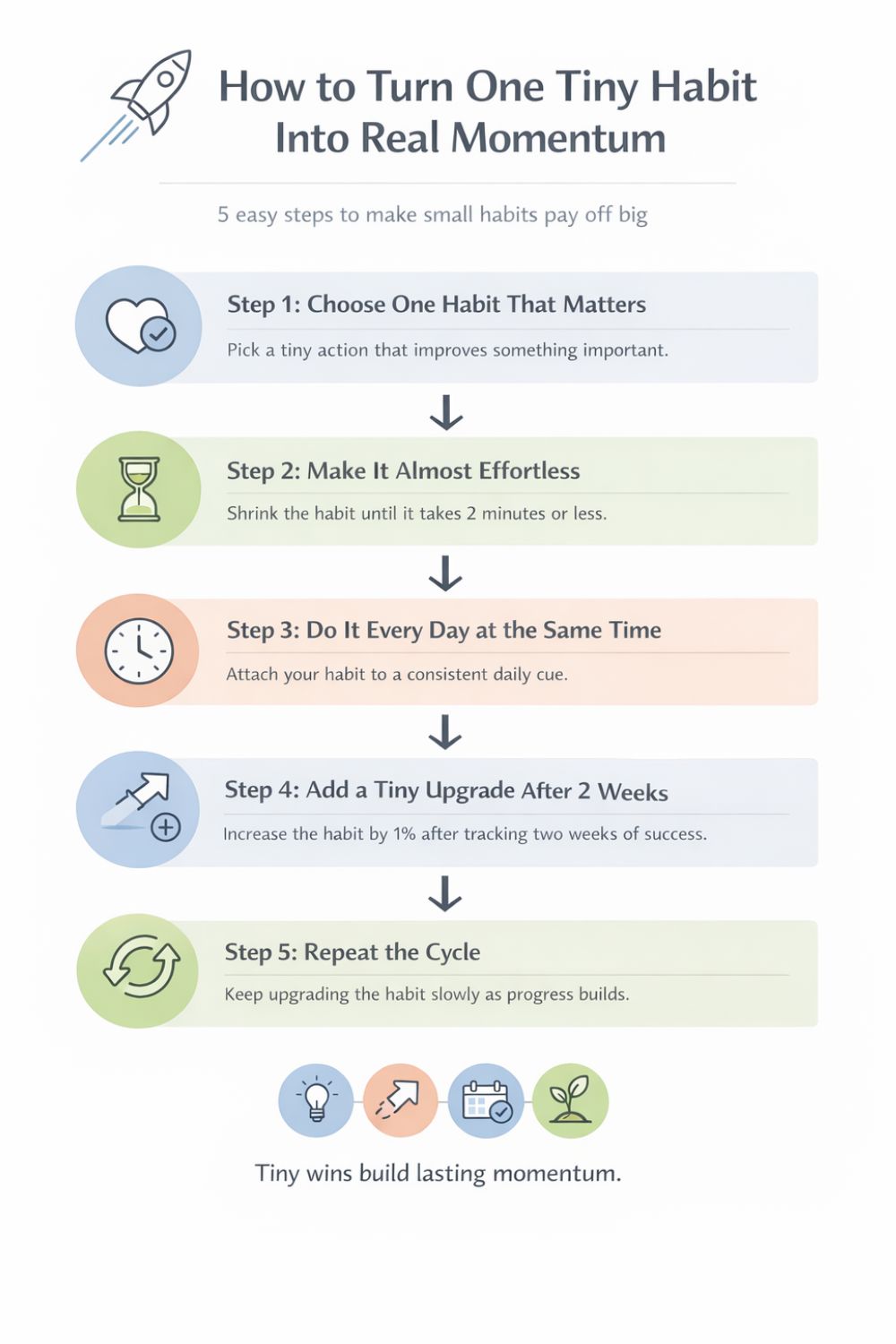
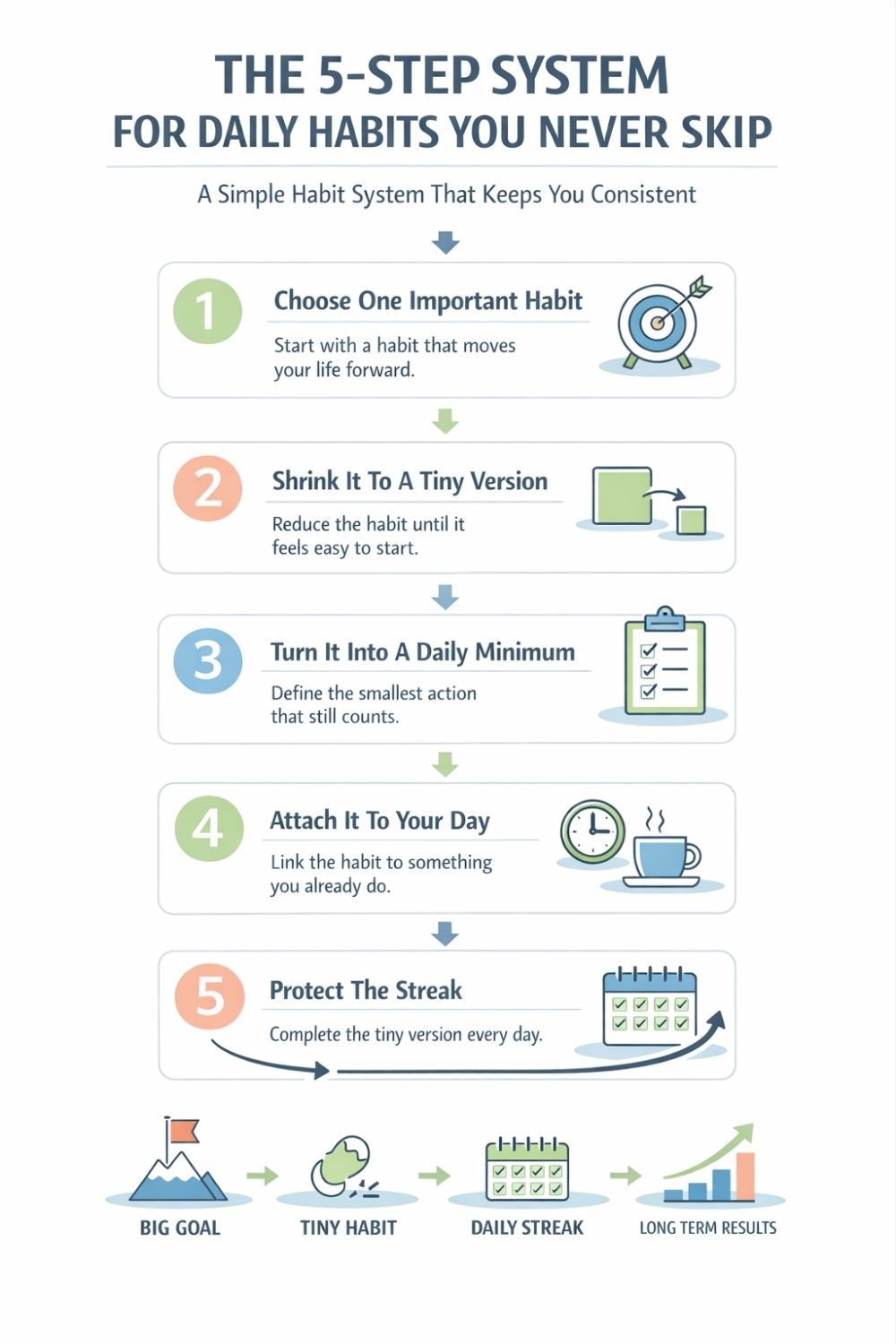
    The 1% Better Rule is a simple idea: instead of trying to transform everything at once, you focus on the smallest improvement you can repeat every day. One tiny upgrade. One small action. One simple habit that nudges you forward.

    This approach works because consistency beats intensity. Small actions feel manageable even when energy is low. And when those actions repeat daily, they slowly compound into real progress.

    You may have heard similar ideas in discussions about atomic habits, where the focus is on small systems rather than dramatic change. The difference with the 1% Better Rule is its simplicity. You’re not trying to optimize your entire life.

    You’re just getting a little better today than you were yesterday.

    That tiny improvement might be reading one page, organizing one item on your desk, walking for two minutes, or writing one sentence toward a goal. It may feel insignificant in the moment, but repetition turns it into momentum.

    Over time, these small actions create powerful daily habits to improve your life. They reduce overwhelm, build confidence, and help you follow through consistently.

    Instead of waiting for the perfect plan or the perfect mood, you simply begin with the smallest possible step.

    And that’s where real change begins.

    Choose the Smallest Possible Improvement

    Most people struggle with habits because they start too big. They try to redesign their entire routine overnight, which quickly leads to frustration and burnout.

    The 1% Better Rule begins with shrinking the habit until it feels almost effortless.

    Pick a micro-upgrade: Identify the smallest possible action that moves you in the right direction. If your goal is to read more, start with one page. If you want to improve your health, begin with one stretch or one minute of movement.

    Make the habit easy to repeat: A habit should feel so manageable that you can do it even on your busiest day. The goal is not intensity. The goal is repetition.

    Connect the habit to something you already do: Attach the improvement to an existing routine. For example, write one sentence in your journal after opening your laptop each morning or review one task on your to-do list after pouring your coffee.

    Lower the barrier to starting: Remove anything that slows you down. Keep the book on your desk, the notebook open, or the habit tracker visible.

    Stop before it feels difficult: Ending while the habit still feels easy increases the chances you’ll repeat it tomorrow.

    This approach may feel almost too simple, but that’s exactly why it works.

    When habits are small, the brain doesn’t resist them. They don’t trigger the same internal pushback as major life changes.

    Instead, they quietly slip into your routine.

    And once a habit becomes part of your day, it becomes far easier to build on it.

    Turn Tiny Actions Into Automatic Habits

    Once you choose your small improvement, the next step is turning it into something automatic.

    Habits become powerful when they stop requiring constant decisions.

    Instead of relying on motivation every day, you build a simple system that guides your behavior.

    Create a clear trigger: Every habit needs a cue. This could be a time of day, a location, or an existing action. For example, begin your habit right after opening your work computer.

    Keep the action extremely short: Tiny habits are easier to repeat because they don’t drain energy. Even a two-minute action can build momentum.

    Track your consistency: Use a habit tracker, calendar, or checklist. Marking each completed day reinforces progress and helps you stay aware of your streak.

    Celebrate completion quickly: A simple checkmark or small acknowledgment tells your brain the habit is rewarding.

    Focus on one improvement at a time: Trying to build several habits simultaneously often leads to inconsistency. One habit practiced daily is far more powerful than five habits attempted occasionally.

    Over time, your brain begins to expect the routine.

    You sit down at your desk and automatically review your task list. You finish breakfast and naturally open your notebook. You end your workday and take a short walk without thinking about it.

    This is how strong habits for a better life are formed.

    They stop feeling like tasks and start feeling like part of your normal rhythm.

    And once a habit becomes automatic, maintaining it requires very little effort.

    Let Small Wins Compound Over Time

    The real strength of the 1% Better Rule comes from compounding.

    One small action may not seem impressive today, but daily repetition creates remarkable results over time.

    Trust gradual progress: Tiny habits accumulate quietly. One page a day becomes multiple books per year. One short walk becomes hours of movement across a month.

    Allow the habit to grow naturally: Once the habit feels effortless, expansion often happens on its own. One page becomes three. One push-up becomes five.

    Use momentum to increase effort slowly: When the routine feels stable, add a small upgrade. The key is gradual improvement rather than sudden leaps.

    Protect your streak whenever possible: Missing a day occasionally is normal. But try not to miss two days in a row, which can interrupt the rhythm.

    Focus on identity instead of output: Every repeated habit reinforces the identity of someone who follows through.

    Instead of asking, “Did I accomplish something big today?” you begin asking, “Did I keep my promise to myself?”

    That shift in perspective is powerful.

    Over time, the habit stops being something you’re trying to maintain. It becomes part of who you are.

    And that identity shift is where real transformation begins.

    Where to Apply the 1% Better Rule First

    The best place to start using the 1% Better Rule is in an area that already matters to you.

    Choose something meaningful, but keep the improvement extremely small.

    Morning routines: Add one tiny action that improves the start of your day, such as drinking water, writing one intention, or reviewing your top priority.

    Work productivity: Improve your workflow by clearing one item from your inbox or organizing one document each day.

    Learning and skill-building: Read one page, practice a skill for two minutes, or watch a short educational video daily.

    Health habits: Stretch for one minute, take a brief walk, or do a single mobility exercise.

    Home organization: Put away one item, wipe one surface, or tidy one small area each day.

    Starting with small improvements reduces resistance.

    You’re not trying to completely redesign your schedule. You’re simply creating a small pattern of progress.

    As that pattern repeats, the habit becomes easier to maintain.

    And once a habit feels normal, expanding it requires very little effort.

    The key is remembering that the smallest action counts.

    Consistency matters far more than size.

    How the 1% Rule Prevents Burnout

    Many self-improvement systems fail because they demand too much energy.

    People start with excitement but quickly become exhausted trying to maintain ambitious routines.

    The 1% Better Rule avoids this problem entirely.

    Tiny habits require minimal effort: Even on difficult days, a small improvement is manageable.

    Consistency builds confidence: Each completed habit strengthens your sense of reliability.

    Momentum replaces motivation: Instead of waiting to feel inspired, you simply follow the routine.

    Progress feels calm rather than stressful: Small improvements create steady movement without emotional pressure.

    Your identity slowly changes: Over time, you begin to see yourself as someone who follows through.

    This is one of the most powerful benefits of the 1% approach.

    You no longer rely on bursts of motivation or strict discipline. Your progress becomes quieter and more sustainable.

    Even on days when energy is low, the habit remains possible.

    And when those small actions repeat consistently, they build a foundation of steady growth.

    That’s the quiet power behind the 1% Better Rule.

    Tiny improvements may seem insignificant at first. But over time, they transform the way you live, work, and move toward your goals.

    The post The 1% Better Rule: The Tiny Habit That Quietly Changes Everything appeared first on Life Coach Hub.


    Source link

  • The Cozy Night-In Basket for Mother’s Day

    The Cozy Night-In Basket for Mother’s Day


    Mother’s Day gifts often end up being beautiful but forgettable. Flowers fade, candles burn down, and many gifts don’t create a real moment for her to enjoy.

    A cozy night-in basket changes that. Instead of giving her just an item, you’re giving her a full evening.

    This basket is built around a simple formula that feels instantly comforting: a soft blanket, a good book, and a warm cup of tea. When these pieces are thoughtfully chosen and styled together, they create an experience rather than a random assortment of gifts.

    The goal isn’t to overwhelm the basket with dozens of items. It’s to build a quiet scene that invites her to slow down.

    Soft colors, layered textures, and a few comforting extras make the basket feel intentional and calming. The moment she sees it, she should immediately imagine curling up with it later that evening.

    The best part is that this type of basket is incredibly flexible. You can adjust the book, tea, or color palette to match her personality while still keeping the cozy theme.

    This guide will walk you through building the basket step by step. From choosing a calming color palette to layering the blanket, book, and tea formula, every element helps create a gift that feels thoughtful and beautifully put together.

    By the end, you’ll have a basket that doesn’t just sit on a table. It becomes a full evening waiting for her.

    Need some relationship guidance? Drop on by our directories choc full of relationship coaches and dating coaches to help make your love life the best it can be.  Or click here to have us match you to the best.

    Start With the Cozy Color Palette

    Before selecting any items for the basket, begin with the color palette. This simple step makes the entire gift look intentional instead of random.

    When every item shares a similar tone, the basket instantly feels more curated and visually calming.

    Choose a calming palette: Pick two or three soft tones such as cream, warm beige, sage green, dusty rose, or light gray. These gentle colors naturally create a relaxing atmosphere and help the basket feel cozy the moment someone sees it.

    Neutral palettes work especially well because they let textures stand out. A knitted blanket, linen napkin, or ceramic mug looks even more inviting when the colors are soft and understated.

    Match items within the palette: As you shop, keep your chosen colors in mind. Look for tea packaging, book covers, mugs, and snacks that loosely match the same tones.

    You don’t need everything to be identical. The goal is simply to avoid clashing colors so the basket feels harmonious.

    Use the basket as a design element: The container itself should fit the cozy theme. A woven basket, wooden crate, or neutral fabric bin helps anchor the palette and adds natural texture.

    A warm wicker basket paired with soft fabrics immediately communicates comfort.

    Once the color palette is established, the rest of the basket becomes much easier to build. Instead of wondering what to add, you’ll naturally choose items that belong together visually.

    This small planning step turns the entire basket into a calm, cohesive gift that feels beautifully thought out.

    Build the Blanket + Book + Tea Formula

    With your color palette decided, it’s time to build the heart of the basket. The cozy night-in formula is simple but incredibly effective.

    A soft blanket, a comforting book, and a warm cup of tea create the foundation for a relaxing evening.

    Choose the blanket as the anchor item: Start with a throw blanket that fits your color palette and feels soft and inviting. A knit, fleece, or waffle-textured throw works especially well.

    Fold the blanket loosely so it fills the back of the basket and creates height. This becomes the visual centerpiece of the entire gift.

    The blanket instantly signals comfort. It’s the item that makes the basket feel warm and inviting before anything else is even noticed.

    Add a relaxing book she’ll enjoy: Next, choose a book that matches how she likes to unwind. Some moms love uplifting novels, while others prefer cookbooks, inspirational reads, or beautifully photographed coffee-table books.

    The key is choosing something easy to sink into rather than something demanding.

    Stand the book upright in front of the folded blanket so the cover is visible. This makes the basket feel fuller while keeping the book protected.

    Pair the book with a tea moment: A warm drink completes the cozy formula. Include a box of herbal tea, loose-leaf tea in a small jar, or individually wrapped tea sachets.

    Chamomile, vanilla rooibos, lavender mint, and honey ginger blends all feel perfect for relaxing evenings.

    You can also add a simple mug or tea infuser so she has everything she needs for that first cup. When she sees the basket, the scene becomes obvious—blanket, book, tea, and quiet time.

    This trio transforms the basket into an experience rather than just a collection of items.

    Layer Small Comfort Extras

    Once the main blanket-book-tea formula is in place, you can add a few small extras that deepen the cozy feeling.

    These additions should enhance the evening rather than overcrowd the basket.

    Think of them as little details that make the moment feel complete.

    Include a comforting snack: A small treat pairs beautifully with tea and reading time. Shortbread cookies, chocolate truffles, biscotti, or a gourmet chocolate bar are all simple options.

    Choose packaging that matches your color palette whenever possible. Even a simple kraft paper wrap tied with twine can make the snack feel intentional.

    Snacks help the basket feel indulgent. They turn the evening into a tiny retreat rather than just a quiet moment.

    Add one calming sensory detail: A small candle, lavender sachet, or gentle room spray helps set the mood.

    Soft scents like vanilla, lavender, sandalwood, or honey are especially fitting for a relaxing evening.

    When the candle is lit and the blanket is wrapped around her shoulders, the entire scene becomes more immersive.

    Use soft packaging touches: Small details can make a big difference in presentation. Tuck items into a folded linen napkin, wrap tea in parchment paper, or tie ribbons in soft neutral tones.

    These touches keep the basket visually calm and cohesive.

    The goal isn’t to add as many items as possible. It’s to create a layered feeling of comfort.

    By choosing just a few thoughtful extras, the basket stays simple while still feeling abundant.

    Style the Basket for a Layered Look

    Presentation plays a huge role in how the gift feels when she first sees it.

    Even simple items can look beautiful when they are layered thoughtfully.

    Create a soft base layer: Start by lining the basket with the blanket or a folded cloth. This base layer gives the basket a plush foundation and keeps smaller items from shifting.

    It also adds a sense of fullness right away.

    Place taller items toward the back: Position the folded blanket at the back and lean the book slightly against it. This creates natural height and frames the basket visually.

    The eye should immediately notice these anchor pieces.

    This layering technique makes the basket feel abundant even with just a few items.

    Arrange smaller items in the front: Place the tea, mug, candle, and snacks in the front area. Let them overlap slightly rather than spacing everything apart.

    A relaxed arrangement looks far more natural than perfectly spaced rows.

    Tuck tissue paper, dried flowers, or a soft napkin between items if small gaps appear.

    The finished basket should look inviting and effortless—like a cozy evening already waiting for her.

    Turn the Basket Into a Full Evening Experience

    To make the basket even more memorable, add one small element that guides how the evening will unfold.

    This transforms the gift from a collection of items into a thoughtful plan.

    Include a “Tonight’s Plan” card: Write a small card that outlines the cozy evening ahead. Something simple like “Blanket. Tea. Book. Relax.” is enough.

    This playful detail makes the basket feel intentional.

    It also gives her permission to actually take the time for herself.

    Add a meaningful bookmark: Slip a handwritten note into the book or attach it to a bookmark.

    A short message thanking her for everything she does can turn the moment into something deeply personal.

    This small touch often becomes the most memorable part of the gift.

    Make the setup easy to use: If possible, place the items on a small tray inside the basket. That way she can carry everything to the couch or bed in one trip.

    When she unwraps the basket, she should immediately imagine how the evening will look.

    A cozy blanket around her shoulders, tea steaming nearby, and a quiet moment with a good book.

    The basket becomes more than a gift. It becomes a peaceful pause she didn’t have to plan herself.

    Easy Variations of the Cozy Night-In Basket

    Need some relationship guidance? Drop on by our directories choc full of relationship coaches and dating coaches to help make your love life the best it can be.  Or click here to have us match you to the best.

    Once you know the core formula, it’s easy to adjust the basket to fit different personalities and preferences.

    The structure stays the same while the details change.

    Create a spa-inspired version: Replace the book with a journal or relaxation guide. Add bath salts, a face mask, or a soft headband to turn the evening into a quiet spa night.

    The blanket and tea still anchor the basket.

    Build a reader’s escape basket: Choose two books instead of one and include a reading light or bookmark set. This version is perfect for moms who love getting lost in a story.

    A warm drink and soft blanket make it even better.

    Make a dessert-and-tea version: Swap the savory snacks for sweet treats like macarons, chocolate truffles, or biscotti.

    Pair them with a flavored tea blend for a cozy dessert moment.

    No matter which variation you choose, the purpose stays the same.

    The basket isn’t just about the items inside. It’s about creating a quiet, comforting evening that feels like it was planned just for her.

    The post The Cozy Night-In Basket for Mother’s Day appeared first on Life Coach Hub.


    Source link

  • The Done List: A Simple Way to Build Motivation by Tracking What You Finished

    The Done List: A Simple Way to Build Motivation by Tracking What You Finished


    Most productivity systems revolve around what still needs to be done.

    You make a to-do list in the morning, cross off a few tasks, and by the end of the day the list still looks unfinished. Even when you’ve been busy all day, it can feel like you didn’t accomplish enough.

    That feeling slowly drains motivation.

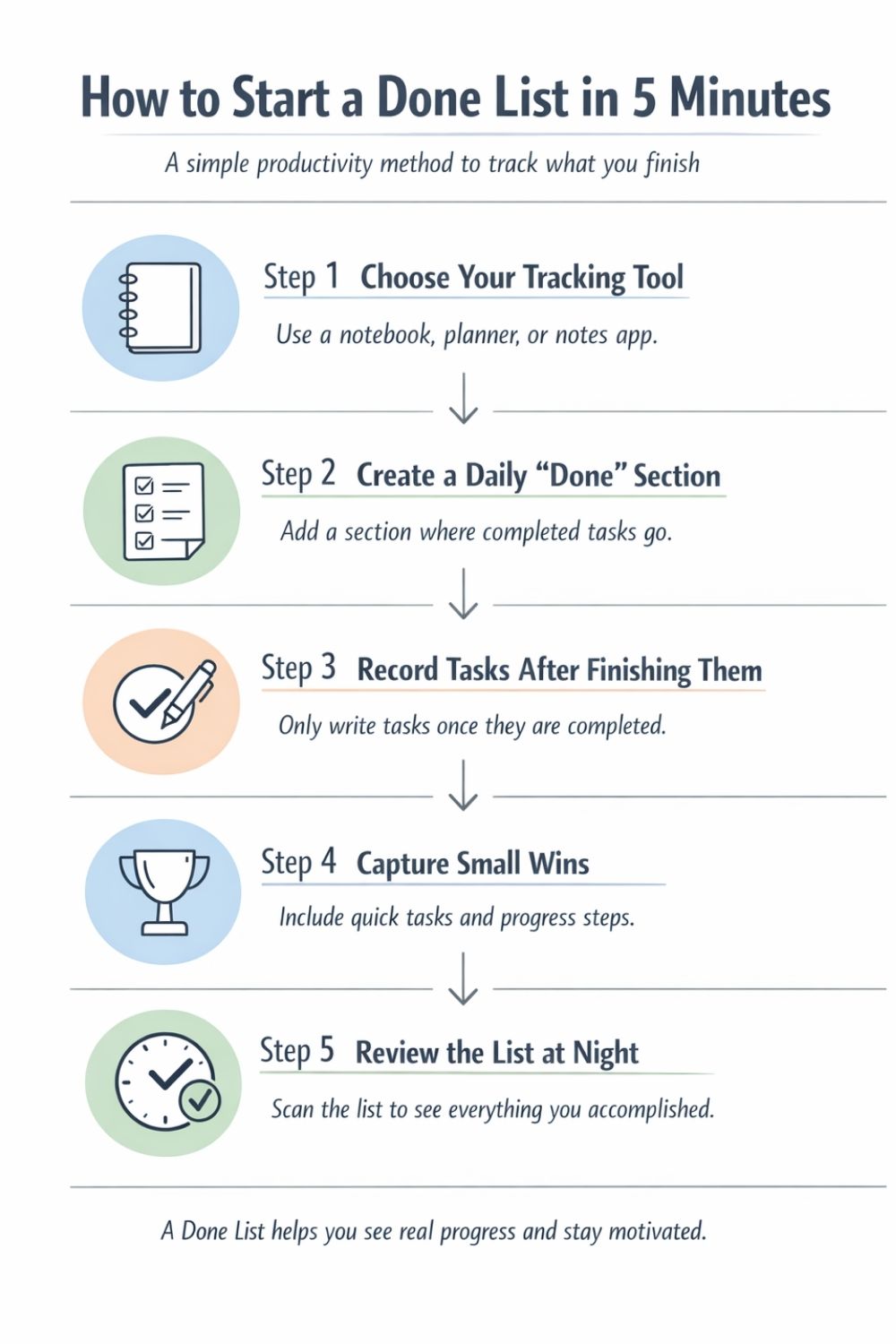
    A Done List solves this problem by flipping the focus. Instead of tracking what remains unfinished, you record what you actually completed. Every action—big or small—becomes visible proof that you’re moving forward.

    This approach changes how you experience your workday.

    Instead of ending the day focused on what’s missing, you see evidence of progress. Small actions add up. Momentum becomes visible. Motivation grows naturally.

    The best part is how simple the system is.

    A Done List takes about five minutes to maintain. There’s no complicated planning system, no elaborate productivity framework, and no pressure to structure your entire day.

    You simply capture what you finished.

    Over time, this small shift can make a surprising difference in how productive you feel and how consistently you show up for your goals.

    Start a Simple Done List System

    The strength of the Done List comes from its simplicity. If the system is too complicated, you’ll eventually stop using it.

    The goal is to create something you can maintain every day, even when your energy is low.

    Choose a simple place to track it:
    Use something you already open regularly. A notebook, planner, notes app, or digital document all work well. The easier it is to access, the more likely you are to maintain the habit.

    Create a clear daily section:
    At the start of each day, write the date and leave space beneath it. This becomes the area where you’ll record completed tasks throughout the day.

    Write tasks down after finishing them:
    The Done List works best when entries are recorded only after the action is complete. This prevents the list from turning into another to-do list.

    Include both big and small actions:
    Finishing a project matters, but so does sending an email, organizing a file, or making a quick phone call. Small actions often move work forward more than we realize.

    Keep entries short and specific:
    Write tasks clearly so they represent a real action. For example: “Finished client presentation,” “Scheduled meeting,” or “Updated spreadsheet.”

    By the end of the day, you’ll have a visible record of your progress.

    Even on slower days, the list often reveals that you accomplished far more than you initially thought.

    Capture Momentum Throughout the Day

    The Done List becomes most powerful when it’s updated throughout the day.

    Instead of waiting until the evening, record actions as they happen. This helps reinforce the feeling of progress while you’re still working.

    Momentum builds faster when it’s visible.

    Write tasks immediately after completing them:
    When you finish something, pause for a moment and add it to your list. This small pause reinforces the habit of recognizing progress.

    Break larger tasks into visible steps:
    Instead of writing something vague like “worked on report,” capture the specific actions. You might list “researched data,” “wrote outline,” and “edited introduction.”

    This makes progress easier to see.

    Add unexpected tasks you handled:
    Many productive actions happen outside your planned schedule. Helping a coworker, fixing a small problem, or responding to an urgent request all count.

    Recording them helps your list reflect reality.

    Track effort-based work as well:
    Some work doesn’t produce immediate results. Brainstorming ideas, researching options, or preparing materials still represent forward movement.

    These steps deserve a place on the list.

    Let the list grow naturally:
    There’s no correct number of entries. Some days might have five items, while others may have twenty.

    What matters is that each entry represents a completed action.

    Over time, the Done List helps you realize that progress happens in small pieces, not just big milestones.

    Use the Done List to Build Motivation

    The Done List changes the way your brain interprets productivity.

    Instead of focusing on unfinished tasks, it trains you to notice what you’ve accomplished. This small shift has a powerful effect on motivation.

    Progress becomes visible.

    Review your list at the end of the day:
    Take one minute to scan everything you completed. This quick reflection helps close the day with a sense of accomplishment.

    Highlight meaningful progress:
    Some actions directly support your bigger goals. Circle or mark those entries so they stand out.

    Seeing them reinforces that your daily effort matters.

    Notice how much you actually handled:
    Many people underestimate their productivity because they forget small actions. The Done List captures these moments and shows the full picture.

    Celebrate consistency, not perfection:
    Some days will be extremely productive while others will be slower. What matters most is that you continue showing up.

    Small consistent actions build long-term progress.

    Move unfinished tasks forward calmly:
    If something remains incomplete, simply move it to your next to-do list. Your Done List ensures the day still feels productive.

    Over time, this habit strengthens motivation because you see proof of progress every single day.

    Turn Your Done List Into a Weekly Motivation Log

    A daily Done List is helpful on its own, but reviewing several days together can reveal even more insight.

    At the end of the week, spend a few minutes scanning your previous lists.

    Patterns quickly begin to appear.

    Review everything you completed during the week:
    When you look at five or six days together, the amount of work becomes much more visible. Small daily actions accumulate into meaningful progress.

    Group related accomplishments together:
    You might notice categories like planning tasks, communication work, creative work, or administrative tasks. These clusters reveal how your time is actually being used.

    Identify progress toward bigger goals:
    Circle tasks that directly contributed to major projects or personal goals. This shows how daily effort supports long-term progress.

    Look for productivity patterns:
    You may notice that certain days are naturally more productive. Others might contain more interruptions.

    These patterns help you plan your schedule more effectively.

    Use the insights to guide the next week:
    Instead of guessing where to focus your energy, let your Done List show you what’s already working.

    This weekly reflection turns the Done List into more than just a tracking tool. It becomes a record of consistent effort and growth.

    Use the Done List on Low-Energy Days

    Some days motivation is strong. Other days it’s difficult just to get started.

    The Done List works especially well during low-energy periods because it encourages small actions instead of perfection.

    Progress stays possible even on difficult days.

    Start with the smallest possible task:
    Choose something that takes only a few minutes. Reply to one email, organize a document, or review a short note.

    Completing one task often breaks the feeling of inertia.

    Write down every completed action:
    Even tiny accomplishments deserve a place on the list. Recording them reinforces the idea that effort counts.

    Small wins build momentum.

    Focus on movement rather than perfection:
    Low-energy days are not about maximum productivity. They’re about keeping the habit of progress alive.

    Small steps still move your goals forward.

    Let the list motivate the next step:
    Once you see a few completed tasks on the page, it often becomes easier to add another.

    Momentum grows naturally.

    End the day with visible proof of effort:
    Even if the day felt slow, the Done List shows that you kept moving forward.

    That simple reminder can make it easier to begin again tomorrow.

    The post The Done List: A Simple Way to Build Motivation by Tracking What You Finished appeared first on Life Coach Hub.


    Source link

  • One-Tiny-Task Promise: How to Start Anything by Finishing the Smallest Possible Task

    One-Tiny-Task Promise: How to Start Anything by Finishing the Smallest Possible Task


    Some days the hardest part of productivity isn’t the work itself. It’s starting.

    When a task feels big, complicated, or mentally heavy, the brain tends to delay it. You might open a document, stare at it, and suddenly feel the urge to check email, scroll your phone, or reorganize your desk instead.

    This isn’t laziness. It’s friction.

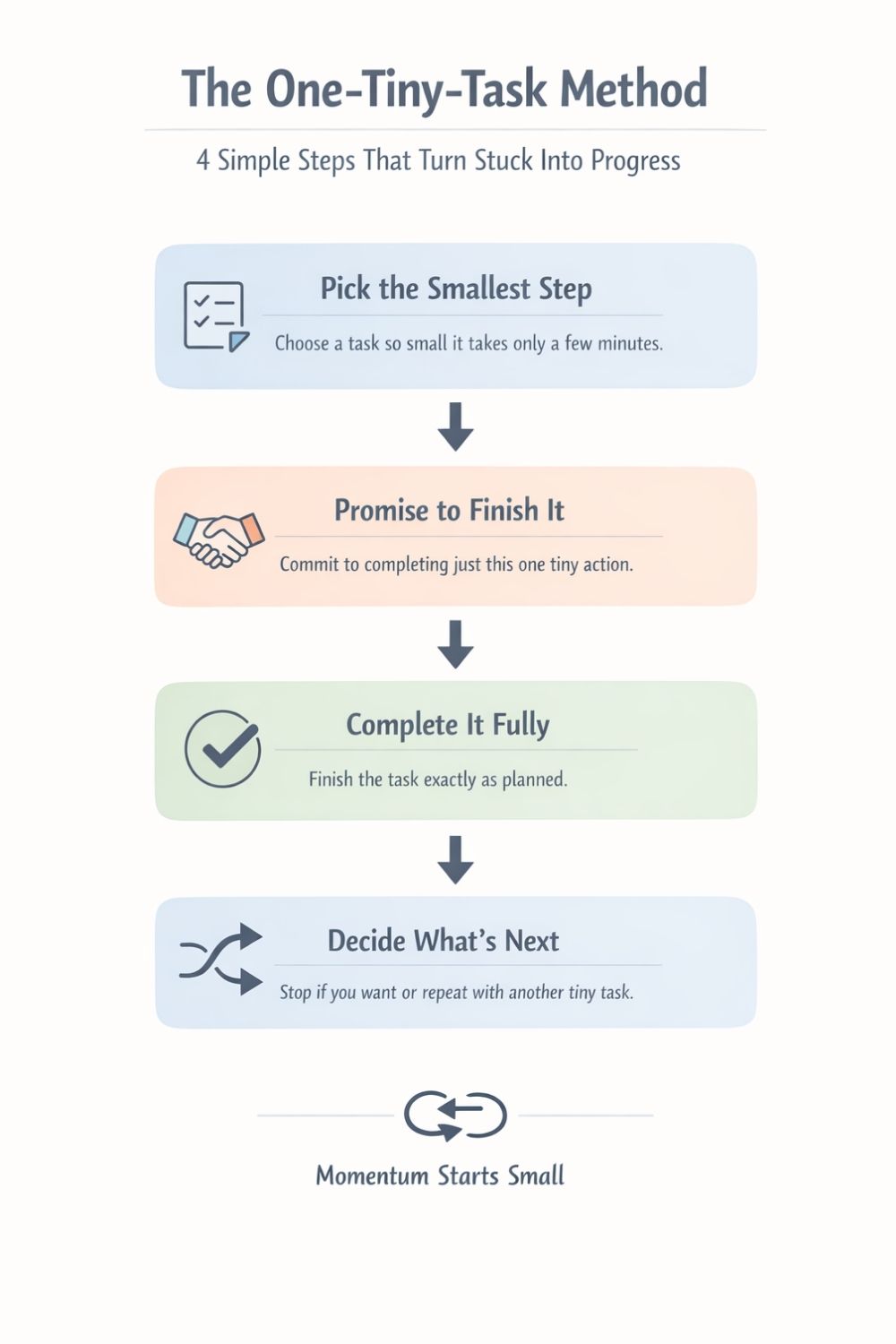
    The One-Tiny-Task Promise is a simple framework designed to reduce that friction. Instead of trying to complete a full project or even a full work session, you commit to finishing just one extremely small task.

    Not ten tasks.
    Not an hour of work.
    Just one tiny step.

    This works because the brain responds strongly to completion. Finishing something—even something small—creates a feeling of progress that can break the mental freeze that stops many people from starting.

    The beauty of this method is that it works even on low-energy days. When motivation is low and your focus feels scattered, a tiny task is still manageable.

    Once the first task is complete, you can decide whether to continue. Sometimes momentum kicks in and you keep going. Other times you stop, and that’s still a success because you kept your promise.

    Over time, this approach builds something powerful: self-trust. When you repeatedly follow through on small promises to yourself, starting becomes easier.

    Instead of relying on motivation, you rely on a simple system.

    And that system begins with choosing the smallest possible step.

    Define the Smallest Possible Task

    The first step of the One-Tiny-Task Promise is choosing a task so small that resistance almost disappears.

    Most productivity struggles happen because people start with tasks that are still too large. “Work on the project” or “clean the office” sounds manageable on paper, but the brain interprets these as big commitments.

    The solution is to shrink the task dramatically.

    Shrink the task until it feels almost trivial: Take the larger goal and reduce it to a single tiny action. Instead of “write the report,” your first step might be opening the document and writing one sentence.

    Small tasks remove the emotional weight that normally blocks action.

    Make the step finishable in five minutes or less: A tiny task should have a very short time horizon. When the brain knows the task will end quickly, it’s far easier to begin.

    Even something as small as writing three bullet points can work.

    Choose a step with a clear finish line: Vague tasks create hesitation. Instead of “review notes,” choose something concrete like highlighting three key ideas or organizing one section.

    Clear endings help the brain recognize progress.

    Write the task in simple, specific language: When the task is written clearly, it becomes easier to start. A note that says “draft one paragraph” feels much more actionable than “work on writing.”

    The goal of this stage isn’t productivity yet.

    The goal is simply removing the barrier to starting.

    Once the task is small enough, beginning no longer feels overwhelming.

    Make a Simple Promise to Finish One Task

    The power of this framework comes from the promise itself.

    Instead of telling yourself that you will “work hard today” or “be productive,” you make a single clear commitment: you will finish one tiny task.

    This dramatically reduces pressure.

    Commit to completing only one small action: Your responsibility is limited to the one step you selected. You are not committing to an hour of work or finishing the entire project.

    The promise stays intentionally small.

    Remove the expectation that you must continue: This is one of the most important parts of the method. You are allowed to stop after completing the task.

    Knowing that continuation is optional lowers resistance.

    Start immediately once the promise is made: Avoid preparing or overthinking the step. As soon as the task is chosen, begin working on it.

    Momentum begins with action, not planning.

    Treat the promise as meaningful: Even though the task is small, finishing it still matters. Every time you follow through on a promise to yourself, you reinforce the habit of execution.

    Many people struggle with productivity because they make promises that are too large to keep.

    The One-Tiny-Task Promise solves that problem by making the commitment extremely achievable.

    Keeping small promises consistently builds confidence.

    And confidence makes future tasks easier to start.

    Finish the Task Completely

    Once you start the tiny task, the next step is simple: finish it fully.

    Completion is what creates the psychological reward that fuels momentum.

    When the brain experiences a finished action, it releases a sense of progress and closure. That small reward often encourages you to keep going.

    Focus on finishing exactly what you promised: Avoid expanding the task or adding extra steps. If the promise was to write one sentence, then writing one sentence is the goal.

    The power of the method comes from finishing.

    Remove distractions for a few minutes: Since the task is short, give it your full attention. Silence notifications, close extra tabs, and complete the action without interruption.

    This helps the task finish quickly.

    Mark the task as complete: Crossing something off a list or checking a box reinforces the feeling of accomplishment. Visual confirmation strengthens the sense of progress.

    Even tiny completions matter.

    Pause briefly to acknowledge the win: Many people rush straight to the next task without noticing the completion. Taking a moment to recognize the finished step reinforces motivation.

    This small recognition helps the brain associate action with reward.

    The goal here isn’t perfection or productivity.

    The goal is completion.

    Finishing even the smallest task tells your brain something important: progress is happening.

    And once progress begins, it becomes easier to continue.

    Decide Whether to Continue or Stop

    After completing the tiny task, you reach an important moment: the decision point.

    This is where the One-Tiny-Task Promise becomes powerful.

    Because you only promised to finish one step, everything after that is optional.

    Check in with your energy and focus: Ask yourself whether you feel like doing another tiny task. Sometimes the answer is yes because momentum has started to build.

    Other times the answer will be no.

    Both outcomes are fine.

    Choose another small step if you want to continue: If you decide to keep going, simply repeat the same process. Select another tiny task and complete it fully.

    Momentum often grows naturally when tasks stay small.

    Allow yourself to stop without guilt: If you finish the task and feel done, you can stop. You kept your promise.

    That alone is a win.

    Use momentum when it appears: On many days, the hardest part of work is simply beginning. Once you’ve started, it becomes easier to continue.

    You may find yourself completing several tiny tasks in a row.

    The method works either way.

    Even one completed task creates forward movement.

    And forward movement is how momentum begins.

    Turning the One-Tiny-Task Promise Into a Daily Habit

    Once you start using this framework, it can easily become part of your daily routine.

    Instead of waiting for motivation, you simply return to the same starting point: one tiny task.

    This creates consistency without requiring large bursts of energy.

    Begin your day with one small completion: Starting the day with a quick win can create early momentum. Even a simple action like outlining a few notes can help shift your brain into work mode.

    The goal is to start moving.

    Use the method whenever you feel stuck: When you notice procrastination or hesitation, return to the One-Tiny-Task Promise. Choose a small step and complete it.

    This resets your focus.

    Apply the system to different goals: The framework works for writing, learning, organizing, planning, or creative work. Any large project can be broken into tiny starting points.

    The method adapts to almost any situation.

    Track your tiny wins over time: Keeping a small list of completed actions can reveal how much progress comes from small steps. Over weeks and months, those tiny tasks accumulate into meaningful results.

    Consistency matters more than intensity.

    And the easiest way to stay consistent is to make starting simple.

    Examples of One-Tiny-Task Promises

    Understanding what counts as a tiny task can make the system easier to apply.

    The key idea is simple: reduce the starting step until it feels quick and achievable.

    Writing project: Write one sentence or create three bullet points outlining your idea.

    Even this small step begins the writing process.

    Email inbox: Reply to one email instead of trying to clear the entire inbox.

    A single reply creates progress.

    Work project: Open the project file and list the next three actions needed.

    This small step clarifies what comes next.

    Learning something new: Read one paragraph of a book or watch a two-minute portion of a tutorial.

    Short learning sessions can still move knowledge forward.

    Organization task: Clear one small area of your desk rather than cleaning the entire workspace.

    Tiny improvements still count as progress.

    These examples show how almost any task can be reduced to a small, manageable starting point.

    Once the first action is complete, the next step often feels easier.

    And sometimes, that one tiny task is all it takes to get momentum moving again.

    The post One-Tiny-Task Promise: How to Start Anything by Finishing the Smallest Possible Task appeared first on Life Coach Hub.


    Source link

  • Minimum Viable Day: The Tiny Baseline That Keeps You Consistent

    Minimum Viable Day: The Tiny Baseline That Keeps You Consistent


    How You Can Overcome Your Procrastination

    Discover four tips that will help you overcome your procrastination and free you from its heavy burden.


    Read More


    Source link

  • 8 Small Closet Fixes That Instantly Create More Space

    8 Small Closet Fixes That Instantly Create More Space


    Which Thanksgiving Tablescape Matches Your Personality? Vintage, Modern, Simple, or Elegant

    Are you all about style, decor and organization? Download a copy of our Decluttering Workbook. **** Thanksgiving is more than a meal—it’s a gathering of personalities, stories, and traditions. The […]


    Read More


    Source link

  • 30 Digital Products Ideas for Selling Online

    30 Digital Products Ideas for Selling Online


    If you want to make money selling something online but you don’t want the hassle of inventory, shipping and everything that goes along with selling physical products there is an alternative.

    Selling digital products is a no-muss, no-fuss way to make money online. A LOT of money.

    And, best of all, it is one of the best passive income ideas, which means you do a little work up-front, and then you don’t have to do much while the money keeps rolling in.

    You create something once and sell it over and over to customers around the world.

    Digital products are non-physical items like ebooks, templates, courses, and printables that you deliver electronically through email or download.

    Pretty much anyone can start this small business, especially if you have some knowledge or experience to share (which everyone does!)

    The best part about selling digital products is how easy it is to get started. You don’t need a big budget or a warehouse.

    You just need an idea and the tools to create it. Or even better, someone you can pay to create it.

    Whether you want to earn extra income with a side hustle or build a full business, digital products give you flexibility and freedom with your own home business.

    This guide will walk you through the best digital products ideas as well as everything you need to know about creating and selling digital products.

    You’ll learn what makes a product profitable, explore different product types across various industries, and discover how to market what you make.

    We’ll cover practical ideas you can start working on today to turn your skills into income.

    What Are Digital Products?

    macbook pro beside white and blue plastic cupmacbook pro beside white and blue plastic cup

    Digital products are items that exist entirely in electronic format and can be sold repeatedly without physical inventory or shipping.

    These products range from educational materials like online courses to creative assets like templates, and they offer sellers high profit margins with minimal overhead costs.

    Definition and Types of Digital Products

    Digital products are goods that exist only in digital format. You can download them, access them through email, or view them on gated platforms.

    Common types include ebooks, online courses, videos, music files, and digital art. You’ll also find software programs, mobile apps, and website themes in this category.

    Printable digital products let your customers download designs and print them at home for personal use.

    Templates and tools make up another major category. You can sell resume templates, graphic design files, or filters for programs like Photoshop.

    Digital memberships and subscription content have grown popular too. Your customers pay for ongoing access to exclusive materials, community forums, or premium libraries of content.

    Related reading:

    Benefits of Selling Digital Goods

    Selling digital products gives you low overhead costs since you don’t need to hold inventory or pay for shipping.

    You can achieve profit margins around 90% after fees because recurring costs stay minimal.

    The process can be automated. Orders deliver instantly through apps or gated platforms without your direct involvement. You create the product once and sell it to unlimited customers.

    Digital goods give you flexibility in pricing and delivery. You can offer free products to build your email list, paid one-time purchases, or monthly subscriptions.

    The e-learning market alone is expected to reach $848 billion by 2030.

    In addition, these products also have a lower carbon footprint than physical items. You avoid manufacturing waste and shipping emissions entirely.

    Top Digital Products To Sell Online

    Digital products offer flexibility and profit potential because you create them once and sell them repeatedly.

    From written content to visual resources and educational materials, these digital products ideas meet different customer needs and skill levels.

    1. Ebooks

    person holding black tablet computer during daytimeperson holding black tablet computer during daytime

    Ebooks are a profitable digital product to sell. You can write about topics you know well, from cooking to business advice to self-help.

    The startup costs are low. You just need writing software and maybe a design tool for the cover.

    Of course, AI tools can help make the process faster, but AI can all sound the same so you do need to be heavily involved with real writing. You can also hire a ghost writer to write the ebook for you.

    You can sell ebooks directly from your website or through platforms like Amazon Kindle Direct Publishing to reach more readers.

    Popular ebook topics include how-to guides, fiction stories, business strategies, and personal development.

    Keep your ebook focused on solving one specific problem or teaching one clear skill. This makes it more valuable to buyers.

    Price your ebooks based on length and value. Shorter ebooks work well at $7-15, while longer, more detailed books can sell for $20-50 or more.

    2. Downloadable Guides

    Downloadable guides give your customers quick answers to specific problems. These are usually shorter than ebooks and focus on actionable steps.

    You can create guides as PDFs that customers download right after purchase. Common types include beginner’s guides, step-by-step tutorials, and resource lists.

    For example, a freelancer might sell a guide on finding clients, while a designer could offer a guide on color theory.

    Make your guides visual and easy to scan. Use bullet points, checklists, and images to break up text. This format works well for people who want fast information they can use right away.

    Guides typically sell for $5-25 depending on the topic and detail level. Bundle several related guides together to create more value and charge higher prices.

    3. Templates and Design Assets

    Templates save your customers time by giving them ready-made formats they can customize.

    Business templates, presentation templates, and social media templates are always in demand.

    And, you can use an easy tool like Canva to create these. There are actually a ton of Canva digital products ideas for a business.

    Popular template types include:

    • Resume templates for job seekers
    • Proposal templates for freelancers
    • Notion templates for productivity
    • Canva templates for social media
    • Website templates for small businesses

    You can create templates using tools like Canva, Google Docs, or Notion. Digital templates work well because customers in every industry need them.

    A small business owner might buy invoice templates while a content creator purchases social media post layouts.

    Design assets like fonts, icons, and graphics are also profitable. These help other creators build their own projects without starting from scratch. You can sell individual assets or bundle them into themed packs.

    Price templates between $5-50 based on complexity. Template bundles with multiple files can sell for $50-200.

    4. Online Courses and Video Lessons

    Woman working on a laptop in front of a chalkboard.Woman working on a laptop in front of a chalkboard.

    Online courses let you teach your skills at scale. Video courses are especially popular because students learn by watching and following along.

    You can create courses on almost any topic where you have expertise. Business skills, creative hobbies, fitness routines, and technical tutorials all sell well. Break your course into short video lessons that students complete at their own pace.

    Keep your video lessons focused and actionable. Each lesson should teach one specific skill or concept. Add worksheets, checklists, or practice exercises to increase the value.

    You don’t need expensive equipment to start. A smartphone camera and basic editing software work fine for your first courses. Focus on clear audio and good lighting.

    Price courses based on the transformation you provide. Short mini-courses might sell for $27-97, while comprehensive programs can charge $200-500 or more.

    5. Audiobooks

    Audiobooks reach customers who prefer listening over reading. You can turn existing written content into audio format or create original audio products.

    Record yourself reading your ebook or create new audio content like meditations, affirmations, or storytelling.

    Many people listen while commuting, exercising, or doing chores. This makes audiobooks convenient for busy buyers.

    Sound quality matters more than perfect narration. Use a decent microphone and record in a quiet space. You can hire voice actors if you don’t want to record yourself.

    Children’s audiobooks, business books, and self-help content perform especially well in audio format. Bundle audiobooks with the text version to give customers options.

    6. Children’s Books

    Children’s books work as both ebooks and printable digital downloads. Parents and teachers constantly look for new stories and educational content for kids.

    You can create illustrated storybooks, coloring books, activity pages, or educational workbooks.

    Printable games, puzzles, and worksheets also sell well to parents and educators. These products don’t require fancy illustrations. Simple, colorful designs often work best.

    Focus on specific age groups and learning goals. A counting book for toddlers needs different content than a reading workbook for first graders. Bundle related materials together to create activity packs.

    Sell on your own website or platforms like Etsy where parents shop for printable resources. Children’s digital products typically range from $3-15 for single items and $15-40 for bundles.

    Downloadable Printables

    Printables are digital files that customers download and print at home. They work well because you create them once and sell them unlimited times without handling inventory or shipping.

    When it comes to digital products ideas, downloadable printable are very popular and there are a lot of options.

    7. Personal Finance Templates

    Budget trackers and financial planners are super popular printables because people want to manage their money better.

    You can create monthly budget sheets with pre-made categories for rent, groceries, and savings.

    Debt payoff trackers help buyers visualize their progress toward becoming debt-free.

    Expense tracking sheets work well when you include clear instructions and example entries. Some sellers bundle multiple templates together, like a complete financial starter pack with budgets, savings goals, and bill tracking sheets.

    The key is making these templates easy to use right away. Include simple formulas if you’re selling spreadsheet versions, or keep PDF versions clean with fillable fields.

    Your buyers want something they can start using within minutes of downloading. You can even use Canva to create items like this yourself.

    8. Planners

    planner open on a desk with pensplanner open on a desk with pens

    Daily and weekly planners sell consistently throughout the year. You can design planners for specific purposes like fitness tracking, habit building, or content creation.

    A well-designed planner includes dated or undated pages depending on your target audience’s needs.

    Focus planners work well for students and remote workers who need to organize tasks by priority.

    Meal planning pages combined with grocery lists create a complete system buyers appreciate.

    You might also create niche planners for specific groups like teachers, freelancers, or new parents.

    Your planner design should balance functionality with visual appeal. Too much decoration makes pages hard to use.

    Too little makes them feel boring. Test your layouts by printing them yourself first to check spacing and usability.

    9. Calendars

    Printable calendars remain steady sellers, especially when you design them around specific needs or aesthetics.

    Monthly view calendars with large date boxes give people room to write appointments and reminders. Annual calendars work as wall art or quick reference sheets.

    Seasonal and holiday calendars sell best when you release them a few months early. Academic year calendars targeting students and teachers should launch in summer.

    You can create themed versions with specific color schemes or add motivational quotes to each month.

    Try offering your calendars in multiple sizes like letter, A4, or poster dimensions. This flexibility helps buyers print them however works best for their space and printer capabilities.

    10. Coloring Books

    Adult coloring books and printable coloring sheets offer relaxation and creative expression. You can focus on specific themes like mandalas, nature scenes, or inspirational quotes surrounded by decorative patterns.

    Each page should have enough detail to be engaging without becoming frustratingly complex.

    Children’s coloring pages sell well when tied to learning activities or popular themes. Alphabet coloring sheets, number practice pages, or simple animal designs appeal to parents and teachers.

    Holiday-themed coloring pages like Valentine’s Day or Christmas designs see seasonal spikes in sales.

    Your line work needs to be clean and clear when printed. Avoid lines that are too thin or designs that are too intricate for standard home printers.

    Test print your coloring sheets before selling to ensure the quality meets buyer expectations.

    11. Workbooks

    Educational workbooks and skill-building exercises create value for learners of all ages. You might design math practice sheets, handwriting workbooks, or language learning exercises.

    Business workbooks for goal setting, brand development, or marketing planning appeal to entrepreneurs.

    Each workbook page should guide users through specific exercises or prompts. Include answer keys when relevant, and add helpful tips or examples throughout.

    Structure your workbook with a logical progression so buyers can work through it step by step.

    Workbooks perform better when they promise a specific outcome. “30-Day Social Media Planning Workbook” is clearer than “Marketing Workbook.”

    Your buyers want to know exactly what they’ll accomplish by completing your product.

    12. Meal Plans

    Meal planning printables help busy people organize their weekly cooking and shopping.

    You can create blank meal planning templates with sections for breakfast, lunch, dinner, and snacks. Add accompanying grocery list pages that organize items by store section.

    Themed meal plans work well too, like vegetarian meal prep, family-friendly dinners, or budget-conscious eating plans.

    Include recipe cards as bonus content or create matching shopping lists that correspond to specific meal combinations. Some sellers offer seasonal meal plans that use ingredients at their peak freshness.

    Your meal planning templates should be simple enough to customize. Leave space for notes about prep time or serving sizes.

    Try creating versions for different household sizes or dietary preferences to expand your potential buyer base.

    Creative and Artistic Digital Products

    Creative digital products let you turn your artistic skills into income streams that sell repeatedly.

    These products range from visual assets like digital art and stock photos to audio files like music tracks and sound effects.

    These digital product ideas are best for serving creators and businesses who need ready-made content.

    13. Digital Art

    abstract art paintingabstract art painting

    Digital art includes illustrations, paintings, and designs created using software like Procreate, Adobe Illustrator, or Photoshop.

    You can sell original artwork as downloadable files for customers to use as wallpapers, prints, or decorative pieces.

    Many artists create themed collections, such as botanical illustrations or abstract patterns, to appeal to specific audiences.

    Try offering your digital art in multiple formats and sizes to increase value. NFTs have opened new markets for digital artists, though the market fluctuated to $504 million in 2025.

    You can also create printables like wall art, greeting cards, or printable coloring sheets that customers download and print at home.

    Bundle related pieces together to create higher-value products. Seasonal collections or niche themes tend to perform well because they solve specific customer needs.

    14. Stock Photos and Photography Presets

    Stock photos provide businesses and content creators with professional images they can license for websites, marketing materials, and social media posts.

    The stock photography market reached $5.09 billion in 2025 and is expected to grow to $7.27 billion by 2030.

    Focus on filling gaps in the market by photographing underserved subjects or styles. You can sell individual photos or bundle them into themed collections.

    Protect your work with watermarks until purchase.

    Photography presets and Photoshop presets are editing filters that help photographers achieve consistent looks across their images.

    These presets save time and appeal to both amateur and professional photographers. LUTs (lookup tables) serve a similar purpose for video editors, allowing them to apply color grading quickly to footage.

    You can create preset packs for different moods, seasons, or photography styles. Include before-and-after examples to show customers the transformation your presets provide.

    15. Stock Videos

    Just like selling stock photography, another way to make money is from selling stock videos.

    Stock videos, including footage, animations, and video transitions, serve the growing demand for visual content in marketing and social media.

    Content creators, businesses, and video editors buy stock videos to enhance their projects without filming from scratch.

    Popular categories include nature scenes, business settings, abstract backgrounds, and lifestyle footage.

    You can also create specialized content like drone footage, time-lapses, or motion graphics that command higher prices.

    License your videos through your own store or marketplaces, though some platforms take up to 50% commission. Higher-quality 4K and specialized footage typically earns more than standard clips.

    16. Fonts and Typography

    Custom fonts and typography assets help designers create unique branding and visual identities.

    You can design complete font families with multiple weights and styles, or create specialty display fonts for specific uses like logos or headlines.

    Each font should include all necessary characters, numbers, and punctuation marks. Provide your fonts in multiple file formats like OTF and TTF to ensure compatibility across different software.

    Hand-lettered fonts, script styles, and modern sans-serif options remain popular. Try creating font bundles that pair well together for better value and higher sales. Include examples showing your fonts in use to help customers visualize applications.

    17. Music Tracks, Sound Effects, and Loops

    black condenser mic with stand and headphonesblack condenser mic with stand and headphones

    Music tracks provide background audio for videos, podcasts, presentations, and games.

    You can compose original pieces in various genres and moods, from upbeat corporate music to ambient soundscapes. Offer different lengths and variations of each track to increase versatility.

    Sound effects are individual audio clips like footsteps, door slams, or nature sounds that content creators layer into their projects.

    Music loops are short, repeatable segments that play seamlessly when connected end-to-end, perfect for background music that needs to run continuously.

    All of these audio products are great digital products ideas for selling online.

    Price your audio products based on licensing terms. Royalty-free licenses typically cost more upfront but allow unlimited use, while limited licenses restrict how customers can use your content.

    18. Licensed Music and Songs

    Licensed music includes complete songs with vocals and full production that businesses and creators can use legally in their projects.

    This differs from simple background tracks by offering more complex arrangements and often featuring lyrics.

    You maintain copyright ownership while granting customers specific usage rights through licensing agreements.

    Define clearly whether licenses cover commercial use, how many projects customers can use the music in, and any attribution requirements.

    This product works well if you’re a musician or composer with finished songs. Consider offering different license tiers at various price points based on usage scope.

    19. Presentation Templates

    Presentation templates for PowerPoint, Google Slides, and Keynote help professionals create polished slide decks quickly.

    Your templates should include pre-designed layouts for common slide types like title slides, content slides, charts, and image galleries.

    Create templates for specific industries or purposes, such as business pitch decks, educational lectures, or marketing presentations.

    Include multiple color schemes and font pairings within each template package.

    Provide templates with editable elements so customers can customize colors, fonts, and layouts to match their branding.

    Include instructions or a guide showing how to use and customize your templates effectively.

    Digital Tools and Interactive Assets

    Digital tools and interactive assets give other creators and businesses ready-made solutions they can use right away.

    These products range from full software platforms to small design elements that make someone’s work easier and faster.

    These are probably the most difficult digital products ideas to sell just because creating them is so much more involved and requires specialized knowledg.e

    20. SaaS Solutions

    SaaS tools are software programs that people access through the internet instead of downloading to their computer.

    You charge users a monthly or yearly fee to keep using your tool. This creates steady income that keeps coming in month after month.

    Popular SaaS products solve specific problems for businesses or creators. You might build a social media scheduling tool, a project management system, or an email marketing platform. The key is finding a problem that people will pay to solve.

    You can start small with a simple tool that does one thing really well. As you get more users, you can add features based on what they ask for.

    Many successful SaaS products started as basic tools that grew over time. AI prompt packs have become popular SaaS offerings, giving users pre-written prompts for AI tools like ChatGPT.

    21. Mobile Apps

    iphone in hand with apps on screeniphone in hand with apps on screen

    Mobile apps live on smartphones and tablets. These are very profitable digital products ideas to sell.

    People use them every day for everything from tracking their fitness to managing their money. You can sell apps through the Apple App Store or Google Play Store.

    The best mobile apps solve problems people face when they’re on the go. Think about tools for productivity, entertainment, health, or learning.

    You might create a fitness app, a language learning tool, or a budgeting helper.

    You can make money from apps in several ways. Some apps charge a one-time purchase price.

    Others are free to download but offer in-app purchases or subscriptions for extra features. Ad-supported apps let users access everything for free while you earn from advertisers.

    22. Website Themes and Templates

    Website themes and templates give people ready-made designs for their websites.

    Instead of starting from scratch, they can install your theme and customize it with their own content and colors.

    WordPress themes are especially popular since millions of websites use WordPress.

    You can create themes for different types of websites. E-commerce themes help people sell products online.

    Blog themes work for writers and content creators. Portfolio themes showcase creative work for designers and photographers.

    Good themes are easy to customize and work well on phones and tablets. They should load quickly and look professional.

    Many theme creators offer different versions at different price points. A basic version might cost $30 while a premium package with extra features could sell for $100 or more.

    23. Plugins and Extensions

    Another digital marketing product ideas to sell are plugins and extensions which complement a website.

    Plugins and extensions add new features to existing software or websites. WordPress plugins are very popular because they let website owners add things like contact forms, SEO tools, or security features without coding.

    Browser extensions work inside web browsers like Chrome or Firefox. They might block ads, help manage passwords, or make it easier to save articles to read later. These small tools can become very popular if they solve annoying problems.

    You can offer free versions with basic features and charge for premium versions with more capabilities.

    Many plugin creators make good money this way. The key is creating something that fills a real gap in what’s currently available.

    24. Software

    Software products are programs people download and install on their computers.

    This includes design tools, video editors, accounting programs, and productivity apps. Unlike SaaS tools, people usually pay once to own the software forever.

    Desktop software often has more power than web-based tools. Creative professionals use software like this for video editing, 3D modeling, and graphic design.

    Business software helps with tasks like invoicing, inventory management, or customer relationship management.

    You can sell software directly from your website or through platforms like the Mac App Store. Some developers offer both a one-time purchase option and a subscription model.

    Updates and customer support become important when you sell software since users expect the program to keep working as operating systems change.

    25. Icons, Fonts, and 3D Models

    Design assets like icons, fonts, and 3D models save designers and developers hours of work. Instead of creating these elements from scratch, they can buy your pre-made assets and use them in their projects.

    Icon packs include dozens or hundreds of icons in a consistent style. These might be for websites, apps, or presentations.

    Fonts give designers new typography options for branding and design work. Custom fonts can sell for anywhere from $20 to several hundred dollars depending on the number of weights and styles included.

    3D models serve game developers, architects, and visual effects artists. You might create furniture models, character designs, or building elements.

    The 3D modeling market keeps growing as more industries use 3D visualization. You can sell these assets individually or in themed bundles that offer better value for buyers.

    Memberships, Bundles, and Subscription Products

    Subscription-based digital products create steady recurring passive income by delivering ongoing value to your customers.

    These products work well because people pay you monthly or yearly instead of just once.

    26. Membership Sites and Recurring Revenue Models

    Membership sites give you recurring revenue and passive income when customers pay monthly or yearly fees.

    You can offer exclusive content, community access, or tools that members can’t get anywhere else.

    Your membership might include video lessons, downloadable resources, or live coaching sessions.

    Some creators combine all three to add more value. You could also build a community where members connect with each other.

    The key is delivering fresh content regularly. Members need to feel they’re getting their money’s worth each month.

    You might release new materials weekly or give members early access to your products.

    Popular membership types include fitness coaching programs, business training communities, and creative resource libraries.

    Pick a topic you know well and can create content about consistently.

    27. Product Bundles and Digital Packs

    Bundles combine multiple digital products into one package at a lower price than buying each item separately. This helps you sell more products while giving customers better value.

    You might bundle digital planners with matching workbooks and goal-setting templates.

    Creative template bundles could include fonts, graphics, and design templates together. The products should make sense as a group.

    Bundles work well for seasonal offerings or themed collections. A wedding planning bundle might include checklists, budget spreadsheets, and vendor contact lists.

    A fitness bundle could combine workout plans, meal plans, and progress trackers.

    Price your bundle to save customers at least 20-30% compared to individual purchases. This discount encourages people to buy the whole package instead of just one item.

    28. Premium Newsletters

    Premium newsletters charge subscribers for exclusive content delivered to their inbox. Unlike free newsletters, these provide insider information, detailed analysis, or specialized knowledge.

    You might send weekly investment tips, industry news breakdowns, or expert interviews.

    Some creators share personal stories and advice their free audience never sees. The content needs to be worth paying for though!

    Successful premium newsletters focus on specific niches. Topics like investing, marketing strategies, or career advice work well. Your readers pay because they can’t find this information elsewhere.

    Set clear expectations about delivery frequency and content type. Most premium newsletters cost between $5 and $50 per month. You can offer annual subscriptions at a discount to lock in longer commitments.

    29. Email Courses

    Email courses teach a specific skill or topic through a series of emails sent over several days or weeks. Each email builds on the previous one to create a complete learning experience.

    Your course might teach photography basics in 7 days or social media marketing in 30 days. Break your topic into logical lessons that students can complete quickly. Include action steps or exercises in each email.

    People like email courses because they arrive automatically and don’t require logging into a platform.

    Students learn at their own pace without feeling overwhelmed. You can charge one-time fees or include courses as membership benefits.

    Good topics include practical skills like writing, cooking techniques, or productivity systems. Keep lessons focused and actionable so students see results quickly.

    30. Study Guides

    Study guides help students prepare for tests, learn new subjects, or master specific skills. You can create guides for academic subjects, professional certifications, or hobby-related knowledge.

    Your study guide might include practice questions, key concepts, cheat sheets, and memory aids.

    Add visual elements like diagrams or charts to explain complex topics. Many creators also include answer keys and explanations.

    Popular study guides cover standardized tests, professional licenses, language learning, and college courses.

    You could also make guides for travel (like travel guides with key phrases and cultural tips) or parenting guides with age-specific advice.

    Sell study guides individually or bundle them by subject or difficulty level. Students often buy multiple guides when preparing for big exams.

    Update your guides regularly to keep information current and accurate.

    Selling and Marketing Your Digital Products Online

    Once you create your digital product, you need the right platform and tools like with any new business.

    Your success depends on choosing tools that fit your needs, focusing on marketing and writing clear product listings, setting smart prices, and building an email list to drive sales.

    Choosing the Right E-Commerce Platform

    You have several options for where to sell digital products online. Each platform offers different features and fees.

    Shopify lets you build a complete online store with built-in tools for selling digital downloads. You control your branding and customer experience. The platform charges monthly fees but takes lower commission rates than marketplaces.

    WooCommerce works as a free plugin for WordPress sites. You pay for hosting and domain costs but avoid monthly platform fees. This option gives you full control over your store.

    Gumroad makes it simple to sell digital products with minimal setup. The platform handles payment processing and file delivery. You pay higher transaction fees but skip monthly costs.

    Etsy connects you with shoppers already looking for digital products like templates and printables. The marketplace charges listing fees and takes commission on sales. You get access to built-in traffic but compete with many other sellers.

    Pick a platform based on your technical skills, budget, and whether you want to build your own brand or tap into existing marketplace traffic.

    Setting Up Your Product Listings

    Your product listings need clear descriptions that show buyers exactly what they get. Write specific details about file formats, sizes, and what customers can do with your product.

    Use high-quality preview images or mockups. Show your digital product in use so buyers can picture themselves using it. For templates or printables, display examples of the finished result.

    Include these elements in every digital product listing:

    • File types and sizes
    • Number of files included
    • Software requirements
    • License terms and usage rights
    • Delivery method and timing

    Customer reviews build trust with new buyers. Ask early customers to leave honest feedback. Display these reviews prominently on your product pages and landing pages.

    Create dedicated landing pages for your most popular products. These focused pages convert better than general store pages because they speak directly to one audience need.

    Pricing and Launch Strategies

    Research what similar digital products cost before setting your price. Check competitor pricing on multiple platforms to find the right range for your market.

    Digital products typically have profit margins around 90% after platform fees. You can price lower than physical products while still earning good profits.

    Start with competitive pricing to build sales momentum and customer reviews.

    Pre-sales help validate your product idea before you finish creating it. Offer early-bird pricing to your email list or social media followers. This approach brings in revenue and proves demand.

    Consider these pricing models:

    • One-time purchase: Single payment for lifetime access
    • Tiered pricing: Basic, premium, and deluxe versions at different price points
    • Bundles: Multiple products packaged together at a discount
    • Subscriptions: Monthly or yearly access to your product library

    Test different price points to see what converts best. You can always adjust pricing based on sales data and customer feedback.

    Marketing and Email Campaigns

    Email marketing drives consistent sales for digital products. Build your email list from day one using a free lead magnet – a smaller digital product you give away in exchange for email addresses.

    Popular lead magnets include:

    • Mini ebooks or guides
    • Template samples
    • Checklists
    • Video tutorials
    • Resource lists

    Set up email marketing automation to welcome new subscribers and introduce them to your paid products. Send a series of helpful emails that build trust before asking for a sale.

    Your email campaigns should mix valuable content with product promotions. Share tips related to your niche, success stories, and case studies showing how customers use your products. Include product offers every 3-4 emails.

    Use email templates to save time creating campaigns. Most email platforms offer pre-built templates you can customize with your branding and message.

    Send regular emails to stay connected with your audience. Weekly or bi-weekly emails work well for most digital product sellers.

    Track open rates and click rates to improve your messages over time.

    How to Find Profitable Digital Product Ideas to Sell

    Finding the right digital product to sell starts with understanding what people want to buy, what trends are gaining momentum, and what you’re capable of creating well.

    Validating Market Demand

    You need to check if people actually want your digital product idea before spending time creating it.

    Start by searching online marketplaces like Etsy, Udemy, or Amazon to see if similar products exist and how they’re selling. Look at the number of reviews and ratings to gauge interest.

    Check social media platforms and forums where your target audience hangs out. Pay attention to the questions people ask and problems they mention repeatedly.

    These pain points often reveal gaps in the market.

    Use keyword research tools to see how many people search for terms related to your product idea. High search volume with low competition is a good sign.

    You can also create a simple landing page describing your product and run a small ad campaign to test interest before building the full product.

    Ask potential customers directly through surveys or polls on your email list or social media. Their honest feedback will tell you if they’d actually pay for what you want to create.

    Researching Trending Niches

    Google Trends helps you spot rising interest in specific topics over time. Type in keywords related to your digital product ideas and check if the trend line is moving up.

    Compare different ideas to see which ones show stronger growth patterns.

    Browse bestseller lists on platforms like Amazon, Etsy, and Gumroad to identify what’s selling well right now.

    Notice patterns in the types of products that appear frequently across multiple platforms.

    Join online communities in niches you’re interested in. Reddit, Facebook groups, and Discord servers often reveal emerging needs before they become mainstream.

    Watch what content creators in your niche are talking about and what their audiences are requesting.

    Look at what digital products influencers and experts in various fields are promoting. Their recommendations often indicate where the market is headed.

    Subscribe to industry newsletters to stay informed about shifts in consumer interests.

    Assessing Your Skills and Interests

    Your most profitable digital products will combine what you’re good at with what you enjoy doing.

    Make a list of your professional skills, hobbies, and areas where people already ask you for advice. These are your strongest starting points.

    Think about your past work experience and any specialized knowledge you’ve gained. Even skills you think are basic might be valuable to beginners in your field.

    Teaching something you find easy can be a great digital product opportunity.

    Match your skills against the market demand you’ve researched. The sweet spot is where your abilities overlap with what people want to buy.

    You don’t need to be the world’s top expert, just knowledgeable enough to help your target audience solve their problems.

    Think about which topics you could create content about consistently without burning out. Sustainable digital product businesses come from genuine interest, not just chasing trends.

    Challenges and Solutions in the Digital Market

    You face competition from free alternatives for many digital products. Your customers can often find similar content at no cost through blogs, YouTube videos, or free downloads.

    To stand out, you need a clear unique selling proposition. Position yourself as an expert in your niche or promise deeper content than free options provide.

    Well-written product descriptions help demonstrate your product’s superior value.

    Piracy poses another challenge. Your digital files can be copied and shared more easily than physical goods.

    Use watermarks on images and videos to protect your work. Consider using secure delivery platforms that limit unauthorized sharing.

    Some marketplaces charge up to 50% commission on each sale. You can avoid these fees by building your own online store where you control pricing and keep more revenue.

    Frequently Asked Questions About Digital Products to Sell

    Starting a digital product business raises many questions about product ideas, market research, pricing strategies, and production methods. These answers will help you launch your online business with confidence.

    What are some creative digital product ideas for launching an online business?

    Digital planners and journals work well for people who want to organize their lives. You can create monthly planners, habit trackers, or goal-setting worksheets that buyers download and use on their devices.

    Stock photography and video footage offer another creative option. You can sell your images to bloggers, marketers, and content creators who need visual content for their projects.

    Printable art and wall decor let buyers download designs and print them at home. This includes motivational quotes, nursery art, and seasonal decorations.

    Website templates and themes help business owners set up their sites quickly. You can design templates for different platforms or industries based on your skills.

    How can I identify profitable digital product niches for my online store?

    Look at your own skills and knowledge first. The best digital products come from expertise you already have, whether that’s graphic design, writing, coding, or teaching.

    Research online communities where your target customers gather. Facebook groups, Reddit forums, and Discord servers reveal what problems people want to solve.

    Check existing marketplaces like Etsy, Gumroad, or Creative Market to see what’s selling. Pay attention to products with many reviews and high ratings.

    Use keyword research tools to find what people search for online. This shows you the demand for specific topics and helps you spot gaps in the market.

    Survey your email list or social media followers about their biggest challenges. Their answers give you direct insight into products they would actually buy.

    What digital product examples have shown success in the online market recently?

    Notion templates have grown popular as more people use this productivity tool. These templates help users organize projects, track habits, or manage content calendars.

    Online courses continue to perform well across many topics. People pay for structured learning in areas like marketing, photography, personal finance, and creative skills.

    Digital stickers and graphics for content creators sell consistently. Social media users buy these for Instagram stories, YouTube thumbnails, and digital planning.

    Ebooks about specific problems or skills remain profitable. Short, focused guides often outperform longer books because they deliver quick solutions.

    Subscription-based content like premium newsletters or member communities generate recurring revenue. This model works when you provide ongoing value to subscribers.

    Could you suggest some beginner-friendly digital products to start selling online?

    Checklists and simple templates require minimal design skills to create. You can make these in Google Docs or Canva and save them as PDFs.

    Printable worksheets for planning, learning, or tracking work well for beginners. Parents, teachers, and professionals buy these to solve everyday problems.

    Curated resource lists or directories take research skills rather than technical abilities. You compile useful links, tools, or recommendations into an organized document.

    Simple graphics like social media templates or quote cards need basic design knowledge. Free tools like Canva provide templates you can customize and sell.

    Short guides or how-to documents let you package your knowledge without writing a full ebook. Focus on solving one specific problem in 5-10 pages.

    What are the steps to create and market a digital product from home?

    Start by choosing a product idea that matches your skills and audience needs. Research similar products to understand what works and what’s missing from the market.

    Create your product using tools you already have or free software. Google Docs works for written content, Canva handles graphics, and screen recording software creates video tutorials.

    Set up a way to sell and deliver your product. Platforms like MailerLite, Gumroad, or Payhip handle payments and automatically send download links to buyers.

    Build an email list before you launch. Offer a free related resource to collect addresses, then share valuable content that builds trust with subscribers.

    Create a simple sales page that explains what your product does and why it helps. Include clear descriptions, preview images, and customer benefits.

    Promote your product through the channels where your audience already spends time. This might include your email list, social media, blog posts, or online communities.

    How do I price my digital products competitively while ensuring profitability?

    Research competitor pricing for similar products in your niche. Look at both low-end and premium options to understand the price range buyers expect.

    Consider your product’s depth and value rather than just production time. A short guide that solves a major problem can command higher prices than a longer but less focused product.

    Start with a lower price point to build reviews and social proof. You can increase prices once you have customer testimonials and proven demand.

    Factor in platform fees and payment processing costs when setting prices. Many platforms charge between 5-10% plus payment processor fees of around 3%.

    Test different price points to see what converts best. You might find that a slightly higher price actually increases sales by positioning your product as more valuable.

    Offer bundle pricing or tiered options to increase average order value. Buyers often choose mid-tier options when presented with multiple choices.
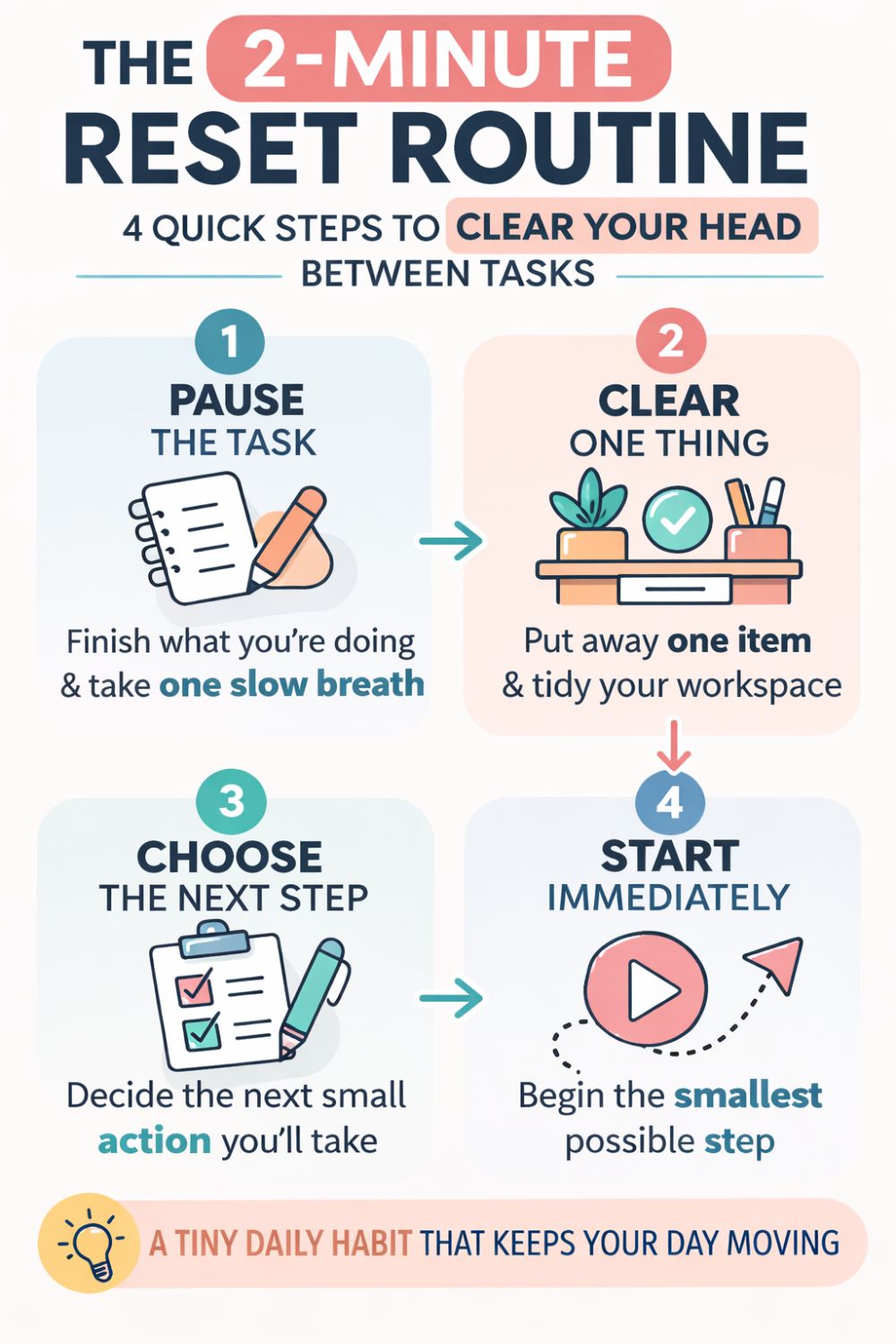


    Source link