Blog

  • Overthinking the First Step? The “Practice Round” Trick That Helps You Start Without So Much Pressure

    Overthinking the First Step? The “Practice Round” Trick That Helps You Start Without So Much Pressure


    Want to try this at home? No worries! Download a copy of our SMART Goals PDF Worksheet.

    ****

    Make Today a Practice Round

    Some goals feel heavy before you even begin.

    You open the document, look at the task list, think about the email, or stare at the project you said you would start, and suddenly it feels like more than a task. It feels like a test of whether you are disciplined enough, talented enough, organized enough, or serious enough.

    That is where perfectionism quietly takes over.

    It tells you that your first attempt should already be good. It tells you that if you cannot do the task properly, you should wait until you have more time, more energy, more clarity, or more confidence. And because those perfect conditions rarely arrive, the task keeps getting pushed off.

    The “practice not performance” reframe gives you a different way in.

    Instead of treating today like the final version, you treat it like a practice round. You are not here to prove your worth. You are here to rehearse the next move.

    Need some in depth help with goal settings, motivation or productivity ? Drop on by our directories choc full of productivity coaches, accountability coaches, and goal-setting coaches, and start reaching those goals! Or click here to have us match you to the best.

    That shift matters because pressure often makes starting harder than the work itself. When the goal is to perform, every tiny step feels loaded. When the goal is to practice, the same step becomes lighter. You can try something, notice what happens, and improve from there.

    This does not mean you stop caring about quality. It means you stop demanding quality before you have even created a first version.

    A practice day might look like:

    • Writing five rough sentences instead of a polished introduction
    • Opening the file and organizing your notes
    • Sending a simple update instead of rewriting it ten times
    • Practicing one part of a bigger skill
    • Spending five minutes on the task instead of waiting for a perfect hour

    This is especially useful at work, where tasks can feel visible and judged. It is also helpful for any goal that has become tangled with pressure, procrastination, or self-criticism.

    Today does not have to be your final performance.

    Today can simply be the day you practice showing up.

    1. Name the Pressure Before You Try to Push Through It

    Before you try to force yourself into action, pause and name what is making the task feel so loaded.

    A lot of perfectionism hides behind vague discomfort. You might say, “I just do not feel like doing this,” when the deeper truth is, “I am scared this will not be good enough.” That distinction matters because low motivation and fear of imperfection need different solutions.
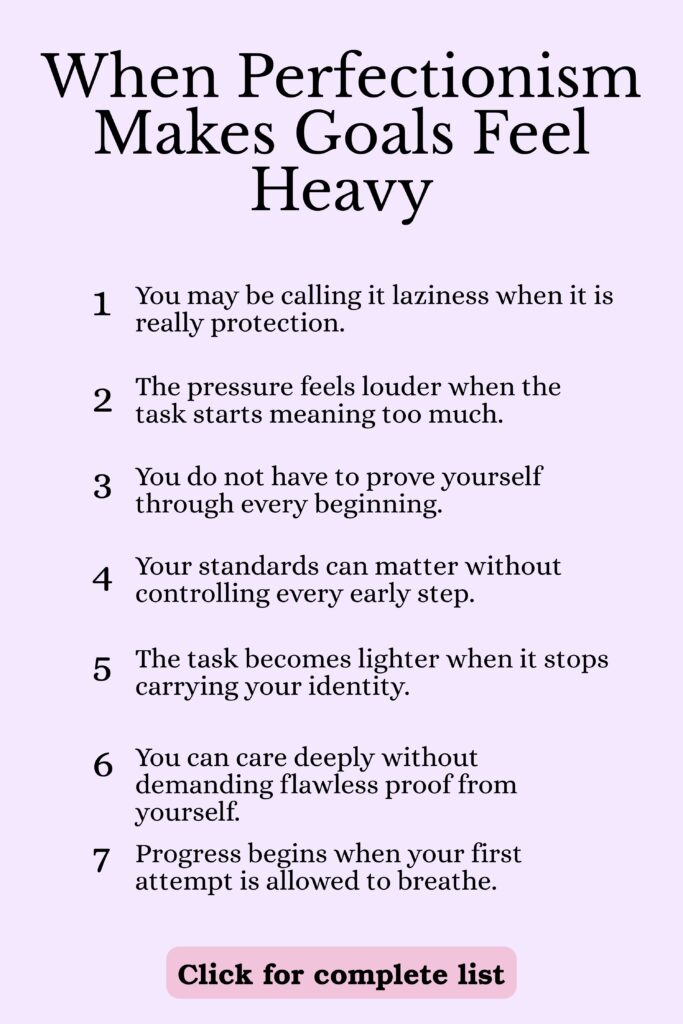
    Start by writing down the pressure thought in plain language. Do not make it sound nicer than it is. Capture the exact sentence your brain is using.

    It might sound like:

    • “This has to be impressive.”
    • “I should already know how to do this.”
    • “If I start and it is bad, I will feel embarrassed.”
    • “I cannot send anything until it is perfect.”
    • “People will think I am not good at this.”

    Once you see the thought written down, it becomes less powerful. It is no longer a foggy feeling sitting in your chest. It is a sentence you can examine.

    Then separate the task from the meaning you attached to it.

    Spot the actual task: Write what you truly need to do in the simplest possible terms. For example, “draft the email,” “outline the meeting points,” “review the first page,” or “make a rough plan.”

    Name the extra meaning: Write what your brain has added on top. For example, “This has to prove I am competent” or “This needs to be the perfect version.”

    Shrink the task back down: Remind yourself that the task is not your whole identity. It is one action, one draft, one message, one small move.

    This is not about dismissing the pressure. It is about understanding it.

    Sometimes the pressure is trying to protect you from criticism. Sometimes it is trying to prevent embarrassment. Sometimes it is trying to make sure you do not waste effort. Those are understandable fears, but they are not always useful guides.

    When you name the pressure first, you stop treating it like a command.

    You can say, “I see why this feels big, but the next step is still small.”

    That one sentence can make starting feel possible again.

    2. Change the Goal From “Do It Well” to “Practice the Move”

    One of the fastest ways to reduce pressure is to change what counts as success.

    If your goal is “do this well,” your brain may immediately start scanning for all the ways you could fail. It wonders whether the work will be good enough, whether someone will judge it, whether you have enough time, and whether the result will match the image in your head.

    That is a lot of weight to put on the first step.

    Instead, change the goal to “practice the move.”

    This makes the task more concrete. You are not trying to produce the perfect result. You are practicing the skill inside the task.

    For example:

    • If the task is writing, you are practicing getting thoughts onto the page.
    • If the task is sending a work update, you are practicing clear communication.
    • If the task is organizing a project, you are practicing sorting the next few steps.
    • If the task is making a decision, you are practicing choosing with limited information.
    • If the task is following through, you are practicing returning to the goal.

    This shift is small, but it changes the emotional temperature of the work.

    Choose one practice move: Pick the smallest skill you can rehearse today. Do not choose the whole project. Choose one part of the project.

    Define the practice version clearly: Write a sentence like, “Today I am practicing starting before I feel ready” or “Today I am practicing writing a rough first version.”

    Let the result be unfinished: Give yourself permission to create something that still needs editing, improving, or expanding later.

    The key is to make the practice move so clear that you know exactly what to do next.

    Instead of saying, “I need to work on my presentation,” try, “I am practicing explaining the main idea in three rough bullet points.”

    Instead of saying, “I need to get better at productivity,” try, “I am practicing opening the task before I check anything else.”

    Instead of saying, “I need to be more consistent,” try, “I am practicing coming back for five minutes.”

    A performance goal asks, “Was this good enough?”

    A practice goal asks, “Did I rehearse the move?”

    That second question is much easier to answer. It is also much easier to repeat.

    And repeatable action is where real progress starts.
    3. Use a Five-Minute Practice Timer

    When a task feels big, your brain may assume it requires a big block of time.

    That is one reason starting becomes so difficult. You imagine needing an uninterrupted afternoon, a clear mind, a perfect setup, and enough energy to finish the whole thing. If you do not have all that, you delay.

    A five-minute practice timer breaks that pattern.

    The point is not to pretend five minutes can complete every goal. The point is to make starting small enough that your brain stops treating it like a threat.

    Five minutes is useful because it is short enough to feel safe, but long enough to create movement. You can write a messy paragraph. You can sort a few notes. You can open the project and identify the next step. You can send one message. You can make the task less mysterious.

    Set the timer before you negotiate: Choose five minutes and begin before your brain creates a full argument against it.

    Pick one visible action: Choose something you can see when it is done, such as three bullets, one paragraph, one list, one folder cleaned up, or one message drafted.

    Stop when the timer ends if you need to: You are allowed to continue, but you do not have to. The win is that you practiced beginning.

    This matters because perfectionism often demands a complete, polished session. The five-minute timer teaches your brain that partial progress still counts.

    A simple five-minute practice might look like this:

    • Minute 1: Open the task and write the practice prompt
    • Minute 2: List what you already know
    • Minute 3: Choose the next tiny action
    • Minute 4: Do the action roughly
    • Minute 5: Write what the next step would be

    That last minute is important. It makes it easier to return later because you are not leaving yourself with a blank page or a vague task.

    After the timer ends, ask:

    • What is clearer now?
    • What exists now that did not exist five minutes ago?
    • What would be easier to do next?

    This helps you notice progress instead of only noticing what remains unfinished.

    Five minutes will not solve everything. But it can interrupt the avoidance loop.

    And sometimes, that is the real first win.

    4. Add a Gentle Practice Prompt

    A practice prompt is a short sentence that tells your brain what today is for.

    This matters because perfectionism often starts talking before you do. It sets the tone with thoughts like, “This better be good,” “You are behind,” or “You need to get this right.” If you do not replace that voice, it can frame the entire task as a performance.

    A gentle practice prompt gives you a better opening line.

    Try this sentence:

    “Today I am only practicing ______.”

    The word “only” is useful here. It lowers the stakes. It reminds you that you are not trying to solve your entire life, finish the full goal, or become a different person in one sitting.

    You are practicing one thing.

    For example:

    • “Today I am only practicing starting.”
    • “Today I am only practicing writing before judging.”
    • “Today I am only practicing making one decision.”
    • “Today I am only practicing asking for clarification.”
    • “Today I am only practicing returning to the task.”

    The prompt works best when it is specific.
    “Today I am practicing productivity” is too broad. It gives your brain too much room to turn the task into another performance.

    “Today I am practicing opening the document and writing five rough bullets” is clearer. You know exactly what practice looks like.

    Choose the skill inside the task: Ask what this task is asking you to rehearse. Is it focus, communication, consistency, planning, follow-through, or decision-making?

    Write the prompt where you can see it: Put it at the top of the document, on a sticky note, in your planner, or beside the task on your list.

    Repeat it before you start: Say it once before the five-minute timer begins, especially if you feel the pressure rising.

    You can also use this prompt after a difficult moment.

    If you made a mistake, you might write, “Today I am practicing learning without spiraling.”

    If you are behind, you might write, “Today I am practicing restarting without making it dramatic.”

    If you feel exposed at work, you might write, “Today I am practicing sharing a draft before it is perfect.”

    A good prompt does not magically remove discomfort. It simply gives you a kinder frame for moving through it.

    That frame can be enough to help you begin.

    5. Keep a Tiny Practice Log

    A practice log helps you collect evidence that you are showing up.

    This is different from a performance tracker. A performance tracker can easily become another place to judge yourself. You start measuring whether you did enough, how well you did it, and whether your progress looks impressive.

    A practice log has a gentler job.

    It records the fact that you practiced.
    That matters because perfectionism often makes you forget every small attempt that did not produce a perfect result. You may be making more progress than you realize, but because the progress feels ordinary or unfinished, your brain dismisses it.

    A tiny practice log makes the invisible visible.

    Keep it simple. One line per practice round is enough.

    You might write:

    • “Practiced starting before I felt ready.”
    • “Practiced drafting without editing.”
    • “Practiced sending a clear update.”
    • “Practiced working for five minutes.”
    • “Practiced choosing the next step instead of overthinking.”

    Do not turn this into a complicated system. The more effort the log requires, the more likely it becomes another task to avoid.

    Write what you practiced: Focus on the skill, not the outcome. This keeps the log connected to habit building instead of perfectionism.

    Keep the entry short: One sentence, one checkbox, or one phrase is enough.

    Review for patterns once a week: Look for what helps you return to the goal. Do not use the log to criticize yourself.

    The review is where the log becomes especially useful.

    You might notice that you start more easily in the morning. You might notice that writing a rough list first reduces pressure. You might see that certain tasks need a smaller first step than you expected.

    You may also notice that you are more consistent when you allow imperfect sessions.

    That is important evidence.

    A perfectionist brain often believes that pressure creates progress. But your log may show something different. It may show that gentleness, clarity, and small practice rounds help you act more often.

    The goal is not to build a perfect streak.

    The goal is to build trust with yourself.

    Every short entry says, “I came back.”

    And coming back is a real skill.

    6. Reframe Mistakes as Practice Data

    Mistakes feel different when you treat them as data instead of proof.

    When you are in performance mode, a mistake can feel personal. You missed the deadline, so you tell yourself you are unreliable. You sent an awkward email, so you tell yourself you are bad at communication. You procrastinated, so you tell yourself you have no discipline.

    That kind of thinking does not help you improve. It usually makes the next attempt feel even heavier.

    Practice mode gives you another option.

    A mistake becomes information about the system, the task, the timing, the instructions, or the next adjustment you need to make.

    That does not mean you pretend mistakes do not matter. It means you look at them in a way that helps you keep moving.

    Describe what happened neutrally: Use plain, factual language. For example, “I waited until the end of the day to start,” or “I tried to edit while drafting,” or “I did not clarify the next step.”

    Look for the friction point: Ask where the task became harder. Was the first step too vague? Was the deadline unclear? Were you trying to make it perfect too early?

    Choose one small adjustment: Pick something useful for the next practice round, such as starting with a timer, asking a question sooner, making a checklist, or creating a rough draft first.

    This process is especially helpful for perfectionists because it interrupts the shame spiral.

    Instead of asking, “What is wrong with me?” ask, “What did this practice round teach me?”

    That question keeps you in motion.
    For example, if you avoided a work task all day, the lesson might be that the task was too undefined. Next time, your first practice move could be writing the question, “What exactly needs to happen first?”

    If you over-edited an email for thirty minutes, the lesson might be that you need a two-step process. First draft the message. Then edit it once. Then send it.

    If you quit because the first attempt looked bad, the lesson might be that you need to label early versions more clearly. Call it a rough draft. Call it notes. Call it version one.

    Mistakes are not pleasant, but they are useful.

    They show you where the next practice round needs support.

    7. Use This at Work When You Feel Watched or Judged

    Work can make perfectionism louder.

    Even ordinary tasks can feel high-stakes when other people might read, review, question, or respond to your work. A simple update can start to feel like a performance. A meeting can feel like a test. A first draft can feel like evidence of your ability.

    That pressure can make you slow down in ways that look like procrastination, but are really self-protection.

    The practice reframe helps because it separates the early stage from the final stage. Not every work moment is a delivery moment. Some moments are for thinking, sketching, drafting, preparing, and clarifying.

    You can treat those moments as practice.

    Label the first pass privately: Before you begin, tell yourself, “This is only the practice version.” That can make it easier to create something rough without judging it immediately.

    Build a low-risk draft: Start with notes, bullets, talking points, or a messy outline before trying to create the polished version.

    Decide what stage the task is in: Ask whether this is a thinking stage, drafting stage, review stage, or final delivery stage. Do not demand final-stage quality from a thinking-stage task.

    This is especially helpful for emails, presentations, project plans, reports, and difficult conversations.

    For example, if you need to send a work email, your practice round might be writing the message badly on purpose. Not to send, just to get the point out. Then you can clean it up.

    If you need to prepare for a meeting, your practice round might be listing the three things you want to say. You are not scripting the entire meeting. You are rehearsing clarity.

    If you need to start a project, your practice round might be creating a simple “knowns and unknowns” list. That gives you a place to begin without pretending everything is figured out.

    The important part is to stop treating every first attempt like it is being graded.

    At work, quality still matters. But quality usually improves through stages.

    Practice mode lets you move through those stages instead of freezing at the start.

    8. How a Coach Can Help You Practice Without Over-Performing

    A goal-setting coach or organizational coach can be especially helpful if you understand the practice reframe but struggle to apply it consistently.

    That is because perfectionism often feels logical from inside your own head. You may believe you are just being responsible, thorough, or ambitious. And sometimes you are. But there is a point where high standards stop helping and start blocking action.

    A coach can help you notice that line.
    They can also help you turn a vague goal into a practice-based plan. Instead of saying, “I need to get better at follow-through,” you can define the specific behaviors that build follow-through over time.

    For example:

    • Starting with five minutes
    • Creating a weekly review habit
    • Sending earlier drafts
    • Breaking goals into practice rounds
    • Noticing avoidance patterns
    • Building a realistic accountability system

    Identify the perfectionism pattern: A coach can help you spot where you tend to freeze, overwork, overthink, delay, or restart from scratch.

    Turn goals into practice steps: Instead of focusing only on the final outcome, a coach can help you define the repeated actions that make the outcome more likely.

    Review progress without self-attack: A coach can help you look at what worked and what did not without turning every missed step into a personal failure.

    This kind of support is not about lowering your standards. It is about building a process that lets you act before everything feels perfect.

    A coach might ask questions like:

    • What would the practice version of this goal look like?
    • What is the smallest repeatable action?
    • Where does the pressure usually spike?
    • What are you making this task mean about you?
    • What would make the next attempt easier?

    Those questions can help you move from self-judgment into strategy.
    Coaching can also create a safer space to practice imperfect action. If you tend to hide messy drafts, avoid asking for help, or wait too long to share progress, a coach can help you rehearse those moments in a lower-pressure way.

    Sometimes what you need is not more motivation.

    Sometimes you need a better way to practice.

    9. Follow-Up Practice: Create a “Good Enough to Continue” Standard

    Perfectionism often moves the finish line.

    You start with a reasonable goal, but once you begin, your brain keeps adding requirements. The quick outline now needs to be detailed. The simple email now needs to sound flawless. The five-minute task now needs to become a full productivity session.

    By the end, the task feels too big again.

    A “good enough to continue” standard helps prevent that.

    This standard defines what counts before you start. It gives you a clear stopping point, so you do not keep raising the bar while you work.

    The phrase is important. You are not deciding what is good enough forever. You are deciding what is good enough to continue.

    That might mean:

    • A rough outline is good enough to continue tomorrow
    • Three bullets are good enough to clarify the idea
    • One sent message is good enough to restart momentum
    • Five minutes is good enough to keep the habit alive
    • A messy first draft is good enough to edit later

    Define the minimum useful version: Ask, “What would make this task easier to return to?” That is often your real practice goal.

    Write the standard before starting: Put it somewhere visible so your brain cannot quietly change the rules halfway through.

    Stop when the practice goal is met: Pause and acknowledge that you completed the practice round, even if the full task is not finished.

    This is powerful because it trains you to respect small completions.

    Perfectionists often struggle with this. They finish one small piece and immediately discount it because there is more to do. But every big goal is built from smaller pieces that are allowed to count.

    A good enough standard might sound like:

    • “Good enough is five rough ideas.”
    • “Good enough is a draft I can revise.”
    • “Good enough is choosing the next action.”
    • “Good enough is sending the update clearly.”
    • “Good enough is practicing for five minutes.”

    The standard should be practical, not dramatic.

    You are not trying to convince yourself that poor work is excellent. You are simply giving yourself permission to keep moving through the stages.

    Good enough to continue is how imperfect work becomes better work.

    It gives you something to improve from.

    10. Follow-Up Practice: Build a Repeatable Starting Ritual

    If starting always depends on your mood, energy, confidence, or motivation, it will feel unpredictable.

    A starting ritual makes the first few steps easier because you do not have to decide how to begin every time. You use the same small pattern until your brain starts to recognize it.

    This is where practice becomes a habit.

    The ritual does not need to be beautiful, elaborate, or aesthetic. In fact, it is better if it is simple. The goal is to reduce friction, not create another thing to perfect.

    A basic starting ritual might look like this:

    • Sit down
    • Open the task
    • Write the practice prompt
    • Set a five-minute timer
    • Complete one small action
    • Write the next step

    That is enough.

    Choose a reliable cue: Attach the ritual to something that already happens, such as opening your laptop, starting your workday, finishing coffee, or sitting at your desk.

    Repeat the same first action: Make the first action so familiar that you do not have to think about it. Opening the document or writing the prompt can become the bridge into the task.
    Reward the return: Give yourself credit for beginning again, not just for finishing everything.

    This matters because motivation often grows after action begins, not before. If you wait to feel motivated, you may wait a long time. But if you create a small ritual that gets you into motion, motivation has something to attach to.

    A repeatable ritual also helps on low-energy days.

    You do not have to ask, “How do I tackle this whole thing?” You only have to ask, “What is the first step of my ritual?”

    That keeps the day from becoming a debate.

    For perfectionists, the ritual should include permission for roughness. You might write, “Practice version first” at the top of every draft. You might keep a note beside your desk that says, “Do the first pass badly enough to begin.”

    The wording can be simple. The effect can be big.

    When starting feels safe and familiar, you are more likely to return.

    And when you return often enough, progress becomes less dependent on pressure.

    Make Starting Feel Safe Again

    Want to try this at home? No worries! Download a copy of our SMART Goals PDF Worksheet.

    Need some in depth help with goal settings, motivation or productivity ? Drop on by our directories choc full of productivity coaches, accountability coaches, and goal-setting coaches, and start reaching those goals! Or click here to have us match you to the best.

    You do not need to turn every goal into a test of your character.

    Some days are not for proving yourself. Some days are for practicing the next move. That is not laziness, and it is not lowering your standards. It is how people build skills without crushing themselves under the weight of the final version.

    When you treat today as practice, you give yourself room to begin before you feel fully ready.

    You can write the rough draft. You can make the messy list. You can send the simple update. You can ask the basic question. You can return for five minutes without turning it into a full identity review.

    That is how momentum often starts.

    Not with a perfect plan.

    Not with a flawless mood.

    Not with a dramatic burst of confidence.

    Just with one practice round that feels safe enough to try.

    The more you practice this, the more your relationship with goals can change. You stop seeing every task as a moment where you either succeed or fail. You start seeing each attempt as information, repetition, and growth.

    A missed day becomes something to learn from.

    A messy draft becomes something to edit.

    A small start becomes something worth counting.

    The next time a goal feels heavy, ask yourself one question:

    “What would this look like if today were only practice?”

    Then make the answer small enough to do.

    Set the timer. Write the prompt. Choose the first move. Let the first version be imperfect.

    You can always improve something that exists.

    And today, existing might be the whole point.

    The post Overthinking the First Step? The “Practice Round” Trick That Helps You Start Without So Much Pressure appeared first on Life Coach Hub.

    Source link

  • Fell Off Track? The 24-Hour Goal Restart That Gets You Moving Again Without Starting Over

    Fell Off Track? The 24-Hour Goal Restart That Gets You Moving Again Without Starting Over


    How to Set Goals

    Sure, you have goals. Everyone does. There is a big difference, however, between goals and goal setting.


    Read More


    Source link

  • Keep Quitting Your Goals? How to Spot the Exact Reason You’ll Quit and Build a Plan Around It

    Keep Quitting Your Goals? How to Spot the Exact Reason You’ll Quit and Build a Plan Around It


    Vision Board Ideas That Actually Help You Stay Focused on Your Goals

    Try these vision board ideas that make goal setting feel clearer, calmer, and way easier to stick with every day.


    Read More


    Source link

  • Keep Putting It Off? The Tiny Countdown Trick That Beats Procrastination Fast

    Keep Putting It Off? The Tiny Countdown Trick That Beats Procrastination Fast


    Why Procrastination is Bad: Stop Procrastinating About Procrastination!

    How to overcome procrastination


    Read More


    Source link

  • Track Your Motivation, Not Your Whole Life: A 5-Minute Energy-and-Effort Log

    Track Your Motivation, Not Your Whole Life: A 5-Minute Energy-and-Effort Log


    Want to try this at home? No worries! Download a copy of our SMART Goals PDF Worksheet.

    *****

    Why Your Motivation Might Not Be the Real Problem

    When you keep falling off a goal, it is easy to assume the problem is motivation.

    You tell yourself you need more discipline. You wonder why you cannot just stick with the plan. You may even start thinking you are the kind of person who gets excited at the beginning, then gives up when life gets busy.

    But inconsistency is not always a motivation problem.

    Sometimes the real problem is low energy. Sometimes the plan is too big for the day you actually had. Sometimes you keep trying to do your hardest task at the worst possible time. Sometimes your schedule is overloaded, and your brain is quietly refusing to add one more thing.

    That is why tracking your whole life can backfire.

    A full habit tracker, mood tracker, sleep tracker, meal tracker, and productivity dashboard might sound helpful in theory. But when you are already tired, it can become another task to fail at.

    A 5-minute energy-and-effort log is different.

    It does not ask you to document everything. It asks you to notice just enough to understand what is getting in the way.

    Instead of asking, “Did I succeed or fail today?” you ask:

    • How much energy did I have?
    • How hard did this feel?
    • When did I try to do it?
    • What made it easier or harder?

    That tiny check-in can show you patterns you might otherwise miss.

    Maybe you are not inconsistent. Maybe your goal is scheduled during your lowest-energy part of the day. Maybe the task has too much hidden friction. Maybe you need a smaller version for drained days.

    The point is not to judge yourself more accurately.

    The point is to adjust your plan more intelligently.

    This article walks you through how to create a simple daily log that helps you spot whether low energy, overload, timing, or task friction is really causing your inconsistency. You do not need a complicated system. You only need five minutes, a few honest ratings, and a willingness to treat your behavior like useful information.

    Need some in depth help with goal settings, motivation or productivity ? Drop on by our directories choc full of productivity coaches, accountability coaches, and goal-setting coaches, and start reaching those goals! Or click here to have us match you to the best.

    1. Set Up a Log You Can Fill Out Even When You’re Tired

    The best tracking system is not the prettiest one. It is the one you will still use when your energy is low.

    If your log requires color coding, multiple apps, detailed journaling, and perfect daily entries, it may work for three days. Then it will probably become another thing you avoid. For this kind of check-in, simple is the whole strategy.

    Start with a format that feels almost too easy.

    You can use:

    • A notes app
    • A paper notebook
    • A printable tracker
    • A spreadsheet
    • A habit app with custom notes
    • A sticky note beside your desk

    The tool matters less than the friction. If opening it feels annoying, choose something easier.

    Use the same four fields every day:

    • Energy
    • Effort
    • Timing
    • One short note

    That is enough.

    You do not need to write a full recap of your day. You are only collecting clues.

    • Choose the simplest format: Pick a place you can open in under ten seconds, because the log should feel like a quick check-in, not a daily writing assignment.
    • Create only four daily fields: Track energy, effort, timing, and one short note so the system stays focused on what actually affects follow-through.
    • Use quick rating scales: Rate energy from 1 to 5 and effort from 1 to 5, where 1 means very low and 5 means strong or demanding.
    • Keep the note field tiny: Write one short phrase like “too many meetings,” “slept badly,” “started too late,” or “felt easier after lunch.”

    Here is a simple version:

    Date:
    Energy: 2/5
    Effort: 4/5
    Timing: 8:30 p.m.
    Note: Too tired after work

    That one entry already tells you something.

    It tells you the task was not just “not done.” It was attempted at night, with low energy, and it felt hard.

    That is useful. That is the point.

    Your log should be light enough that you can complete it even on the days when the goal itself does not happen.

    2. Track Energy Before You Track Performance

    Most people track performance first.

    They ask, “Did I work out?” “Did I write?” “Did I clean?” “Did I finish the thing?”

    Those questions can be useful, but they leave out something important: what kind of capacity you had that day.

    A task that feels doable on a high-energy morning can feel impossible after a long day of decisions, interruptions, errands, calls, and emotional noise. The task did not change. Your capacity did.

    That is why energy needs to come before performance.

    When you log your energy, you are not making excuses. You are identifying the conditions you are working with.

    A simple 1 to 5 energy scale works well:

    • 1 = barely functioning
    • 2 = low energy
    • 3 = okay, but not strong
    • 4 = steady and capable
    • 5 = energized and ready

    You can also add a short label for the kind of tired you feel.

    For example:

    • Sleepy
    • Mentally full
    • Emotionally drained
    • Physically tired
    • Socially exhausted
    • Overstimulated
    • Flat or unfocused

    This matters because different types of tired need different solutions.

    Sleepy may mean you need an earlier bedtime or a lower-effort morning plan. Mentally full may mean you need fewer decisions before starting. Socially exhausted may mean you should avoid placing personal goals right after heavy meetings or family demands.

    • Rate your energy honestly: Write down how much capacity you actually had before deciding what the day says about your discipline.
    • Name the kind of tired you felt: Use plain labels like sleepy, drained, mentally full, or physically tired so you can see what kind of energy is missing.
    • Compare energy to your goal size: Notice whether you expected a high-output task from a low-capacity day.
    • Look for repeat energy dips: Watch for patterns like “always tired after work” or “better before lunch.”

    This one shift can be powerful.

    Instead of saying, “I never stick with things,” you may realize, “I keep putting my hardest goal into my lowest-energy window.”

    That is not a character flaw.

    That is a scheduling problem.

    3. Separate Low Motivation From High Effort

    Sometimes you think you are unmotivated because a task feels too hard to start.

    But “hard to start” can mean many different things.

    It might mean the task is unclear. It might mean there are too many steps. It might mean you have not decided what “done” looks like. It might mean the task is emotionally loaded, boring, messy, or too big for the amount of time you have.

    That is why your log should track effort separately from energy.

    Energy is your capacity. Effort is the demand of the task.

    A low-energy day can make a normal task feel harder. But even on a decent-energy day, some tasks still feel heavy because they contain hidden friction.

    Use a 1 to 5 effort scale:

    • 1 = very easy
    • 2 = manageable
    • 3 = takes some push
    • 4 = hard to start or finish
    • 5 = feels like a wall

    This helps you notice when a task is repeatedly asking too much.

    For example, “plan meals for the week” might sound like one task. But hidden inside it are several smaller steps:

    • Check the fridge
    • Choose recipes
    • Think about schedules
    • Make a grocery list
    • Decide what to prep
    • Possibly shop
    • Possibly cook

    No wonder it feels like a 5.

    The problem may not be motivation. The problem may be that the task is not actually one task.

    • Score how hard the task felt: Rate the effort required, not just whether you completed the action.
    • Notice hidden friction: Look for unclear steps, missing supplies, too many decisions, or anything that made starting harder.
    • Mark tasks that cost more than expected: If a “small” task keeps feeling like a 4 or 5, treat that as information.
    • Shrink the next version: Turn the task into something smaller, like “open the document,” “choose one recipe,” or “put shoes by the door.”

    This is where your log becomes more than a tracker.

    It becomes a plan editor.

    Instead of pushing yourself to “try harder,” you can ask, “How can I make this task cost less effort next time?”

    That question is often much more useful.

    4. Use Timing Clues to Find Your Natural Follow-Through Window

    Timing can quietly make or break a goal.

    You may be trying to build a habit at a time of day that works on paper but fails in real life. Maybe you planned to work out after dinner, but that is when your energy drops. Maybe you planned to write before bed, but your brain is already done. Maybe you planned to organize on Sunday night, but that is when you feel pressure about the week ahead.

    A motivation tracker that ignores timing misses one of the biggest clues.

    In your log, write down the rough time you tried to do the task, or the time you planned to do it and skipped it.

    You do not need exact timestamps.

    Simple notes work:

    • Morning
    • Before work
    • Lunch
    • Mid-afternoon
    • After work
    • After dinner
    • Before bed

    After a week or two, you may start seeing patterns.

    Maybe your best window is earlier than you thought. Maybe your worst window is the one you keep forcing because it looks convenient. Maybe the task itself is fine, but the placement is wrong.

    • Record when you tried: Note the time of day so you can see whether timing is helping or hurting your consistency.
    • Compare your best and worst windows: Look for the times when starting feels lighter, distractions are lower, or your brain feels more available.
    • Stop forcing the hardest slot: If evenings are consistently drained, stop treating evening failure as a discipline issue.
    • Attach the task to a stronger anchor: Pair the action with something that already happens, like after coffee, before email, after school drop-off, or right after lunch.

    The goal is not to find a perfect time. Most people do not have one.

    The goal is to find a better time.

    Even moving a task by 30 minutes can change how it feels. Doing it before you open your inbox may feel completely different from doing it after everyone has asked something from you.

    Your log helps you stop guessing.

    It shows you where follow-through naturally has more support.

    5. Add One “Reason It Didn’t Happen” Without Blaming Yourself

    When a goal does not happen, most people write a story around it.

    “I failed again.”

    “I have no discipline.”

    “I always do this.”

    “I guess I did not want it enough.”

    Those stories feel true in the moment, but they are usually too vague to help. They make you feel worse without showing you what to change.

    A better approach is to choose one practical reason.

    Not a dramatic reason. Not a self-critical reason. Just a usable one.

    Try categories like:

    • Low energy
    • Overload
    • Bad timing
    • Task too big
    • Forgot
    • Unclear next step
    • Too many decisions
    • Not enough time
    • Not actually important today
    • Needed support

    This turns a missed task into information.

    For example, “I skipped my workout because I’m lazy” gives you nowhere to go. But “I skipped it because I got home late and the full workout felt too big” gives you a next step.

    You can create a shorter workout. You can move it earlier. You can set out clothes in advance. You can decide that late days only require stretching.

    That is useful.

    • Pick one reason category: Choose the main reason the task did not happen so the pattern becomes easier to see.
    • Avoid vague labels: Replace “I failed” with something specific like “started too late,” “too many steps,” or “energy was low.”
    • Use the reason to adjust the plan: If the same reason repeats, change the system instead of repeating the same expectation.
    • Keep the tone neutral: Treat the entry like dashboard data, not a character review.

    This part of the log is especially helpful if you tend to blame yourself quickly.

    You are not letting yourself off the hook. You are getting clearer.

    There is a big difference between responsibility and self-criticism.

    Responsibility says, “What can I change so this works better?”

    Self-criticism says, “What is wrong with me?”

    Your log should always point you back to the first question.

    6. Review the Log Once a Week in 5 Minutes

    Daily tracking is useful, but the real value appears when you review the pattern.

    You do not need a long weekly reflection. You only need five minutes to scan your entries and look for repeats.

    The goal is not to analyze every detail. The goal is to notice what happened more than once.

    Look across the week and ask:

    • When was my energy highest?
    • When was my energy lowest?
    • Which tasks felt harder than expected?
    • What reason showed up most often?
    • Did timing affect follow-through?
    • What made things easier?

    Circle or highlight anything that appears two or more times.

    For example, you might notice:

    • Low energy after work on Monday, Tuesday, and Thursday
    • High effort every time you tried to meal plan
    • Better follow-through before checking email
    • Missed habits on days with back-to-back meetings
    • Easier starts when the first step was already prepared

    Now you have something to work with.

    The key is to choose one adjustment for the next week.

    Not five. Not a complete life reset. One.

    • Scan for repeated patterns: Look for anything that shows up more than twice, because repeats are usually more useful than one-off bad days.
    • Choose one adjustment only: Move the task, shrink the task, prep the first step, or change the reminder, but do not overhaul everything.
    • Keep what already worked: Notice the conditions that helped you follow through and repeat them on purpose.
    • Write one sentence for next week: Create a simple plan like “I will do this before lunch” or “On drained days, I only need the 2-minute version.”

    A weekly review keeps the log from becoming passive tracking.

    You are not collecting information just to collect it. You are using it to make your plan more realistic.

    This is where the self-blame starts to loosen.

    When you see the same pattern on paper, it becomes harder to believe the problem is simply that you are not trying.

    You may be trying. You just may be trying against the same obstacle every day.

    7. Build a Low-Energy Version of Every Important Goal

    One of the best things your log can show you is when your plan needs a low-energy version.

    Most people create goals for their best selves.

    They imagine the version of themselves who slept well, has time, feels focused, and is ready to do the full routine. That version may exist sometimes. But it is not the only version who needs a plan.

    Your tired self needs a plan too.

    Your busy self needs a plan. Your emotionally drained self needs a plan. Your “I have ten minutes and no patience” self needs a plan.

    This does not mean lowering your standards forever. It means keeping the habit alive when your capacity is lower than expected.

    For every important goal, create three versions:

    • Full version
    • Medium version
    • Minimum version

    For example, if your goal is exercise:

    • Full version: 45-minute workout
    • Medium version: 15-minute walk
    • Minimum version: 2 minutes of stretching

    If your goal is writing:

    • Full version: Draft 1,000 words
    • Medium version: Write one section
    • Minimum version: Open the document and write one messy sentence

    If your goal is planning:

    • Full version: Full weekly review
    • Medium version: Choose top three tasks
    • Minimum version: Pick tomorrow’s first task
    • Define the full version: Write down what the goal looks like on a strong day when you have enough time and energy.
    • Create the minimum version: Decide what counts on a drained day so you do not abandon the goal completely.
    • Protect the habit thread: Use the low-energy version to stay connected to the routine without pretending every day is the same.
    • Let the log tell you when to scale back: If energy is low and effort is high, use the smaller version before quitting the goal.

    This is not cheating.

    It is adaptive consistency.

    The minimum version keeps the door open. It gives you a way to continue without demanding full output from a low-capacity day.

    That is often what makes a goal sustainable.

    8. Use the Log to Redesign Your Plan, Not Criticize Yourself

    A tracker is only helpful if it leads to better decisions.

    If your log becomes a place where you record failure after failure, it will feel heavy fast. The purpose is not to create written proof that you are inconsistent. The purpose is to help you redesign the plan until it fits your real life better.

    Start by looking for mismatches.

    A mismatch happens when your plan expects something your day cannot reliably provide.

    For example:

    • You planned a high-focus task during your most interrupted hour.
    • You planned a full workout on your lowest-energy evening.
    • You planned a complicated habit without preparing the first step.
    • You planned too many changes at once.
    • You expected motivation to solve a task that actually needs structure.

    Once you see the mismatch, adjust the plan.

    You might change the time, size, location, reminder, first step, or frequency.

    Small changes can make a big difference.

    If a task feels too big, shrink it. If it gets forgotten, make it visible. If it always fails at night, test it earlier. If it creates decision fatigue, decide the next step in advance.

    • Match tasks to energy levels: Put demanding tasks into higher-energy windows and save easier maintenance tasks for lower-energy times.
    • Remove one friction point: Use your notes to eliminate one recurring obstacle, such as unclear steps, missing materials, or too many decisions.
    • Change the goal size before changing the goal: If the goal still matters but keeps failing, test a smaller version before dropping it.
    • Track whether the adjustment worked: After a few days, check whether the new version lowered the effort score or improved follow-through.

    This turns your goal into an experiment.

    You are not asking, “Am I disciplined enough?”

    You are asking, “What conditions make this easier to repeat?”

    That question is kinder, but it is also more practical.

    Because once you know the conditions that support consistency, you can build around them.

    You stop relying on motivation to carry the whole plan.

    What a Coach Can Help You See in Your Log

    A 5-minute log can be useful on your own, but it can become even more powerful when someone helps you interpret the pattern.

    A goal-setting coach, productivity coach, organizational coach, or life coach can help you look at the log without the self-blame that often comes up when you review your own behavior.

    Sometimes the pattern is obvious to someone outside your head.

    You may say, “I do not know why I keep failing at this.”

    A coach might notice that every missed day comes after a packed schedule. Or that every high-effort rating happens when the task has no clear first step. Or that you are trying to build a routine during the part of the day when you have the least control.

    The value is not that a coach magically fixes your motivation.

    The value is that they help you turn the data into a better experiment.

    • Spot patterns you might dismiss: A coach can help you notice repeated energy dips, overload cycles, and timing problems that you may be treating as personal failure.
    • Separate excuses from useful data: A coach can help you tell the difference between avoidance and a plan that genuinely needs to be redesigned.
    • Turn observations into experiments: Instead of saying “try harder,” a coach can help you test smaller steps, stronger anchors, or better timing.
    • Build accountability around adjustments: Coaching can keep the focus on learning and follow-through, not perfection.

    This can be especially helpful if you are hard on yourself.

    When you are used to self-criticism, even useful data can feel like evidence against you. A coach can help you read the log more neutrally.

    They may ask questions like:

    • What happens right before this task gets skipped?
    • What would make this easier by 20 percent?
    • What is the smallest version that still counts?
    • Where does this fit naturally in your day?
    • Is this goal still aligned with what you actually want?

    Those questions move you from blame to design.

    And when your plan fits better, consistency often gets easier.

    Common Log Patterns and What They Usually Mean

    After you use your log for a week or two, certain patterns may start to repeat.

    These patterns are helpful because they show you what kind of adjustment to try next. You do not need to guess blindly. Your entries can point you toward the most likely fix.

    One common pattern is low energy plus high effort.

    This usually means the task is too demanding for your current capacity. You may still care about the goal, but the version you are asking yourself to do is too large for that moment.

    The adjustment is usually to shrink the task, move it to a better time, or create a low-energy version.

    Another common pattern is good energy plus high effort.

    This can mean the task itself has friction. Maybe the next step is unclear. Maybe the task involves too many decisions. Maybe you are avoiding it because it feels uncomfortable, boring, or emotionally loaded.

    The adjustment is to clarify the first step, remove decisions, or break the task into smaller pieces.

    Here are a few patterns to watch for:

    • Low energy plus high effort: The task may be too big for your current capacity, so test a smaller version or move it to a stronger time of day.
    • Good energy plus high effort: The task may be unclear, complicated, or emotionally heavy, so define the first step more clearly.
    • Low energy plus low effort: This is a good window for maintenance habits, quick resets, or minimum versions.
    • Good energy plus low effort: This is a strong window for consistency, slightly bigger goals, or tasks that usually get postponed.
    • Repeated bad timing: The task may be placed in the wrong part of your day, even if the goal itself is realistic.
    • Repeated “forgot” entries: The goal may need a stronger cue, visible reminder, or built-in anchor.
    • Repeated “too big” entries: The goal needs a smaller starting point, not more pressure.

    The goal is not to diagnose yourself.

    The goal is to choose your next adjustment.

    When you can name the pattern, the solution becomes less emotional and more practical.

    The Real Win Is Knowing What to Adjust

    The biggest benefit of a 5-minute energy-and-effort log is not that you become a perfect tracker.

    You probably will not fill it out perfectly. You may miss a day. You may forget a few details. You may only use it during seasons when a goal feels stuck.

    That is fine.

    The real win is learning how to understand your inconsistency without immediately blaming yourself.

    When you track energy, effort, timing, and one short note, you start to see the difference between a motivation problem and a plan problem.

    You may discover that your goal is too large for your current season. You may discover that your best focus window is earlier than you thought. You may discover that low-energy days need a minimum version. You may discover that the task you keep avoiding is not hard because you are lazy, but because it has too many unclear steps.

    That kind of information gives you choices.

    You can move the task.

    You can shrink the task.

    You can prep the first step.

    You can lower the effort.

    You can protect your best energy window.

    You can ask for support.

    You can stop expecting the same output from every version of yourself.

    The log is not there to control your whole life. It is there to help you notice what your life is already telling you.

    If you want to start today, keep it very simple.

    Tonight, write down:

    • Energy: 1 to 5
    • Effort: 1 to 5
    • Timing: when you tried
    • Note: one phrase about what helped or got in the way

    That is enough.

    Do it for a few days, then look for one pattern.

    Not every pattern. Not your entire personality. Just one useful clue.

    Because consistency usually improves faster when you stop asking, “What is wrong with me?” and start asking, “What needs to change so this is easier to repeat?”

    *****

    Want to try this at home? No worries! Download a copy of our SMART Goals PDF Worksheet.

    Need some in depth help with goal settings, motivation or productivity ? Drop on by our directories choc full of productivity coaches, accountability coaches, and goal-setting coaches, and start reaching those goals! Or click here to have us match you to the best.

    The post Track Your Motivation, Not Your Whole Life: A 5-Minute Energy-and-Effort Log appeared first on Life Coach Hub.


    Source link

  • The 3-Number Weekly Review for People Who’ll Never Keep a Habit Tracker

    The 3-Number Weekly Review for People Who’ll Never Keep a Habit Tracker


    Want to try this at home? No worries! Download a copy of our SMART Goals PDF Worksheet.

    *****

    The Weekly Review for People Who Hate Daily Tracking

    Habit trackers sound great until you actually have to use them.

    At first, they feel motivating. You make the chart, pick the colors, decide what counts, and imagine how satisfying it will feel to check off every little box. Then real life happens. You forget one day, then two. Suddenly the tracker feels less like support and more like proof that you are behind.

    That is exactly why a weekly review can work better than a daily habit tracker for some people.

    Instead of logging every habit every day, this method asks you to look at just three numbers once a week. That is it. Three numbers that tell you whether your routine is helping, where it is breaking down, and what needs to change next.

    This is not about becoming the kind of person who tracks everything. It is for people who want useful feedback without turning their whole life into a spreadsheet.

    The goal is simple: use three numbers to answer one question.

    Is this routine actually working?

    That question matters because many people keep trying to fix their goals with more motivation, when the real issue is the routine itself. Maybe the plan is too big. Maybe the timing is wrong. Maybe the first step is unclear. Maybe the habit is fine, but the environment around it keeps getting in the way.

    A 3-number weekly review helps you see that faster.

    You are not trying to measure every detail. You are looking for a signal. A pattern. A small clue that tells you what to keep, what to adjust, and what to stop forcing.

    This method works especially well for goals like:

    • Building a workout routine
    • Improving focus
    • Making mornings easier
    • Staying consistent with meals
    • Keeping up with a personal project
    • Following through on weekly priorities
    • Creating a routine that feels less chaotic

    By the end of the article, you will know how to choose your three numbers, review them once a week, and use them to make one realistic adjustment. No daily logging required.

    Need some in depth help with goal settings, motivation or productivity ? Drop on by our directories choc full of productivity coaches, accountability coaches, and goal-setting coaches, and start reaching those goals! Or click here to have us match you to the best.

    1. Choose the One Routine You Actually Want to Improve

    Before you pick your three numbers, choose the routine you want to understand better.

    This part matters because a lot of goal tracking fails when it becomes too broad. If you try to measure your entire life at once, you end up with too much information and not enough clarity. The weekly review works best when it has one clear focus.

    Start by choosing one area that keeps feeling harder than it should.

    It might be your mornings, your work focus, your workouts, your meals, your cleaning routine, your sleep schedule, or your weekly planning. The best place to start is usually the area that creates the most repeated friction.

    Not the biggest dream. Not the most impressive goal. The thing that keeps making the week feel messier.

    • Pick one focus area: Choose one part of your life that keeps feeling inconsistent, frustrating, or harder to maintain than expected.
    • Keep it narrow enough to review: Instead of choosing “be more productive,” choose “finish my top three work priorities each week.”
    • Look for repeated friction: Notice where the same issue keeps coming back, like rushed mornings, unfinished tasks, skipped workouts, or planning that never happens.
    • Avoid choosing everything at once: The system works because it reduces noise, so do not turn it into a full life audit.

    For example, “get healthy” is too broad. You could measure sleep, exercise, meals, water, steps, energy, mood, and a dozen other things. That gets overwhelming quickly.

    A better focus might be “make my weekday meals easier” or “move my body three times a week.” Those are specific enough to review without needing a complicated system.

    The same applies to productivity. “Be better with time” is hard to measure. “Start work with one focused block before checking messages” is much easier to review.

    Think of the routine as the experiment. You are not judging yourself. You are testing whether the routine is set up in a way that real life can support.

    Once you have one routine in mind, the three numbers become much easier to choose.

    2. Pick Your Three Numbers

    The heart of this method is choosing three numbers that tell the story of your week.

    You do not need a perfect dashboard. You do not need every possible metric. You only need three numbers that show effort, outcome, and friction.

    That combination is useful because effort alone can be misleading. You might work hard but get poor results because the strategy is wrong. Outcome alone can also be misleading because a good result might happen during an unusually easy week. Friction matters because it shows what is making the routine harder to repeat.

    Think of the three numbers like this:

    • Choose one effort number: This shows whether you showed up.
    • Choose one outcome number: This shows whether the routine helped.
    • Choose one friction number: This shows what got in the way.

    For a workout routine, your three numbers might be:

    • Workouts completed
    • Average energy after workouts
    • Skipped workout starts

    For a work focus routine, they might be:

    • Focus blocks completed
    • Important tasks finished
    • Distraction resets

    For a meal routine, they might be:

    • Simple meals made
    • Takeout orders
    • Times you had no plan at mealtime

    The effort number should be something you can count easily. It might be the number of workouts, writing sessions, planning sessions, prepared lunches, or focused work blocks.

    The outcome number should connect to the reason you care about the routine. If the goal is better mornings, the outcome might be on-time starts. If the goal is focus, it might be important tasks completed. If the goal is energy, it might be an average energy rating.

    The friction number is the hidden gem. This is the number most people skip, but it often explains everything.

    Friction might include:

    • Late nights
    • Skipped starts
    • Distractions
    • Missing supplies
    • Unplanned spending
    • Times you had to redo work
    • Days you felt rushed
    • Moments when the routine broke before it began

    Keep each number simple enough to estimate honestly. You are not trying to run a research study. You are trying to get a clear snapshot of the week.

    If a number takes too much work to find, choose a different one.

    3. Set a Weekly Review Time That Is Too Easy to Avoid

    A weekly review only works if it is easy enough to repeat.

    This is where people often accidentally make the system too heavy. They create a long review ritual, add a journal prompt, build a spreadsheet, make a color code, and then wonder why they avoid it after two weeks.

    For this method, the review should feel almost too simple.

    You are going to write down three numbers, look at what they mean, and choose one small adjustment for next week. That is the whole process.

    The best review time is one that fits naturally into your week. Sunday evening works for some people because it helps them prepare for Monday. Friday afternoon works for others because the workweek is still fresh. Monday morning can also work if you like reviewing the past week before planning the new one.

    • Choose a repeatable weekly slot: Pick a time you can use most weeks, such as Sunday evening, Friday afternoon, or Monday morning.
    • Keep the review under 10 minutes: If it feels like a big task, you will eventually avoid it.
    • Attach it to something you already do: Pair it with coffee, calendar planning, a weekly reset, or a desk cleanup.
    • Use the same place every week: Keep your review in one note, planner page, spreadsheet, or paper card.
    • Lower the standard on busy weeks: A two-minute review is still better than skipping it.

    The review does not need to look impressive. In fact, it probably should not.

    A plain note on your phone can work. A single page in a planner can work. A tiny spreadsheet can work. A sticky note can work if that is what you will actually use.

    What matters is that you do not have to set up the system every time you review.

    Try using the same basic format each week:

    • Effort:
    • Outcome:
    • Friction:
    • What this tells me:
    • One adjustment for next week:

    That is enough.

    The easier the review is to start, the more likely you are to keep doing it.

    4. Score the Week Without Turning It Into a Judgment

    Once you have your three numbers, the next step is to score the week without making it personal.

    This is important because numbers can trigger a lot of unnecessary self-criticism. You might see “1 workout” and immediately think, “I am so inconsistent.” You might see “2 focus blocks” and decide you are bad at discipline.

    That is not what this review is for.

    The numbers are not a character report. They are information about how the routine performed in real life.

    Start by writing the three numbers down before interpreting anything. Keep it factual. If you completed two workouts, write two. If you ordered takeout four times, write four. If you had three late nights that disrupted your mornings, write three.

    Then look at the week around the numbers.

    Was there a deadline? Did you travel? Were you tired? Did you have extra family responsibilities? Did your schedule change? Did something emotional or unexpected take up more energy than usual?

    Context does not excuse everything, but it explains a lot.

    • Write down the three numbers first: Start with the facts before adding a story.
    • Compare the numbers to your real week: Notice what was happening around the routine.
    • Look at how the numbers relate: Ask whether effort led to the outcome, or whether friction blocked the result.
    • Avoid labeling the week as good or bad: The goal is to understand the routine, not judge yourself.
    • Find one useful signal: You only need one insight that can guide next week.

    For example, maybe your effort number was low because the routine depended on mornings, but your friction number shows four late nights. That does not mean you are lazy. It means the morning routine is being decided the night before.

    Or maybe your effort number was high, but your outcome did not improve. That might mean you are working hard on the wrong part of the problem.

    This is where the method becomes helpful. You are not asking, “Did I succeed or fail?”

    You are asking, “What is this routine showing me?”

    That question is much more useful.

    5. Use the Numbers to Find the Weak Spot in Your Routine

    After you score the week, look for the weak spot.

    The weak spot is the part of the routine that keeps making follow-through harder than it needs to be. It is not always obvious until you compare the three numbers.

    If your effort number is low, the routine might be too ambitious, too vague, or too easy to forget. If your outcome number is low even when effort is high, the routine may not be solving the right problem. If your friction number is high, your environment, schedule, or setup may be working against you.

    This is why three numbers are more useful than one.

    A single number tells you what happened. Three numbers can help you understand why it happened.

    • Find the number that explains the week best: Look for the number that gives the clearest clue about the routine.
    • Ask what made that number move: Identify the specific situation behind it, such as late nights, unclear priorities, missing supplies, or too many steps.
    • Separate motivation problems from setup problems: Forgetting, avoiding, and running out of time often need different fixes.
    • Watch for repeated patterns: One weird week may not mean much, but the same number repeating for three weeks deserves attention.
    • Choose one weak spot only: Do not turn every insight into a new rule.

    For example, if your goal is to do three focused work blocks each week, your numbers might look like this:

    • Effort: 2 focus blocks
    • Outcome: 3 important tasks finished
    • Friction: 5 distraction resets

    That tells you the routine is partly working, but distractions are making it harder. The weak spot is probably not your desire to focus. It may be your start routine, phone placement, notification settings, or the way you choose tasks.

    Or maybe your numbers look like this:

    • Effort: 4 workouts
    • Outcome: Low energy most days
    • Friction: 4 nights of poor sleep

    In that case, the workout routine might not be the main issue. Sleep may be limiting the outcome.

    The weak spot is where your next adjustment should go.

    6. Make One Small Adjustment for Next Week

    The weekly review is only useful if it changes something.

    But the change should be small. Very small. Smaller than your ambition wants it to be.

    This is where people often overcorrect. They see a disappointing week and create a huge new plan. They add stricter rules, more tracking, earlier wakeups, longer workouts, meal prep, a new planner, and a promise that next week will be different.

    That can feel motivating for a few hours. It usually does not last.

    A better move is to make one small adjustment based on what the numbers showed you.

    • Pick one change based on the numbers: Let the review tell you where to adjust.
    • Make the adjustment smaller than your ambition: Choose something repeatable, not something dramatic.
    • Protect the routine from the main friction: Fix the thing that keeps interrupting the routine.
    • Write the adjustment as a clear action: Make it specific enough that you know exactly what to do.
    • Review the adjustment next week: See whether it helped before adding another change.

    If your effort number was low, your adjustment might be to reduce the target. Instead of four workouts, aim for two. Instead of writing five days, aim for three short sessions. Instead of planning every meal, plan only lunches.

    If your friction number was high, your adjustment might be environmental. Put your phone in another room. Lay out workout clothes the night before. Decide tomorrow’s first task before ending work. Keep simple meal ingredients visible.

    If your outcome number did not improve, your adjustment might be strategic. Maybe you need a different type of workout, a clearer work priority, a simpler morning routine, or a better definition of what progress means.

    A good weekly adjustment sounds like this:

    • “Next week, I will do one focused work block before checking messages on Monday, Wednesday, and Friday.”
    • “Next week, I will lay out workout clothes before bed on two nights.”
    • “Next week, I will plan three easy lunches before grocery shopping.”
    • “Next week, I will choose my top three work priorities every Monday morning.”

    One adjustment is enough.

    The point is not to redesign your life every week. The point is to make the routine slightly easier to repeat.

    7. Example 3-Number Reviews for Different Goals

    The easiest way to understand this method is to see how it looks in real life.

    The three numbers will change depending on the goal, but the structure stays the same. You need one effort number, one outcome number, and one friction number.

    For a workout routine, your review might be:

    • Effort: Workouts completed
    • Outcome: Average energy after workouts
    • Friction: Skipped starts

    If you completed one workout, felt better afterward, and skipped three planned starts, the issue may not be the workout itself. The issue may be getting started. Next week’s adjustment could be making the first step easier, such as changing clothes right after work or doing a 10-minute version.

    For work focus, your review might be:

    • Effort: Focus blocks completed
    • Outcome: Important tasks finished
    • Friction: Distraction resets

    If you completed four focus blocks but only finished one important task, the weak spot may be task selection. You might be focusing, but not on the right work. Next week, your adjustment could be choosing the task before the focus block begins.

    For easier mornings, your review might be:

    • Effort: Night-before prep completed
    • Outcome: On-time starts
    • Friction: Late nights

    This kind of review can quickly show whether the morning problem actually starts at night. If late nights are high, adding more morning motivation may not help. You may need a smaller evening reset instead.

    For meals, your review might be:

    • Effort: Simple meals made
    • Outcome: Takeout orders avoided
    • Friction: No-plan mealtimes

    If the friction number is high, the problem may not be cooking skill or discipline. It may be decision fatigue. Next week’s adjustment could be choosing three fallback meals before the week begins.

    For a personal project, your review might be:

    • Effort: Work sessions completed
    • Outcome: Visible progress made
    • Friction: Avoidance moments

    If avoidance is high, the next step may be too unclear. Your adjustment could be writing the first tiny step before each session.

    These examples show the point of the system: you are not tracking to collect numbers. You are tracking to find the next useful adjustment.

    8. How a Goal Setting Coach Could Help You Use This Better

    You can absolutely use the 3-number weekly review on your own.

    But if you are working with a goal setting coach, productivity coach, life coach, or organizational coach, this framework can become even more useful. A coach can help you choose better numbers, interpret patterns, and turn the review into realistic next steps.

    This is especially helpful if you tend to overcomplicate goals or blame yourself too quickly when a routine does not stick.

    A coach can help you slow down and ask better questions.

    • Clarify which numbers actually matter: A coach can help you choose numbers that reflect the real goal, not just the easiest thing to count.
    • Spot patterns you might normalize: You may overlook repeated friction because it feels like “just how life is.”
    • Turn numbers into next steps: A coach can help you move from insight to action without overthinking it.
    • Keep the system from becoming too complicated: If you start adding too many rules, a coach can bring the review back to the simple version.
    • Support follow-through without shame: The review becomes a practical check-in, not a weekly self-criticism session.

    For example, you might think your problem is discipline because you keep skipping a writing goal. A coach might notice that your effort number drops every week you have unclear next steps. The issue may not be discipline. It may be decision-making.

    Or you might think you need a stricter schedule, but your friction number shows that your current schedule is already overloaded. A coach could help you design a smaller routine that fits your actual capacity.

    The value of coaching is not that someone forces you to follow the plan. The value is having someone help you understand why the plan is not working yet.

    That distinction matters.

    A good coach will not just ask, “Did you do it?” They will help you ask:

    • What made it easier?
    • What made it harder?
    • What pattern keeps repeating?
    • What is the smallest useful adjustment?
    • What would make this routine easier to continue?

    That is exactly what the 3-number review is designed to reveal.

    9. What to Do When the Numbers Look Bad

    Some weeks, the numbers will look bad.

    That does not mean the method failed. It usually means the method is doing its job.

    Bad numbers are not fun to see, but they can be very useful. They show you where the routine breaks when life gets busy, stressful, unpredictable, or simply normal.

    The mistake is treating bad numbers like a verdict.

    If you see a low effort number, you might assume you did not care enough. If you see a poor outcome number, you might assume the goal is not working. If you see a high friction number, you might feel like everything is too messy to fix.

    Pause before you make that leap.

    • Assume the system needs adjusting first: Low numbers may mean the routine is too big, too vague, or poorly timed.
    • Check whether the goal fits your current season: A routine that worked last month may not fit this week’s schedule.
    • Reduce the scope before quitting: Shrink the routine until it becomes repeatable again.
    • Keep one number stable for another week: Do not change everything at once if you still need clearer information.
    • Use bad weeks as data points: The weeks that go sideways often reveal the most important clues.

    For example, if your goal was three workouts and you did zero, that might feel discouraging. But your friction number may show that you had four nights of poor sleep and two late workdays. That tells you something practical. The workout plan may need a different time, a shorter version, or a recovery-based option.

    If your work focus numbers look bad, maybe the issue was not focus. Maybe your week had too many meetings and no protected time. That points to a calendar adjustment, not a personality flaw.

    When the numbers look bad, ask:

    • What made this week harder than usual?
    • Was the target realistic?
    • Did the routine have a clear starting point?
    • Did I depend on motivation at the hardest moment?
    • What would make the next attempt easier?

    A bad week does not mean you need to start over.

    It means you have better information than you had before.

    10. Make the Review Visual Enough to Understand Fast

    The 3-number weekly review should be easy to see at a glance.

    This does not mean you need a beautiful tracker. In fact, making it too decorative can backfire. If the system becomes something you have to design, update, and maintain, it can turn into the exact kind of habit tracker you were trying to avoid.

    The visual part should support clarity, not perfection.

    A simple three-column layout works well because it lets you compare effort, outcome, and friction without reading through a long journal entry. You can use a notebook, digital note, spreadsheet, whiteboard, or printable page.

    Try a format like this:

    • Effort:
    • Outcome:
    • Friction:
    • Main signal:
    • One adjustment:

    That is enough for most weeks.

    You can also add a simple arrow next to each number:

    • Up
    • Down
    • Same

    This helps you see direction over time. If your effort number is slowly rising, that matters. If your friction number keeps rising too, that matters as well. The pattern is often more useful than a single week.

    • Use a simple three-column layout: Put effort, outcome, and friction side by side.
    • Add a weekly arrow: Mark each number as up, down, or steady compared with last week.
    • Highlight the number that explains the week: Circle, bold, or underline the clearest signal.
    • Keep notes short and specific: Use one sentence to explain what happened.
    • Make the page visually boring on purpose: The less effort it takes to maintain, the better.

    Your notes might be as simple as:

    “Late nights made mornings harder.”

    “Phone away helped focus.”

    “Meal plan was too ambitious.”

    “Two workouts felt doable.”

    “Task list was unclear before starting.”

    Those short notes are powerful because they keep the review from becoming vague. You do not need to write a full reflection unless you want to. You only need enough detail to help next week’s adjustment make sense.

    A good visual review should answer the question quickly:

    What is working, what is getting in the way, and what needs to change next?

    A Routine You Can Actually Keep Reviewing

    The best tracking system is not the one that captures every detail.

    It is the one you will actually use when life is full, busy, and imperfect.

    That is why the 3-number weekly review works. It does not ask you to become a daily tracker. It does not require you to log every habit, rate every mood, or keep a perfect streak. It simply asks you to pause once a week and look at three useful signals.

    Those signals help you understand your routine without overcomplicating it.

    One number shows whether you showed up. One number shows whether the routine helped. One number shows what got in the way.

    Together, they give you enough information to make a better decision.

    That decision does not need to be dramatic. Most of the time, the best next step is small. Move the routine to a better time. Lower the target. Remove one obstacle. Prepare one thing in advance. Make the first step easier. Choose the next task before you sit down.

    Small adjustments are not a downgrade. They are how routines become repeatable.

    The weekly review also helps you stop treating every inconsistent week like a personal failure. When you can see the numbers, you can ask better questions. Was the plan too big? Was the timing wrong? Was the outcome realistic? Did the friction start earlier than you thought?

    That is much more useful than simply telling yourself to try harder.

    You do not need a perfect habit tracker to make progress. You need a way to notice what is happening and respond before the routine falls apart completely.

    So choose one routine. Pick three numbers. Review them once a week. Make one adjustment.

    That is enough to start seeing whether your routine is actually working.

    *****

    Want to try this at home? No worries! Download a copy of our SMART Goals PDF Worksheet.

    Need some in depth help with goal settings, motivation or productivity ? Drop on by our directories choc full of productivity coaches, accountability coaches, and goal-setting coaches, and start reaching those goals! Or click here to have us match you to the best.

    The post The 3-Number Weekly Review for People Who’ll Never Keep a Habit Tracker appeared first on Life Coach Hub.


    Source link

  • Low-Anxiety Networking: 12 Approaches for Introverts and Busy People

    Low-Anxiety Networking: 12 Approaches for Introverts and Busy People


    Want to try this at home? No worries! Download a copy of our 10-Minute Networking Follow-Up System.

    *****

    A practical roundup of low-energy, high-impact networking tactics with exact scripts and templates for follow-up.

    Networking gets a bad reputation because people picture the worst version of it: crowded rooms, forced smiles, stiff introductions, and the quiet pressure to somehow be memorable on command.

    But the better version of networking is much smaller than that. It can be one useful question. One thoughtful follow-up. One LinkedIn message that does not feel like a pitch. One coffee chat where the conversation finally has somewhere real to go.

    These reads are for the person who wants professional connections without turning into a different person to get them. Some are mindset-shifting. Some are script-heavy. Some are especially good for job seekers, graduates, introverts, overthinkers, and busy people who do not have the energy to “network more” in some vague, exhausting way.

    Need some business or career guidance? Drop on by our directories choc full of business coaches and career coaches to bring your business or career to the next level. Or click here to have us match you to the best.

    Overcome Your Anxiety and Become a Successful Networker

    Networking feels a lot less intimidating when it stops being about proving yourself and starts being about building real relationships over time. This read is especially helpful if networking makes you feel like you have to sell yourself before anyone even knows you.

    • A softer reframe for people who hate transactional networking
    • A reminder that listening can be more powerful than performing
    • A useful nudge to think long-term, not one-conversation-at-a-time

    What feels refreshing here is the idea that networking does not have to be loud, fast, or self-promotional to work. A genuine “how can I be useful?” mindset can make the whole process feel less awkward and more human.

    Read this if networking anxiety has been making you avoid useful conversations.

    I Have a Degree and Can’t Find a Job: Tips to Create a Personal Brand

    Finishing a degree and still feeling invisible in the job market can be deeply frustrating. This one speaks to that strange post-grad gap where credentials exist, but direction, confidence, and visibility still need to be built.

    • Good for graduates who feel underprepared after college
    • Helps connect job search basics with personal branding
    • Pushes beyond “send more resumes” into career presence

    The most useful part is the way personal branding gets treated as practical, not fake. Your resume, LinkedIn, network, social presence, and confidence all tell a story before an interview ever happens.

    Read this if your degree is not opening doors the way you expected.

    Secret Jobs 101: How to Find Hidden Jobs

    Job boards can make the whole search feel like a numbers game you are somehow losing. This read pulls back the curtain on why so many opportunities never show up in public listings at all.

    • A helpful reality check for frustrated job seekers
    • Makes networking feel more strategic, not random
    • Shows why recruiters and resume visibility still matter

    What makes this one click-worthy is the hidden-market angle. If you have been applying online and hearing nothing, the problem may not be your potential. You may simply be looking where everyone else is looking.

    Read this if your job search feels stuck inside public listings.

    13 Essential Job Coaching Tips: Career Coaching Plan from a Recruitment Coach

    A scattered job search drains confidence fast. This roundup of job coaching tips is useful because it brings the big moving pieces together: strengths, resumes, interviews, networking, goals, time, mindset, and skill-building.

    • Strong for anyone who needs a clearer job search plan
    • Blends practical tactics with confidence-building
    • Helps turn career advice into smaller next moves

    The value here is structure. Instead of treating every rejection like a personal failure, this gives you more places to adjust: your targeting, materials, interview practice, network, or weekly search habits.

    Read this if your job search needs a steadier plan and sharper focus.

    Coffee Chat Questions for Introverts: 32 Easy Prompts That Don’t Feel Forced (Downloadable Template)

    Coffee chats can sound simple until you are actually sitting there wondering what to ask next. This one is great for introverts because it does not rely on charm, quick wit, or pretending to love small talk.

    • Gives you better questions before the awkward pause hits
    • Helps make career conversations feel useful, not performative
    • Includes prompts for openings, follow-ups, advice, and wrap-ups

    The best part is how much pressure this takes off the conversation. Better questions can quietly carry the chat, which means you do not have to carry the whole room with your personality.

    Read this if coffee chats make you freeze, ramble, or overthink every question.

    The 10-Minute Networking Follow-Up System for Busy Professionals

    Following up is where a lot of good conversations quietly disappear. This system is made for people who mean well, get busy, and then realize two weeks later that they never sent the message.

    • A simple process that does not require a complicated CRM
    • Good for busy people who need consistency more than perfection
    • Turns follow-up into a tiny habit instead of a looming task

    What feels especially useful is the three-line structure and weekly 10-minute check-in. It makes staying in touch feel doable, even when your schedule is already packed.

    Read this if you keep meeting good contacts and then accidentally letting them go cold.

    What to Say After a Networking Event: Simple Follow-Up Messages That Actually Get Replies

    The event is not really the finish line. Often, the follow-up message is where the connection either becomes real or fades into “nice meeting you” territory forever.

    • Helps you write messages that feel specific and easy to answer
    • Covers different contacts, from recruiters to peers to weak ties
    • Calls out the small mistakes that make follow-ups feel stiff

    This one is especially good if you tend to over-formalize everything after an event. A warmer, shorter, more memorable message can often do more than a perfectly polished paragraph.

    Read this if you want follow-up messages that sound human and actually invite a reply.

    LinkedIn Networking for Introverts: How to Start Real Conversations Without Feeling Salesy

    LinkedIn can feel weirdly cold when every message sounds like a pitch. This read is for people who want to use the platform without becoming pushy, fake, or overly polished.

    • Makes LinkedIn feel more like conversation than self-promotion
    • Helps you choose easier people to contact first
    • Gives a low-pressure path from connection request to real chat

    The most validating part is the reminder that LinkedIn networking does not need to be a big performance. Warm, specific, curious messages are often more effective than trying to sound impressive.

    Read this if LinkedIn networking feels too salesy, but you still want real professional connections.

    How to Network When You Hate Small Talk

    Some people do not hate people. They hate the shallow, floaty part of networking where everyone circles the room saying the same three things. This read gives that person a better way in.

    • Built around depth-first networking instead of working the room
    • Helpful for introverts, overthinkers, and career changers
    • Focuses on better questions, shared context, and meaningful follow-up

    What makes this piece stand out is that it does not try to force small talk into being fun. It shows how to move toward more useful conversations without skipping the social steps that make people comfortable.

    Read this if you want networking to feel less shallow and more worth your energy.

    Networking Event Scripts for Introverts: What to Say When You Walk In, Join a Group, and Leave Gracefully

    Networking events are full of tiny moments that feel harder than they look: walking in, joining a circle, introducing yourself, escaping politely, and figuring out whether to ask for contact info. This one gives you actual words for those moments.

    • Line-by-line help for the parts most people awkwardly improvise
    • Great for anyone who wants a plan before entering the room
    • Includes scripts for joining, staying, connecting, and leaving

    The real appeal here is relief. Instead of vague advice like “be confident,” you get small phrases and simple moves that make the event feel less like a social test.

    Read this if networking events feel easier when you know exactly what to say.

    The Pattern That Makes Networking Less Draining

    The strongest theme across these reads is that networking gets easier when it becomes smaller and more repeatable.

    You do not need to become the most outgoing person in the room. You need a few reliable questions. A follow-up message you can send without rewriting it five times. A way to notice useful contacts. A reason to reconnect that does not feel random. A simple enough system that you will still use it when life is busy.

    That is why scripts and templates are not a crutch. They are often what make natural conversation possible, especially when nerves, pressure, or decision fatigue get in the way.

    How to Choose the Best Read for Right Now

    Start with the part of networking that currently creates the most friction.

    If showing up is the hard part, the anxiety and event-script pieces will probably help most. If conversations stall, the coffee chat and small talk reads are stronger starting points. If the real problem is letting contacts fade afterward, go straight to the follow-up system or post-event message templates.

    For job seekers, the hidden jobs, personal branding, and career coaching reads add a wider strategy layer. They help connect networking to actual opportunity, not just vague “relationship building.”

    Next Steps

    Pick one article that matches the moment you keep avoiding. One script, one message, or one question can be enough to make the next conversation feel less awkward and more useful.

    READ MORE

    *****

    Want to try this at home? No worries! Download a copy of our 10-Minute Networking Follow-Up System.

    Need some business or career guidance? Drop on by our directories choc full of business coaches and career coaches to bring your business or career to the next level. Or click here to have us match you to the best.

    The post Low-Anxiety Networking: 12 Approaches for Introverts and Busy People appeared first on Life Coach Hub.


    Source link

  • Small Home Office? Try These Big Ideas for Making the Most of Your WorkSpace

    Small Home Office? Try These Big Ideas for Making the Most of Your WorkSpace


    Creating a cozy home office that you actually want to spend time in when all you have is a small space can be challenging.

    However, with a bit of creativity and strategic planning, even the most compact areas can transform into productive and comfortable workspaces.

    The key lies in making smart choices about how to use every inch of available space and making sure your office space promotes focus and efficiency.

    This guide offers practical solutions and innovative ideas to help you set up a home office that not only meets your needs, but also inspires your best work. And looks good!

    Whether you’re dealing with a corner of a living room or a tiny separate room, these tips will help you create a space that feels both functional and uniquely yours, even if it is small.

    Small Home Office Ideas

    If you have a tiny workspace at home, here are some ideas and tips on how to make the most use of your space and still have an office you love.

    Declutter and Organize: Steps to a Tidier Office

    A cluttered desk can hinder productivity, making decluttering and organization super important in a small home office.

    Start by purging unnecessary items and digitizing paperwork where possible to reduce physical clutter.

    Adopt a minimalist approach to your workspace, keeping only what you need daily within arm’s reach.

    Use drawer organizers, cable management solutions, and document holders to keep your space tidy.

    Investing in multi-functional furniture, like a desk with built-in storage, can also help you keep a clear work surface. If you already have a desk, you can add under desk drawers like these.

    Regularly decluttering your office not only frees up space but also reduces distractions, creating a serene environment where focus thrives.

    Remember, a tidy office is a productive one, so make organization an ongoing habit rather than a one-time effort. It is one of the best small work office ideas to stick to on the regular.

    When thinking about ideas for a small home office, don’t forget about planners to stay organized! Try these business planners for entrepreneurs to also help yourself stay productive.

    A small dimension desk like the one below is a great fit for a small home office.

    Maximize Vertical Space: Using Walls and Shelves

    When you have office space at home the secret to gaining extra square footage lies in looking up.

    Vertical space is often underused but has tremendous potential to add both storage and style to any small space.

    Installing shelving units or wall-mounted desks can dramatically increase your workspace without taking up valuable floor area. Floating shelves can be very helpful in a small home office space.

    Try using modular shelves that can be adjusted to fit your storage needs, providing a home for books, office supplies, and decorative items that might otherwise clutter your desk.

    Additionally, a pegboard can be a versatile addition, offering a place to hang calendars, notes, or even small shelves.

    By taking advantage of your walls, you create a more organized and spacious feeling office, making sure that everything you need is within easy reach but out of the way.

    And, it helps you not have any wasted space. Plus, it makes for a cozy home office you actually like.

    Furniture That Fits: Selecting Space-Saving Desks and Chairs

    Choosing the right furniture is pivotal for small home offices, where every inch counts. Space-saving desks and chairs that blend functionality with style can make a big difference.

    Choose a compact desk with built-in storage options, like drawers or shelves, to keep essentials at hand without requiring additional furniture pieces.

    A floating desk attached to the wall can free up space, offering a sleek, minimalist look while providing ample work area. Floating shelves as well can free up more space.

    In addition, a corner desk can make use of small spaces. You can even have a built in desk made that is a corner desk to make the most functional small home office.

    When selecting a desk chair, look for one that is both comfortable for long hours of work and can be easily tucked under the desk when not in use.

    Think about foldable or stackable chairs if the office needs to be cleared for other purposes. However, these might not make for the most comfortable desk chair.

    You should balance maximizing a small space with still being comfortable. Look for an ergonomic chair to help you stay comfortable throughout the work day.

    Additionally, multifunctional furniture, like a desk that can double as a console table, can adapt to your changing needs, and make sure your small home office is efficient and versatile.

    Tech Tips for Tiny Offices: Streamlining Your Digital Setup

    Digital efficiency is as important as physical space management in a compact home office. One key strategy is to minimize paper clutter by digitizing documents.

    Tools like a PDF compressor become invaluable in this process, allowing you to compress PDFs into smaller file sizes without losing quality.

    This not only saves digital storage space but also makes file sharing easier and faster, keeping your digital workspace as clutter-free as your physical one.

    In addition, investing in a dual monitor setup can significantly enhance productivity, offering more screen real estate while taking up minimal desk space.

    If space is too tight for two monitors, think about using a single, larger monitor that can display multiple windows at once.

    Wireless peripherals can reduce cable clutter, and cloud storage services ensure that your files are accessible without the need for physical storage devices.

    By adopting these tech tips, including leveraging a PDF compressor to manage and compress PDFs efficiently, you can create a streamlined, highly functional small home office that supports your work without overwhelming your space.

    Lighting Matters: Brightening Up Your Workspace

    Proper lighting is crucial in any workspace, but it becomes even more important in a small home office where natural light may be limited.

    A well-lit office can reduce eye strain, boost your mood, and increase productivity. And a compact home office can seem larger with more lighting in it.

    Plus, it can turn a tiny workspace into a cozy home office you actually like.

    One of the best home office lighting ideas is to position your desk to take advantage of any natural light available, being mindful to place the screen to avoid glare.

    Supplement with a mix of ambient and task lighting. An overhead ceiling light provides general illumination, while a dedicated desk lamp can offer focused light for tasks, preferably with adjustable brightness and color temperature.

    LED lights are an energy-efficient choice, providing bright, clean light with a smaller footprint. Try using daylight bulbs to mimic natural light, making the space feel larger and more open.

    Reflective surfaces, like mirrors or light-colored walls, can also help bounce light around the room, further enhancing the sense of space.

    Smart Storage Solutions: Keeping Everything in Its Right Place

    In a small home office, smart storage solutions are key to keeping an organized and functional workspace. The super stylish bookshelf above is an example of smart home decor.

    Utilize every available nook for storage, from under-desk drawers to overhead cabinets. Opt for vertical storage options like tall bookcases or wall-mounted shelves to maximize floor space.

    Innovative storage solutions, like ottomans with built-in storage or a pegboard system, can offer flexible and accessible places to store supplies and equipment.

    These type of space saving office ideas will make for a better workspace at home.

    Modular storage units can be customized to fit your specific needs, growing with you as your office needs change.

    Think about using decorative boxes or baskets on shelves to neatly hide away less attractive office essentials.

    Labelling drawers and storage containers can also help in maintaining an organized space, making sure that everything has its place and can be easily found when needed.

    When it comes to design ideas for small office spaces, storage is key!

    Staying Motivated in a Small Space: Tips for Long-Term Productivity

    Maintaining motivation in a small home office requires a blend of discipline and creativity.

    Start by establishing a routine that delineates your work hours, helping to create a psychological separation between work and leisure, even in a shared home space.

    Personalize your office space with decor items that inspire you, like artwork, plants, or motivational quotes, making the space enjoyable and stimulating. Decorate your walls with motivation!

    Just because your office area is small, doesn’t mean you can’t still apply some interior design. You can even paint your desk for a pop of color.

    Breaks are also crucial; stepping away from your desk periodically can boost creativity and prevent burnout. Plus, it is healthier for your body to get up and walk around every so often.

    Incorporate elements of nature, whether through a small desk plant or using natural materials in your office decor, to enhance well-being.

    Finally, regular changes, even small ones like rearranging your desk or updating the wall art, can refresh even a tiny space and keep your environment stimulating.

    More Spacing Saving Tips for a Small Office

    Here are some more small home office ideas to help you make the most of your dedicated space.

    Line the walls with cork board: You can make the walls functional and useful.

    Buy a foldaway desk: You can buy desks now that fold away into storage!

    Choose see-through furniture and storage: Translucent furniture can make your space seem much bigger.

    Buy hanging storage pots: You can hang them on the wall and turn your walls into storage space.

    Make a desk out of a shelf: Put up a single, large shelf onto the wall as your desk. It frees up a lot of space on the floor.

    Our Favorite Products for Saving Space in a Small Home Office

    Pegboard Organizer

    Hanging Peg-Board for organizing items and holding everything you need if you don’t have a lot of floor-space. $19.99

    Corner Desk L-Shaped

    Love the look of this L-shaped desk that fits snugly into a corner and provides under-desk storage for maximum space-saving. $64.99

    Tall Bookshelf

    Narrow bookshelf fits in small spaces but still holds a lot of items. $35.99

    File Organizer

    Space-saving and stylish file box with divider tabs for easy organization. $19.99

    Hidden Desk Drawers

    Hidden under-desk drawers will maximize your space and hide untidy items. $15.99

    Frequently Asked Questions

    What are some creative ways to design a small home office?

    Designing a small home office requires creativity and careful planning. You can maximize your space efficiency by using multifunctional furniture with smart storage solutions.
    Wall organizers, overhead cabinets, and corner shelves can help you make the most of a compact home office. You can even get a foldable desk or corner desk.

    How can I set up an efficient workspace in a tiny room?

    To set up an efficient workspace in a tiny room, you should start by selecting the right furniture pieces. A compact desk with a pull-out keyboard tray and a comfortable chair will save space.

    Using a foldaway desk, or wall mounted is a space saver as well. You can also use under-desk drawers and vertical storage solutions to keep your workspace clutter-free.

    What furniture pieces are essential for a compact office setup?

    Some essential furniture pieces for a compact office setup include a small desk, chair, and storage solutions. You can also consider adding a bookshelf, filing cabinet, or wall-mounted shelves to maximize your storage space. Using your under desk space for storage will save a lot of space.

    How do I organize a small home office on a tight budget?

    Organizing a small home office on a tight budget requires creativity and resourcefulness. You can start by decluttering your workspace and getting rid of any unnecessary items.

    You can also use DIY storage solutions such as repurposed crates, mason jars, and cardboard boxes. Look for items you already have at home that can be turned into storage space. You might even be able to create a small desk with a table you already have!

    What are the best color schemes for a small office to enhance productivity?

    The best color schemes for a small office to enhance productivity are neutral colors such as white, beige, and gray.

    These colors create a calm and focused environment that can help you stay productive but can also make a tiny workspace seem much bigger. You can also add pops of color to white walls with accessories like plants, artwork, or desk lamps.

    What are DIY storage solutions for home offices with limited space?

    Some DIY storage solutions for home offices with limited space include using wall-mounted shelves, repurposing old furniture, and creating a pegboard organizer.

    You can also use hanging baskets, shoe organizers, and drawer dividers to keep your workspace organized and clutter-free.

    What are some space saving solutions for a small home office?

    Space saving solutions will help a small home office seem big. Try under desk drawers and storage, wall mounted shelves and file and document organizers.

    You can buy a desk with built in storage, or mount under desk drawers later. Tall bookshelves and modular shelves will help as well.

    What is the best color to paint a small home office?

    The best overall paint color for a small home office is white because it will make your office seem larger.

    Final Thoughts on How to Arrange a Tiny Home Office

    Crafting a productive and inspiring home office in a small space is not just about making do with what you have; it’s about reimagining and optimizing your environment to support your work and well-being.

    To recap, here are some tips to stay motivated and transform your small office into a powerhouse of productivity and creativity:

    • Maximize vertical space
    • Declutter and organize
    • Choose the right furniture
    • Streamline your digital setup
    • Make sure you have good lighting
    • Use smart storage solutions

    Remember, the effectiveness of your home office is not determined by its size but by how well it is designed to meet your needs and inspire your work.

    As you apply these strategies, you’ll find that even the smallest space can lead to big ideas and even bigger achievements.

    Let your small home office be a testament to the fact that with a bit of creativity and thoughtful planning, great work can happen anywhere.

    Next posts:

    Cheap Ramen Recipes

    10 Beauty Tips Southern Women Swear By

    Buy Now Pay Later Catalogs

    5 DIY Facials You Can Do at Home

    10 Time-Saving Products

    23 Vegetarian Meal Prep Ideas

    What Does the Yellow Reserved Flag Mean on Poshmark?


    Source link

  • Networking Event Scripts for Introverts: What to Say When You Walk In, Join a Group, and Leave Gracefully

    Networking Event Scripts for Introverts: What to Say When You Walk In, Join a Group, and Leave Gracefully


    Want to try this at home? No worries! Download a copy of our Coffee Chat Questions for Introverts.

    ***

    Networking events can feel like they were designed for people who already know exactly what to say.

    You walk into a room full of strangers. Everyone seems busy, paired off, or already comfortable. You are trying to look normal while your brain is asking practical but terrifying questions like: Where do I stand? Who do I talk to? How do I leave without being rude?

    The good news is that networking does not have to be improvised.

    For introverts, the hardest part is often not the conversation itself. It is the blank space before the conversation starts. When you do not have a plan, every tiny moment can feel like a test.

    This article gives you scripts for the three moments that usually feel the hardest:

    • What to say when you walk in
    • What to say when you join a group
    • What to say when you want to leave gracefully

    You do not need to become louder, more outgoing, or more polished overnight. You just need a few reliable lines that help you move through the room with less panic.

    Think of these scripts as social handrails. They give you something to hold onto while you get oriented.

    The goal is not to meet everyone. It is not to collect the most business cards or sound like a perfect professional. The goal is to make a few useful, genuine connections without draining yourself completely.

    A good networking event can be simple. You walk in with a plan. You start one or two conversations. You ask a few thoughtful questions. You leave when you have done enough.

    That is a real win.

    Need some business or career guidance? Drop on by our directories choc full of business coaches and career coaches to bring your business or career to the next level. Or click here to have us match you to the best.

    1. Script Your First 60 Seconds Before You Walk In

    The first minute of a networking event matters because it sets the tone for everything that follows. If you walk in with no plan, the room can feel bigger than it is. If you walk in with one simple script, you give your brain something useful to do.

    You do not need a dramatic entrance. You just need a starting point.

    Choose your arrival line: Pick one simple sentence you can say to the host, check-in person, or first friendly face, such as, “Hi, I’m [Name]. This is my first time at one of these, so I’m just getting oriented.”

    That one line does a lot. It explains why you might look a little unsure, gives the other person an easy way to respond, and helps you avoid pretending you know exactly what you are doing.

    Other arrival lines you can use:

    • “Hi, I’m [Name]. Is this where check-in starts?”
    • “Hi, I’m [Name]. Have things officially started yet?”
    • “Hi, I’m [Name]. I’m just getting settled in.”

    Give yourself a tiny mission: Choose one realistic goal before you enter, such as meeting two people, finding someone in your field, or asking one useful question.

    A tiny mission keeps the event from turning into a vague pressure cloud. “Network better” is too big. “Talk to two people before I leave” is much easier to act on.

    Use the room before the room uses you: Step to the side for a moment, notice where people are gathering, and look for natural conversation zones like the check-in table, coffee station, snack table, or seating area.

    You do not have to walk straight into the busiest group. Look for people who are also arriving, standing alone, or scanning the room. They may be just as relieved to have someone start the conversation.

    Make your first move low-pressure: Start with a practical question instead of trying to launch into an impressive introduction.

    Try:

    • “Have you been to this event before?”
    • “Do you know if there’s a schedule tonight?”
    • “Is this seat taken?”
    • “How did you hear about this event?”

    Keep your body language simple: Face the room, keep your shoulders relaxed, and avoid hiding in your phone for too long.

    A quick phone check is fine. A long phone scroll can accidentally make you look unavailable. Give yourself a minute, then re-enter the room with your tiny mission in mind.

    2. Use a Simple Introduction That Does Not Sound Like a Pitch

    One reason networking feels awkward is that people think they need a perfect elevator pitch. That can make your introduction sound stiff, rehearsed, or too salesy.

    At most events, a better introduction sounds like a normal person explaining who they are and why they are there.

    Start with your name and context: Use a short line like, “I’m [Name], I work in [field], and I came because I’m trying to meet more people in [area].”

    This gives people enough information to place you, without turning the conversation into a presentation.

    For example:

    • “I’m Maya. I work in nonprofit communications, and I came because I’m trying to meet more people in the local marketing space.”
    • “I’m Daniel. I’m in project management, and I’m exploring what’s happening in tech operations right now.”
    • “I’m Priya. I’m a recent grad, and I’m here to learn more about career paths in product.”

    Avoid explaining your whole career history: Keep your first answer to one or two sentences.

    You can always add more if they ask. It is better to start light than to give a long background story that leaves the other person unsure where to respond.

    Add one conversational hook: Include a detail that gives the other person an easy opening.

    Try adding:

    • “I’m especially interested in how people are using AI in this field.”
    • “I’m trying to learn more about career paths that combine writing and strategy.”
    • “I’m hoping to meet people who have made a career switch recently.”

    A hook works because it gives the conversation direction. Instead of stopping at “Nice to meet you,” the other person has something to ask about.

    Prepare a second version for follow-up questions: Have a slightly longer answer ready if someone asks, “What do you do?” or “What kind of work are you looking for?”

    Your second version might sound like:

    “I’ve mostly worked in customer success, but I’m interested in moving toward operations. I like roles where I can improve systems and make things run more smoothly.”

    That sounds clear without sounding memorized.

    End with a question: Move the attention back to them with something easy to answer.

    Try:

    • “What brought you here tonight?”
    • “Are you working in this field too?”
    • “Have you been to this kind of event before?”
    • “What kind of people were you hoping to meet?”

    A good intro is not meant to impress someone into silence. It is meant to open the door to a real conversation.

    3. What to Say When You Want to Join a Group Conversation

    Joining a group conversation can feel like the hardest move in the room. You do not want to interrupt. You do not want to hover. You also do not want to spend the whole event waiting for someone to invite you in.

    The trick is to look for a soft opening and use a line that asks permission without making the moment heavy.

    Look for the soft opening: Choose a group with loose body language, a small gap in the circle, or someone who briefly makes eye contact.

    Some groups are closed off. Their shoulders are turned inward, their voices are low, and nobody is looking around. You can skip those.

    Better groups to join often look a little more open. People are standing in a wider circle. Someone glances around. The conversation has a lighter rhythm. There is physical room for another person.

    Use a permission-based entry line: Try, “Mind if I join you?” or “I heard you mention [topic], and I’d love to listen in if that’s okay.”

    This works because it is polite, clear, and not overly apologetic.

    Other lines you can use:

    • “Hi, I’m [Name]. Is it okay if I jump in?”
    • “I don’t want to interrupt, but this sounds like an interesting conversation.”
    • “I’m also curious about that topic. Mind if I join for a minute?”
    • “You all seem like you’re talking about exactly what I came here to learn.”

    Do not rush to contribute immediately: Listen for a minute before trying to add your own opinion.

    When you join a group, your first job is to understand the current thread. Who is speaking? What are they discussing? Is the mood serious, funny, practical, or casual?

    A little listening makes your first comment feel natural.

    Use a bridge phrase: Start with “That’s interesting because…” or “I’ve been wondering about that too…” before adding your thought.

    Bridge phrases help you enter the conversation without sounding like you are taking it over.

    Try:

    • “That’s interesting because I’ve heard a few people say something similar.”
    • “I’ve been wondering about that too, especially for people changing careers.”
    • “That makes sense. I saw something similar in my last role.”

    Ask a group-friendly question: Use a question that allows more than one person to respond.

    For example:

    • “How are you all seeing that play out?”
    • “Is that common in your industry?”
    • “What do you think is causing that shift?”
    • “Has anyone here tried a different approach?”

    A group-friendly question takes pressure off you. You do not have to perform. You just have to help the conversation keep moving.

    4. What to Say When You Get Stuck in Small Talk

    Small talk can feel especially draining when it goes nowhere. You ask what someone does. They answer. They ask what you do. You answer. Then both of you stand there wondering whether it is too early to escape.

    The solution is not to avoid small talk completely. Small talk is often the doorway. The real skill is knowing how to move from surface-level questions into something a little more useful.

    Turn generic questions into better questions: If someone asks, “What do you do?” answer briefly, then ask a more specific question back.

    For example:

    “I work in HR, mostly around employee onboarding. What kind of work are you focused on right now?”

    Or:

    “I’m in marketing, mainly content strategy. Are you here for business connections, career ideas, or just to meet people in the area?”

    Specific questions give the conversation a better chance.

    Use “why this event?” as your anchor: Ask, “What made you decide to come to this one?”

    This question is simple, but it usually reveals more than “What do you do?” It can lead to career goals, current projects, a job search, a business need, or a shared interest.

    You can also ask:

    • “Have you been to this event before?”
    • “Was there a speaker or topic that caught your attention?”
    • “Are you here for work, learning, or meeting new people?”

    Move from facts to experience: Replace plain factual questions with questions about what the person is noticing, learning, or working through.

    Instead of:

    “What company do you work for?”

    Try:

    “What kind of projects are taking most of your attention lately?”

    Instead of:

    “How long have you been in this field?”

    Try:

    “What has changed the most since you started?”

    Keep a few rescue questions ready: Use these when the conversation starts to stall.

    Good rescue questions include:

    • “What has been the most useful part of the event so far?”
    • “Have you met anyone here you think I should talk to?”
    • “What are you hoping to learn more about this year?”
    • “What kind of work do you want to do more of?”

    Let silence breathe for a second: Do not panic-fill every pause.

    A short pause is not always a failure. Sometimes the other person is thinking. Sometimes they are about to ask a better question. Give the moment a little space before deciding the conversation is over.

    5. What to Say When You Want to Leave a Conversation Gracefully

    Leaving a conversation can feel just as awkward as starting one. You might worry the other person will feel rejected, or that you will seem rude if you move on.

    But at networking events, circulating is normal. People expect conversations to open and close. A graceful exit is simply a clear, kind closing line.

    Signal the close before you leave: Use a warm wrap-up line like, “I’m really glad we got to talk. I’m going to circulate a bit before the event wraps up.”

    This works because it gives the conversation a clear ending. You are not disappearing. You are closing the loop.

    Other exit lines:

    • “I really enjoyed this. I’m going to say hello to a few more people before I head out.”
    • “This was so helpful. I’m going to grab some water, but I’m glad we connected.”
    • “I’m glad we got a chance to talk. I promised myself I’d meet a couple more people tonight.”
    • “I don’t want to keep you from the rest of the room, but I really enjoyed hearing about your work.”

    Add appreciation so it does not feel abrupt: Mention one specific thing you liked from the conversation.

    For example:

    • “I really appreciated what you said about switching industries.”
    • “That point about client communication was helpful.”
    • “I’m glad you mentioned that book. I’m going to look it up.”

    Specific appreciation makes the exit feel personal instead of dismissive.

    Use a practical reason when needed: Give yourself a simple, honest reason to move.

    Try:

    • “I’m going to grab a drink.”
    • “I want to catch the host before they leave.”
    • “I’m going to check out the next table.”
    • “I need to step out for a minute.”

    You do not need a dramatic excuse. A practical transition is enough.

    Offer a follow-up only if you mean it: Say, “Would it be okay if I connected with you on LinkedIn?” or “I’d love to send you that resource we mentioned.”

    Do not offer follow-up just to soften the exit. If you do offer it, make it easy and specific.

    Leave cleanly after the closing line: Smile, thank them, and physically move.

    This matters. If you keep restarting the conversation after closing it, you make the exit harder for both of you. A graceful ending is kind, clear, and complete.

    6. How to Ask for Contact Information Without Making It Weird

    Asking to stay in touch can feel strangely personal, even when that is the whole point of the event. You may worry you are being pushy or that the other person will feel trapped.

    The easiest way to make the ask feel natural is to connect it to the conversation you just had.

    Connect the ask to the conversation: Say, “I’d like to keep in touch because I’d love to hear how that project develops.”

    This gives your request a reason. You are not collecting contacts randomly. You are continuing something that already started.

    Other natural lines:

    • “I’d love to connect on LinkedIn so I can follow your work.”
    • “Would it be okay if I sent you that article we talked about?”
    • “I’d like to stay in touch. This was a really useful conversation.”
    • “Would you mind if I connected with you after the event?”

    Use the easiest platform: Ask, “Are you on LinkedIn?” instead of asking for a phone number unless the relationship already feels warmer.

    LinkedIn is usually the least awkward option at professional events. It also gives the other person context when you follow up later.

    You can say:

    “Are you on LinkedIn? I’d be happy to connect there.”

    Or:

    “Would LinkedIn be the best place to stay in touch?”

    Make the next step specific: If there is a real reason to follow up, name it.

    For example:

    • “I’ll send you the name of that podcast.”
    • “I’d love to ask you one or two more questions about that career path.”
    • “I can send you the template I mentioned.”
    • “I’d be curious to hear how that event goes next month.”

    Specific follow-up feels more natural than a vague “Let’s keep in touch.”

    Give them an easy out: Use “No pressure at all” when the ask could feel like too much.

    For example:

    “No pressure at all, but if you’re open to it, I’d love to connect on LinkedIn.”

    This makes the interaction feel respectful. It also helps you sound confident without forcing the connection.

    Write one detail immediately after: Note what you discussed before you forget.

    You can write a quick note in your phone:

    • “Met Jordan, product manager, talked about career change.”
    • “Met Lena, nonprofit marketing, recommended newsletter.”
    • “Met Chris, operations, follow up about project management tools.”

    That one detail makes your follow-up sound human instead of generic.

    7. Build a Tiny Networking Event Cheat Sheet

    A cheat sheet is not a sign that you are bad at networking. It is a tool that helps you stop relying on panic memory in a crowded room.

    Introverts often do better when they have time to think before speaking. A cheat sheet gives you that thinking time in advance.

    Pick three starter lines: Write one line for arriving, one for joining a group, and one for introducing yourself.

    For example:

    • Arrival: “Hi, I’m [Name]. I’m just getting oriented. Is this where check-in starts?”
    • Group entry: “Mind if I join you? This sounds like an interesting conversation.”
    • Introduction: “I’m [Name]. I work in [field], and I came because I’m hoping to meet more people in [area].”

    These do not have to be clever. They just have to be usable.

    Choose three better questions: Prepare questions that fit the event, your field, or your goals.

    Good options:

    • “What brought you to this event?”
    • “What kind of work are you focused on right now?”
    • “What has been the most useful conversation you’ve had tonight?”
    • “Are there any people here you think are especially helpful to meet?”
    • “What are you hoping to learn more about this year?”

    Questions are powerful because they take pressure off you. You do not need to dominate the conversation. You can guide it.

    Write two exit lines: Have one casual exit and one follow-up exit ready.

    Casual exit:

    “I’m really glad we got to talk. I’m going to circulate a bit before the event wraps up.”

    Follow-up exit:

    “I really enjoyed this conversation. Would it be okay if I connected with you on LinkedIn?”

    Add your personal goal at the top: Keep it small and clear.

    Examples:

    • “Talk to two people.”
    • “Ask one person about career paths in this field.”
    • “Practice joining one group conversation.”
    • “Leave with one follow-up contact.”

    Review it right before entering: Read your cheat sheet in the car, elevator, lobby, or restroom.

    You do not need to memorize it perfectly. You only need the phrases to feel familiar enough that they are easier to reach for when you need them.

    A good cheat sheet does not make you robotic. It makes you prepared.

    8. How a Career Coach Can Help You Practice Before the Event

    Sometimes the problem is not that you need more scripts. It is that you need to practice saying them out loud before the room is full of strangers.

    This is where a career coach can help, especially if networking is tied to a job search, career change, business goal, or professional visibility.

    Clarify your networking goal: A coach can help you decide whether you are looking for referrals, industry insight, new clients, career ideas, or confidence practice.

    Without a goal, every conversation can feel like it has to become something important. With a goal, you know what you are actually trying to do.

    For example, your goal might be:

    • Meet people in a new industry
    • Learn what hiring managers care about
    • Find potential collaborators
    • Practice introducing yourself
    • Build confidence after a career break

    Each goal changes the kind of script you need.

    Turn vague fears into specific scripts: Instead of saying, “I’m bad at networking,” a coach can help you identify the exact moments that make you freeze.

    Maybe you freeze when you walk in. Maybe you do fine one-on-one but struggle with groups. Maybe you can start conversations but do not know how to end them.

    Each moment needs a different script.

    Role-play the awkward parts: Practice joining a group, ending a conversation, asking for LinkedIn, and recovering after a clumsy answer.

    Role-play may feel uncomfortable at first, but it helps your body learn that these moments are survivable. The first time you say the line should not have to be at the actual event.

    Refine your introduction: A coach can help you make your intro sound clear and natural.

    This is especially useful if you are changing careers, returning to work, starting a business, or trying to explain a role that people do not immediately understand.

    Create a post-event follow-up plan: Decide who to message, what to say, and when to send it.

    A coach can also help you review what worked afterward. That way, each event becomes practice instead of proof that you are either “good” or “bad” at networking.

    Walk Out Knowing You Did Enough

    A successful networking event does not have to look impressive from the outside.

    It might be two conversations. It might be one LinkedIn connection. It might be practicing your introduction without apologizing for yourself. It might be walking into the room even though part of you wanted to turn around.

    That counts.

    Define success by follow-through, not charm: Decide what “enough” looks like before the event starts.

    If your goal was to talk to two people and you did that, you succeeded. If your goal was to join one group conversation and you tried, that matters. If your goal was to ask one thoughtful question, that is progress.

    Networking is not a personality contest. It is a skill built through repeatable actions.

    Leave before you are completely drained: You do not have to stay until the final minute to prove you made the most of the event.

    Introverts often follow up better when they leave with a little energy left. If you stay until you are socially exhausted, even a simple message can feel impossible later.

    Give yourself permission to leave when you have completed your goal.

    Use one quick reset after the event: Before you go home or move on with your day, write down three things.

    • Who you met
    • What you talked about
    • Whether you want to follow up

    This takes five minutes and saves you from trying to remember everything the next morning.

    Send simple follow-ups: You do not need a perfect message.

    Try:

    “Hi [Name], it was great meeting you at [Event]. I enjoyed talking about [specific topic]. I’d be happy to stay connected.”

    Or:

    “Hi [Name], I liked what you said about [specific point]. Thanks again for the conversation at [Event].”

    The main takeaway is simple: networking gets easier when the hardest moments are no longer blank spaces.

    When you know what to say as you walk in, how to join a group, and how to leave gracefully, you stop winging every social move. You give yourself a plan.

    And for introverts, that plan can make the whole room feel a little less impossible.

    ***

    Want to try this at home? No worries! Download a copy of our Coffee Chat Questions for Introverts.

    Need some business or career guidance? Drop on by our directories choc full of business coaches and career coaches to bring your business or career to the next level. Or click here to have us match you to the best.

    The post Networking Event Scripts for Introverts: What to Say When You Walk In, Join a Group, and Leave Gracefully appeared first on Life Coach Hub.
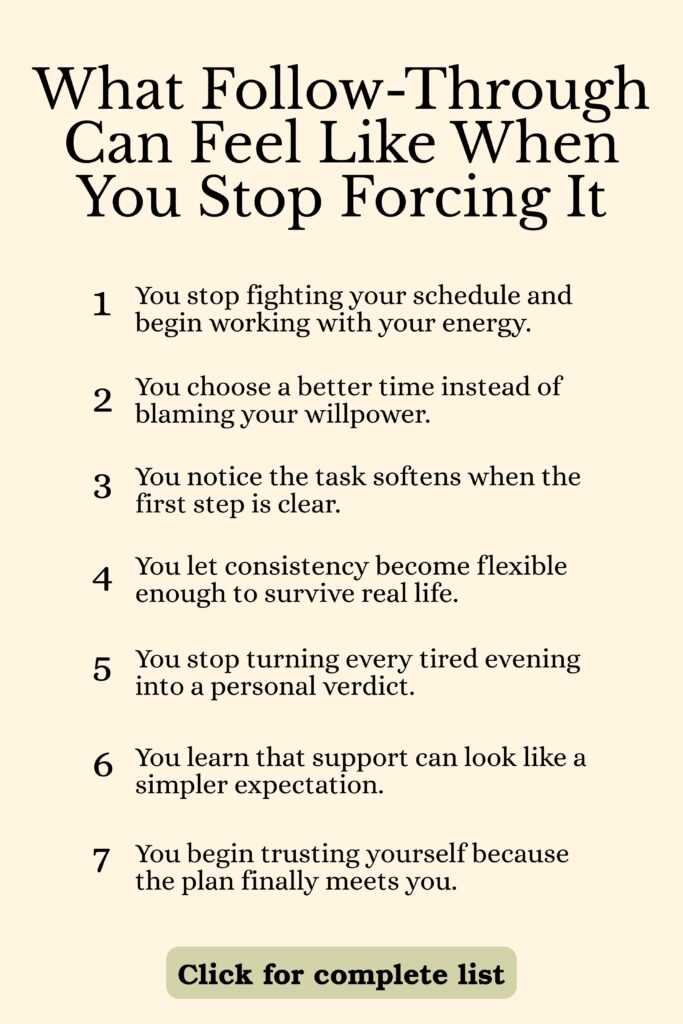


    Source link

  • How to Network When You Hate Small Talk

    How to Network When You Hate Small Talk


    Want to try this at home? No worries! Download a copy of our Coffee Chat Questions for Introverts.

    ***

    Networking can feel like one long performance when you hate small talk.

    You walk into a room, everyone seems to already know what to say, and suddenly the most basic questions feel impossible. “What do you do?” sounds too stiff. “How’s it going?” sounds too empty. “Have you been to one of these before?” sounds like something you are saying only because you cannot think of anything else.

    If that sounds familiar, the problem may not be that you are bad at networking. It may be that the usual version of networking is not built for the way you connect.

    Some people enjoy floating from person to person, keeping conversations light and quick. But if you are more depth-first, that can feel draining. You may do better when a conversation has a point, a thread, or a real reason to continue.

    This is where a different networking style helps.

    Instead of trying to become a more polished small talker, you can learn how to guide conversations toward something more useful. You can prepare better questions, listen for meaningful details, explain what you are looking for clearly, and exit conversations without feeling awkward.

    The goal is not to meet everyone in the room. It is to make a few conversations count.

    A depth-first networking style works especially well if you:

    • Hate forced chatter
    • Overthink what to say
    • Prefer one-on-one conversations
    • Want career connections but dislike “selling yourself”
    • Feel awkward asking for help
    • Want a more natural way to follow up

    This approach gives you structure without making you sound scripted. It helps you stop relying on charm and start relying on curiosity, clarity, and simple next steps.

    Need some business or career guidance? Drop on by our directories choc full of business coaches and career coaches to bring your business or career to the next level. Or click here to have us match you to the best.

    1. Redefine What Networking Is Supposed To Do

    Stop aiming to “work the room”: Choose one specific outcome before you show up, such as meeting two people in your field, learning how someone entered a role, finding one useful resource, or reconnecting with one person you already know.

    A lot of networking advice makes the whole thing sound like a numbers game. Meet as many people as possible. Hand out cards. Add everyone on LinkedIn. Keep moving.

    That is exactly why it feels awful for people who dislike small talk.

    If your brain works better in deeper conversations, “working the room” is the wrong goal. It encourages shallow interactions, rushed introductions, and that uncomfortable feeling that you are always supposed to be looking past the person in front of you.

    A better goal is to define what would make the experience useful.

    For example, before an event, you might decide:

    • “I want to learn how people move into this industry.”
    • “I want to meet one person who works in product marketing.”
    • “I want to practice explaining my career change clearly.”
    • “I want to reconnect with someone I already know.”
    • “I want to ask one person what skill helped them most.”

    This gives your networking a purpose. You are not wandering around hoping something useful happens. You are entering the room with a small mission.

    Trade quantity for quality: Give yourself permission to have fewer conversations that go deeper instead of trying to collect as many names, cards, or LinkedIn connections as possible.

    This is where depth-first networking starts to feel different.

    You might only have two good conversations at an event. That can still be a win. In fact, two thoughtful conversations are often more valuable than twelve forgettable introductions.

    A good networking conversation should help at least one of these things happen:

    • You understand someone’s work better.
    • They understand what you are exploring.
    • You learn a practical next step.
    • You discover a shared interest or goal.
    • You leave with a reason to follow up.

    Use a connection-first mindset: Treat networking as a way to understand people’s work, problems, goals, and ideas, not as a test of how socially impressive you can be.

    You do not have to impress everyone. You do not have to sound fascinating in the first five seconds.

    You only need to be clear, curious, and present enough to create a real exchange.

    That mindset shift takes some pressure off. Networking becomes less about proving yourself and more about finding useful overlap.

    Set a realistic success marker: Decide what would make the interaction “worth it” before you begin, so you are not measuring yourself against an extrovert’s version of a good networking night.

    For someone who hates small talk, success might look like staying for one hour, starting three conversations, or sending one follow-up message afterward.

    That counts. That is networking.

    2. Prepare a Simple Conversation Goal Before You Go

    Pick your main curiosity lane: Decide what you genuinely want to learn from people, such as how they got into their role, what skills helped them grow, what they wish they knew earlier, or what trends they are noticing.

    The hardest part of networking is often not the event itself. It is the blank-mind moment right before you have to speak.

    You see someone standing nearby, you know you should say something, and suddenly every possible opener feels weird. This is where preparation helps.

    Not over-preparation. Just enough structure that you are not inventing the entire conversation from scratch.

    A “curiosity lane” is the category of information you actually care about. It gives your questions a direction.

    For example, your curiosity lane might be:

    • Career paths
    • Industry trends
    • Skill-building
    • Career changes
    • Leadership lessons
    • Job search advice
    • Freelance or business growth
    • Company culture
    • Tools and systems people use

    Once you choose a lane, your questions get easier because they are connected to something real.

    Write three anchor questions: Prepare a few questions that can work in almost any setting, so you are not trying to invent something clever while already feeling awkward.

    Your anchor questions should be simple, flexible, and easy for someone else to answer.

    Good examples include:

    • “How did you get into the work you do now?”
    • “What surprised you most about this field?”
    • “What skill has helped you the most in your role?”
    • “What do you wish you knew earlier in your career?”
    • “What brought you to this event?”
    • “What kind of projects are taking most of your attention lately?”

    These are not flashy questions. That is the point.

    You want questions that feel natural, not like you memorized a list from a networking handbook.

    Match questions to the room: For a career event, use work-focused questions; for a casual meetup, use interest-focused questions; for LinkedIn networking, use questions that connect to the person’s actual experience.

    The same question does not fit every setting.

    At a conference, it makes sense to ask about someone’s work, session takeaways, or industry perspective. At a casual community meetup, it may feel better to ask what brought them there or how they first got interested in the topic.

    Online, you can be more specific because you have more context. If you are messaging someone on LinkedIn, reference their role, post, company, or career path.

    For example:

    • “I noticed you moved from teaching into UX research. I’m exploring a similar transition and would love to ask what helped you make that shift.”
    • “Your post about client onboarding stood out to me. I’m curious what made the biggest difference in your process.”
    • “I saw you’ve worked in both nonprofit and tech roles. How did those experiences compare?”

    Give yourself a fallback prompt: Keep one easy question ready for moments when your mind goes blank, such as “What brought you to this event?” or “What kind of work has been taking most of your attention lately?”

    You do not need ten perfect questions.

    You need one question that can save you when your brain freezes.

    3. Start With Context Instead Of Random Chatter

    Use the shared setting as your opener: Begin with something you both already have in common, such as the event topic, speaker, workshop, industry, company, or reason people are gathered there.

    Small talk often feels painful because it seems random. You are trying to create a conversation out of nothing.

    Context makes that easier.

    If you are at the same event, webinar, workshop, conference, coffee meetup, or online community, you already have a shared starting point. Use it.

    You do not need a clever opener. You need an obvious one that gets the conversation moving.

    For example:

    • “Have you been to this event before?”
    • “What did you think of the speaker?”
    • “Are you working in this field already, or exploring it?”
    • “What made you decide to come today?”
    • “I’m new to this group. Have you been part of it long?”

    These questions work because they are connected to the moment you are both in. They do not feel forced, and they give the other person an easy way to respond.

    Make the first question easy to answer: Avoid opening with something too intense or personal; start with a low-pressure question that lets the other person choose how much they want to share.

    Depth-first networking does not mean you start with deep questions immediately.

    That can feel too abrupt.

    The first question should open the door. The deeper question comes after there is a little trust, context, or momentum.

    For example, instead of starting with:

    • “What is your biggest career struggle right now?”

    Start with:

    • “What kind of work do you do?”
    • “How did you get into that?”
    • “What has that been like lately?”

    The third question is where depth begins. You ease into it.

    Add a small reason for asking: Make the question feel natural by attaching it to your own context, such as “I’m trying to learn more about this field, so I was curious…”

    This is one of the easiest ways to make a question feel less awkward.

    A reason gives the other person context. It also makes you sound more intentional.

    For example:

    • “I’m exploring a career change, so I’m always curious how people found their way into this field.”
    • “I’m trying to get better at understanding different roles in this industry. What does your day-to-day look like?”
    • “I’m new to these events, so I’m curious what usually brings people here.”

    That little explanation reduces the pressure. It tells the other person why you are asking and gives them a clearer way to respond.

    Move past the opener quickly: Once the conversation starts, do not stay stuck on the weather, traffic, or room logistics; use the opener as a bridge into something more useful.

    The opener is only the beginning. Do not judge the whole conversation by those first few seconds.

    Your job is not to make small talk magical. Your job is to use it as a doorway.

    4. Use Better Questions To Go Depth-First

    Ask for the story behind the role: Instead of only asking what someone does, ask how they ended up doing it, what surprised them about it, or what made them choose that direction.

    “What do you do?” is not a bad question. It is just incomplete.

    The answer usually gives you a job title, not a conversation. Someone says, “I’m a project manager,” or “I work in marketing,” and then you have to figure out where to go next.

    The better move is to ask for the story behind it.

    For example:

    • “How did you end up in that kind of work?”
    • “Was that always the plan, or did you find your way into it?”
    • “What made you choose that direction?”
    • “What surprised you about the role once you were actually in it?”

    These questions work because most careers are not perfectly linear. People usually have a story. They made a decision, took a chance, changed direction, learned something the hard way, or followed an opportunity they did not expect.

    That gives the conversation more texture.

    Look for lessons, not just facts: Questions like “What do you wish you knew earlier?” or “What helped you the most when you were starting?” invite more useful answers than simple status updates.

    If you only ask factual questions, the conversation can stay flat.

    For example:

    • “How long have you worked there?”
    • “How many people are on your team?”
    • “What software do you use?”

    These can be useful, but they rarely create much connection on their own.

    Lesson-based questions are better because they invite reflection.

    Try questions like:

    • “What do you wish more people understood about your work?”
    • “What advice would you give someone starting in this area?”
    • “What mistake do you see people make when they try to break into this field?”
    • “What helped you get more confident in that role?”
    • “What skill made the biggest difference for you?”

    These questions are still professional, but they go deeper. They let the other person share experience, not just information.

    Follow the energy in their answer: Notice which part they say with more detail, humor, frustration, or interest, then ask a follow-up about that part.

    This is where active listening starts to matter.

    If someone gives a short answer to one part but lights up about another, follow the energy. That is where the real conversation is.

    For example, if someone says, “I started in sales, then moved into operations, which was a huge learning curve,” you might ask:

    • “What made the operations shift such a learning curve?”
    • “What helped you adjust?”
    • “Did you know you wanted to move that direction?”

    You are not forcing a new topic. You are picking up the thread they already handed you.

    Avoid turning the conversation into an interview: Balance your questions with small pieces of your own context, so the exchange feels mutual instead of like you are collecting information.

    After they answer, add a small bridge.

    For example:

    • “That makes sense. I’ve been trying to understand whether I’d enjoy that kind of work, so that’s helpful.”
    • “I relate to that. I’m in a role now where I’m realizing communication matters more than I expected.”
    • “That’s interesting because I’ve been thinking about making a similar shift.”

    Depth-first networking is not interrogation. It is a thoughtful exchange.

    5. Make Active Listening Do Most Of The Work

    Reflect back the useful part: Repeat or lightly summarize what you heard, such as “So it sounds like the hardest part was getting that first client” or “It seems like the transition was more strategic than accidental.”

    If you hate small talk, active listening is one of your biggest advantages.

    You do not have to be the funniest person in the room. You do not have to carry the conversation with endless stories. You can become good at noticing what matters and helping the other person feel understood.

    That alone makes you more memorable.

    A simple reflection shows that you are not just waiting for your turn to talk.

    For example:

    • “So the biggest shift was learning how to manage stakeholders, not just the project plan.”
    • “It sounds like the role became easier once you understood the company culture.”
    • “So the hard part was not getting started, but knowing which opportunities to say yes to.”

    This kind of response does two things. It proves you listened, and it gives the other person a chance to clarify or go deeper.

    Ask one layer deeper: Use their answer to guide the next question instead of jumping to a new topic, which helps the conversation feel thoughtful and grounded.

    Most people jump too quickly.

    They ask what someone does, then where they live, then whether they liked the speaker, then what they do on weekends. The conversation keeps resetting.

    Depth-first networking works better when you stay with one thread a little longer.

    For example:

    Person: “I moved into this field after realizing I wanted more creative work.”

    You: “What helped you figure out that creativity was the missing piece?”

    That is one layer deeper.

    Person: “Honestly, I kept feeling drained in roles where I was only executing other people’s plans.”

    You: “That makes sense. Did you look for a role that was more strategic, or did you find that by accident?”

    Now you have a real conversation.

    Notice practical clues: Pay attention to names, tools, roles, companies, books, communities, or habits they mention, because these can become follow-up points later.

    Useful networking details often show up casually.

    Someone might mention:

    • A book that helped them
    • A certification they recommend
    • A community they joined
    • A person who influenced them
    • A tool their team uses
    • A mistake they would avoid
    • A company that hires beginners
    • A skill they wish they had learned sooner

    These are gold for follow-up.

    You can later say, “You mentioned that community for new UX researchers. I looked it up and it was exactly the kind of thing I needed. Thank you.”

    That is much stronger than, “Nice meeting you.”

    Let pauses breathe: You do not have to fill every quiet second; a short pause can make the conversation feel more intentional and gives the other person space to say something more real.

    A pause is not always a problem.

    Sometimes it means someone is thinking. Sometimes it means the conversation is shifting from automatic answers to more thoughtful ones.

    Let that happen.

    6. Explain Yourself Clearly Without Oversharing

    Create a one-sentence professional snapshot: Prepare a simple line that says who you are, what you are exploring, and why you are there, without launching into your full career history.

    One reason networking feels stressful is that you know people will eventually ask about you.

    “What do you do?” can feel simple until your answer is complicated. Maybe you are changing careers. Maybe you are between roles. Maybe your job title does not match what you want next. Maybe you are still figuring it out.

    That is why a professional snapshot helps.

    It gives you a short, clear answer you can use without rambling.

    A good snapshot might sound like:

    • “I’m currently in customer support, and I’m exploring project management roles because I like organizing people, timelines, and moving pieces.”
    • “I work in education, but I’m starting to learn more about instructional design and corporate training.”
    • “I’m a marketing coordinator, and I’m trying to grow into more strategy-focused work.”
    • “I’m between roles right now and using this time to learn more about companies doing work in this space.”

    The goal is not to explain everything. It is to give the other person a clear starting point.

    Keep your goal understandable: If you are networking for a job, pivot, mentor, collaboration, or industry insight, say it plainly enough that the other person knows how to place you.

    People cannot help you if they cannot understand what you are looking for.

    This does not mean you need to ask for a job immediately. In fact, you usually should not. But you can make your direction clear.

    Instead of:

    • “I’m just trying to see what’s out there.”

    Try:

    • “I’m trying to understand what entry points make sense for someone moving from operations into customer success.”

    Instead of:

    • “I’m kind of interested in marketing.”

    Try:

    • “I’m exploring content marketing roles, especially ones where writing and strategy overlap.”

    Specificity gives people something to respond to.

    Use specifics instead of vague ambition: Replace “I’m just trying to figure things out” with something clearer, such as “I’m exploring project management roles in healthcare and trying to understand what skills matter most.”

    You do not need to sound certain when you are not. You can be honest and still be clear.

    Try phrases like:

    • “I’m still narrowing it down, but I know I’m interested in…”
    • “I’m exploring a few paths, especially…”
    • “I’m trying to learn more before I make a move.”
    • “I’m not ready to apply yet, but I’m trying to understand what the role actually looks like.”

    That kind of language feels grounded. It also invites advice.

    Make your ask light and appropriate: Ask for advice, direction, or a resource before asking for a referral, introduction, or favor, especially in a first conversation.

    A light ask might be:

    • “Is there a resource you recommend for someone learning about this?”
    • “Is there a skill you would focus on first?”
    • “Would it be okay if I connected with you on LinkedIn?”
    • “Would you mind if I followed up with one question later?”

    Small asks are easier to say yes to.

    They also build trust before you ask for anything bigger.

    7. Transition Without Feeling Awkward

    Signal the close before you leave: Use a simple transition line like “I don’t want to keep you from the rest of the event, but I really appreciated hearing about this.”

    Ending a conversation can be harder than starting one.

    You may worry that leaving sounds rude. So you stay too long, the conversation fades, and then the ending feels even more awkward.

    The fix is to close while the conversation still has energy.

    A transition line gives both people an easy exit.

    Try:

    • “I don’t want to take up your whole evening, but this was really helpful.”
    • “I’m going to grab some water, but I’m glad we got to talk.”
    • “I should say hello to a few more people, but I really appreciated this conversation.”
    • “I’ll let you keep mingling, but thank you for sharing that.”
    • “I’m going to step over to the next session, but I’d love to stay connected.”

    These lines are polite, clear, and normal. You are not abandoning the person. You are simply closing the loop.

    Name the useful takeaway: Mention one specific thing you enjoyed or learned, which makes the ending feel warm instead of abrupt.

    Specificity makes an exit feel intentional.

    For example:

    • “Your point about building relationships before you need them was really helpful.”
    • “I appreciated what you said about learning stakeholder management early.”
    • “That recommendation for the community is exactly what I was looking for.”
    • “It was useful to hear how you made that transition from sales into operations.”

    This turns the ending into a moment of appreciation.

    It also makes you easier to remember.

    Ask for the next step only if it fits: If the conversation was genuinely useful, ask whether it would be okay to connect on LinkedIn or follow up with one question later.

    Not every conversation needs a follow-up. That is important.

    Sometimes a conversation is pleasant, but there is no real reason to continue. Let it be enough.

    But if there is a clear connection, ask simply:

    • “Would it be okay if I added you on LinkedIn?”
    • “Could I follow up later about the resource you mentioned?”
    • “Would you mind if I sent you one question after I look into that program?”
    • “I’d love to stay connected if you’re open to it.”

    Do not make it too heavy. You are opening a door, not asking for a commitment.

    Have an exit script ready: Prepare a few polite lines in advance so you are not trapped in conversations because you cannot think of a graceful way to leave.

    This is especially useful if you overthink.

    You can keep two or three exit lines in your back pocket and use them whenever you need to move on.

    A graceful exit is part of networking. It is not a failure.

    8. Follow Up With Something Specific

    Send the follow-up while the conversation is fresh: Reach out within a day or two, before the details fade and the connection goes cold.

    The follow-up is where a lot of networking quietly falls apart.

    You have a good conversation. You feel proud of yourself. You exchange names or connect online. Then nothing happens.

    A week passes. Then two. Suddenly it feels too late, so you do nothing.

    That is why it helps to follow up quickly.

    You do not need to write a perfect message. You only need to send something clear while the conversation is still easy to remember.

    For example:

    “Hi Maya, it was great meeting you at the career panel yesterday. I really appreciated what you shared about moving from nonprofit work into program management. Your point about learning to manage timelines before managing people gave me a lot to think about.”

    That is enough to reopen the connection.

    Reference the exact conversation: Mention the topic, resource, advice, or story you discussed so the message does not feel generic.

    A weak follow-up says:

    “Great meeting you. Let’s stay in touch.”

    That is fine, but forgettable.

    A stronger follow-up says:

    “Great meeting you at the product meetup. I appreciated your advice about building a portfolio around real business problems instead of fake case studies.”

    That reminds them who you are and why the conversation mattered.

    Specificity does the work.

    You can reference:

    • The event where you met
    • A piece of advice they gave
    • A role or career path they described
    • A resource they mentioned
    • A shared interest
    • A question you discussed
    • A next step you said you would take

    Keep the message short: A good follow-up does not need to be impressive; it just needs to be clear, appreciative, and easy to respond to.

    Do not write a giant paragraph. That can make the other person feel like they need to give an equally long reply.

    Use a simple structure:

    • Greeting
    • Where you met
    • Specific thing you appreciated
    • Light next step

    For example:

    “Hi Daniel, I enjoyed meeting you at the networking breakfast today. Your advice about talking to people in customer success before applying was really helpful. I’m going to start there this week. I’d be glad to stay connected.”

    That is warm, clear, and low-pressure.

    Offer a natural next step: Depending on the connection, ask a small follow-up question, suggest a brief coffee chat, or simply say you enjoyed the conversation and would like to stay connected.

    A next step might be:

    • “Would it be okay if I sent one question after I look into that certification?”
    • “Would you be open to a 15-minute coffee chat sometime this month?”
    • “I’ll check out the book you mentioned and report back.”
    • “I’d love to stay connected as I explore this field.”

    The smaller and more specific the next step, the easier it is for the person to say yes.

    9. Build A Repeatable Networking System

    Create a simple contact tracker: Keep a basic list of who you met, where you met them, what you discussed, and any follow-up action you promised.

    Networking becomes much easier when you stop relying on memory.

    You do not need a complicated CRM. You just need a place to record the basics before you forget them.

    This could be a spreadsheet, notes app, Notion page, paper notebook, or task manager.

    Track simple details like:

    • Name
    • Role or company
    • Where you met
    • What you talked about
    • Resource they mentioned
    • Follow-up needed
    • Date of last contact
    • Possible next step

    This helps you avoid that frustrating feeling of remembering someone was helpful but forgetting what they actually said.

    Sort contacts by next action: Separate people into categories like follow up now, reconnect later, ask for advice, potential collaborator, or useful resource.

    Not every contact needs the same treatment.

    Some people are immediate follow-ups. Others are people you may reconnect with later. Some are simply useful to remember because they mentioned a resource, company, or path you want to research.

    You might use categories like:

    • Follow Up This Week
    • Reconnect Later
    • Possible Mentor
    • Industry Insight
    • Job Search Lead
    • Collaboration Potential
    • Resource Mentioned

    This gives your networking structure. Instead of staring at a list of names, you know what to do next.

    Schedule small networking blocks: Set aside short, recurring time for follow-ups, LinkedIn messages, coffee chat requests, and relationship maintenance.

    Networking does not have to be a huge event.

    In fact, it works better when it becomes a small habit.

    You might schedule:

    • 20 minutes every Friday to send follow-ups
    • One LinkedIn message per week
    • One coffee chat per month
    • One event per quarter
    • A monthly check-in with former coworkers

    Small, consistent actions are less overwhelming than trying to suddenly network intensely when you need a job.

    Review what is working: After each event or outreach session, note which questions felt natural, which openers worked, and where you got stuck.

    This is how you improve.

    After a networking experience, ask yourself:

    • Which question got the best response?
    • Where did I feel most awkward?
    • What did I learn?
    • Who should I follow up with?
    • What would I do differently next time?

    Do not use this as a way to criticize yourself. Use it as feedback.

    You are building a skill.

    10. How A Career Coach Can Help You Network With More Direction

    Clarify your networking goal: A career coach can help you figure out whether you are networking for job leads, career clarity, industry research, confidence, referrals, or long-term relationship building.

    Networking feels harder when your goal is vague.

    If you are telling yourself, “I should network,” that is not specific enough to act on. It creates pressure, but no clear next step.

    A coach can help you turn that vague pressure into a focused plan.

    For example, you may realize you are not actually ready to ask for referrals yet. What you need first is industry research. Or you may discover that you are not lacking connections, but you are unclear about how to explain your career direction.

    A coach can help you name the real issue.

    That might be:

    • You do not know who to reach out to.
    • You are not sure what to say.
    • You are afraid of seeming needy.
    • You struggle to explain your value.
    • You overthink follow-ups.
    • You avoid networking until things feel urgent.

    Once you know the actual problem, you can solve it more directly.

    Practice your conversation scripts: A coach can help you refine your self-introduction, follow-up messages, and transition lines so they sound natural instead of stiff.

    Scripts can be helpful, but only if they sound like you.

    A coach can help you create language for:

    • Introducing yourself
    • Explaining a career pivot
    • Asking for advice
    • Requesting an informational chat
    • Following up after an event
    • Reconnecting with an old contact
    • Ending conversations politely

    The point is not to memorize every word. The point is to have a structure you trust.

    That way, when nerves hit, you are not starting from zero.

    Identify your overthinking patterns: If you tend to spiral before reaching out, second-guess what to say, or avoid events entirely, a coach can help turn vague fear into specific actions.

    Overthinking often sounds like:

    • “What if they think I’m annoying?”
    • “What if I ask a stupid question?”
    • “What if I have nothing to offer?”
    • “What if they do not reply?”
    • “What if I sound desperate?”

    A coach can help you separate real strategy from fear.

    For example, “I need to make a clear ask” is strategy. “Everyone will judge me” is fear.

    That difference matters.

    Create accountability after the event: Instead of leaving networking to mood or motivation, a coach can help you build a realistic follow-up plan and actually use it.

    Many people do the hardest part, then lose the value afterward.

    They attend the event, meet people, have good conversations, then never follow up.

    A coach can help you turn the experience into momentum.

    11. Common Mistakes That Make Networking Feel Worse

    Trying to sound more impressive than you feel: Over-polishing your introduction can make you more nervous and less relatable, so aim for clear and human instead.

    When you feel insecure, it is tempting to compensate by sounding more impressive.

    You may over-explain your experience, use jargon, list every project you have touched, or try to make your career path sound more intentional than it was.

    But that can create more pressure.

    The other person does not need your full resume. They need enough context to understand who you are and what kind of conversation would be useful.

    Clear usually beats impressive.

    For example, this is stronger:

    “I’m in operations now, and I’m exploring project management because I enjoy building systems and keeping teams organized.”

    Than this:

    “I have a cross-functional background with exposure to operations, communication, stakeholder alignment, process improvement, and strategic execution.”

    The second one may sound polished, but the first one is easier to connect with.

    Asking questions you do not care about: Generic questions lead to generic answers; choose questions that you would actually want to hear the answer to.

    People can feel when a question is just filler.

    If you do not care about the answer, it will be hard to follow up naturally. This is how conversations become stiff.

    Choose questions that genuinely interest you.

    If you are curious about career changes, ask about transitions. If you are curious about confidence, ask what helped someone feel more capable. If you are curious about leadership, ask what changed when they first started managing people.

    Better questions make you a better listener.

    Waiting until you need something: Networking feels more pressured when you only do it during a job search, career crisis, or urgent transition.

    This is one of the biggest reasons networking feels uncomfortable.

    If you only reach out when you need a referral, job lead, client, or favor, every message feels loaded.

    The better approach is to build relationships before you urgently need them.

    That could mean:

    • Congratulating someone on a new role
    • Commenting thoughtfully on a post
    • Sharing a useful resource
    • Checking in with a former coworker
    • Asking for perspective before you apply
    • Staying lightly connected over time

    This makes networking feel more human and less transactional.

    Treating silence as failure: Some conversations will be short, flat, or forgettable, and that does not mean you are bad at networking.

    Not every interaction will turn into something.

    Some people will be distracted. Some will not click with you. Some will forget to reply. Some conversations will simply end.

    That is normal.

    Your job is not to make every conversation meaningful. Your job is to practice creating the conditions where meaningful conversations can happen.

    A Better Way To Think About Networking

    You do not have to become the person who loves small talk.

    You do not have to float around the room with perfect confidence. You do not have to charm strangers instantly. You do not have to collect as many contacts as possible or pretend every conversation feels natural.

    You can network in a way that fits how you actually connect.

    Depth-first networking is built around a different idea: better conversations beat more conversations.

    Instead of forcing yourself through endless surface-level chatter, you prepare a few thoughtful questions. You listen carefully. You explain your direction clearly. You ask for small next steps when they make sense. Then you follow up in a way that feels specific and human.

    That is a real networking skill.

    It may not look loud from the outside. It may not look like the classic image of someone confidently shaking hands with everyone in the room. But it works because it is based on attention, clarity, and follow-through.

    If networking has always made you uncomfortable, start smaller.

    Choose one event. One person. One question. One follow-up.

    Let that count.

    Then build from there.

    The goal is not to become someone else. The goal is to make career connection feel less like performance and more like a skill you can practice, repeat, and trust.

    ***

    Want to try this at home? No worries! Download a copy of our Coffee Chat Questions for Introverts.

    Need some business or career guidance? Drop on by our directories choc full of business coaches and career coaches to bring your business or career to the next level. Or click here to have us match you to the best.

    The post How to Network When You Hate Small Talk appeared first on Life Coach Hub.
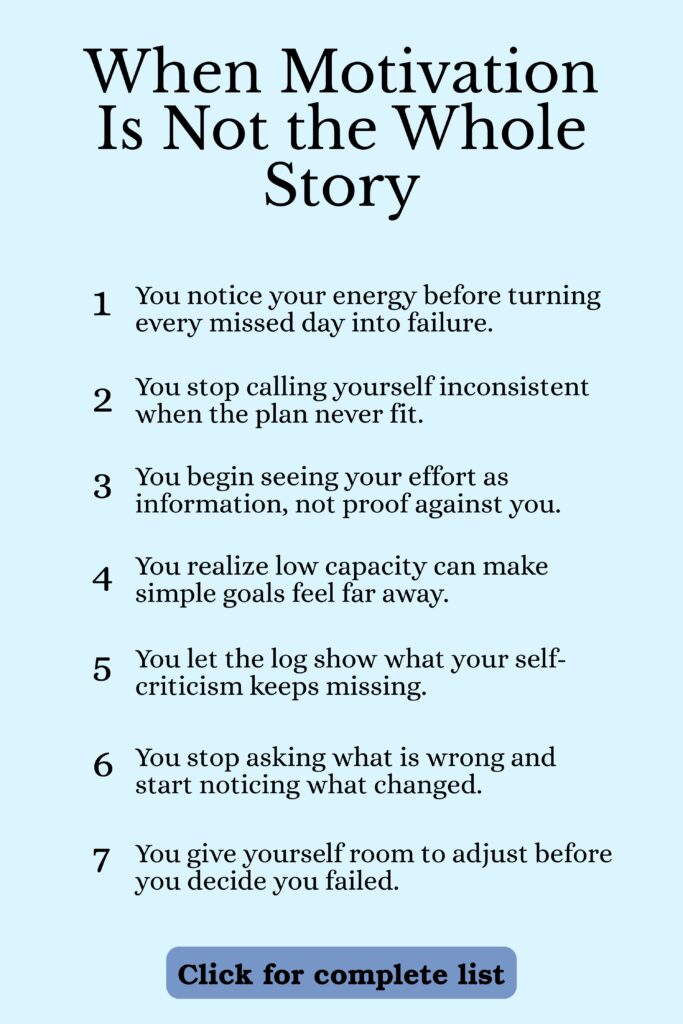


    Source link