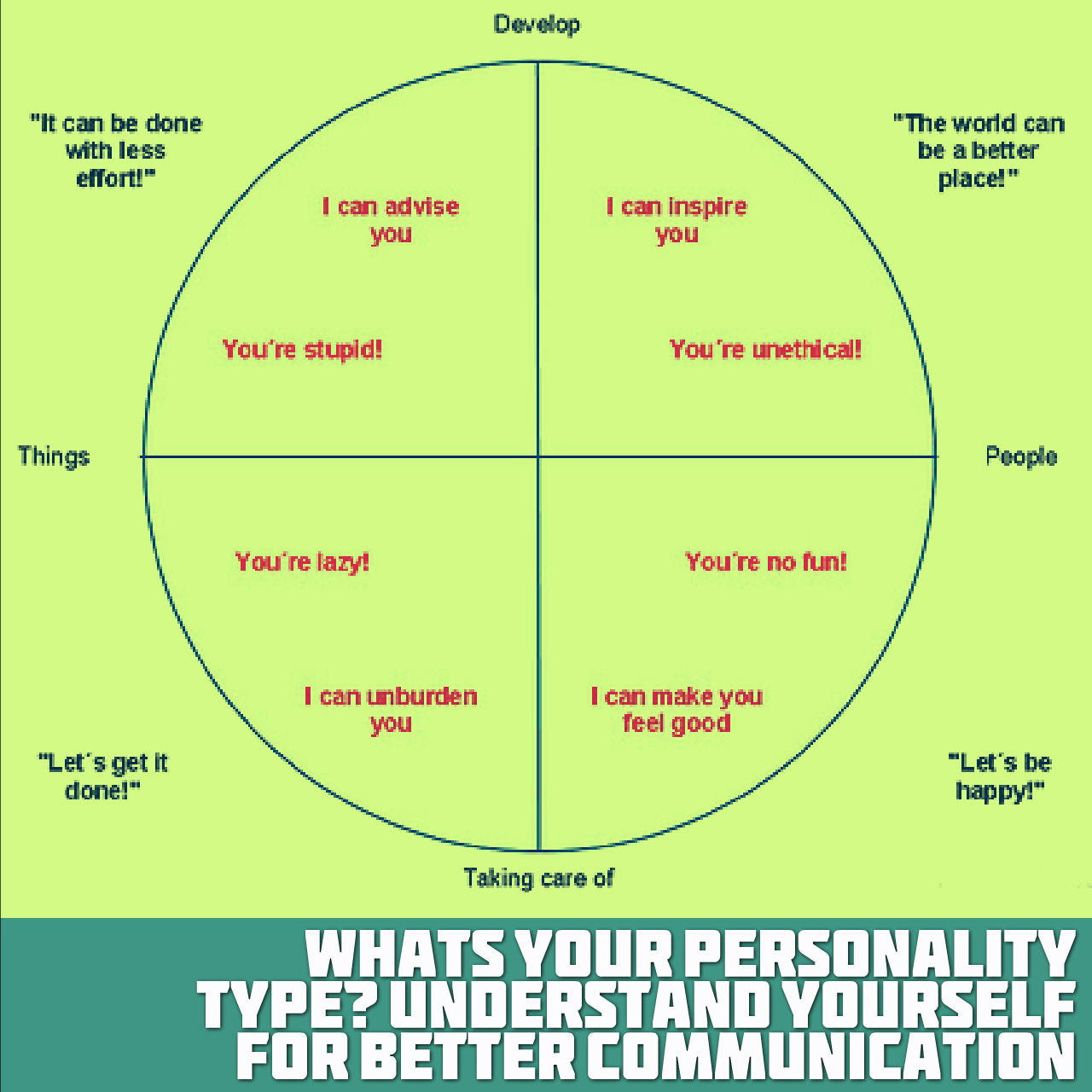

The basic ingredients of a personality can be put together to create a full representation of an individual.
How your communication is received is just as important as what you are saying. Understanding your personality will assist you in communicating better.
We all have the capacity to build our interpersonal communication skills. A great mirror for the self is to understand your own personality type, and how you come off to others. Only then can you learn how to interact most effectively with the other personality types.
Why understand your personality type?
Personality type has been studied for thousands of years. Roots of Western personality development begin with Hippocrates (ca. 460 BC – ca. 370 BC) who divided individuals into four groups based on fluid volumes in the body:
- Phlegmatic
- Melancholic
- Sanguine
- Choleric
Understanding your personality type will assist you in understanding your motivations, and why others are not always on the same page. The insight into why others act the way they do gives you an edge in all situations.

Personality dimensions
Personality Dimensions is the best personality assessment to begin with, as it divides all people into four different colours:
- Inquiring Green
- Organized Gold
- Authentic Blue
- Resourceful Orange
We are all a blend of the four colours; however, we all have a preference that dictates our communication style. These four designations relate to the four used by Hippocrates, but with a modern perspective. Personality Dimensions is completed with an assessment using cards and questionnaire.
Myers-Briggs Type Indicator (MBTI)
The Myers-Briggs Type Indicator (MBTI) divides the population into sixteen different personality types. These sixteen personality types further expand the four personality dimensions groups into four groups of four, though with different verbiage.
If you want to get more from your life, and are looking for concrete action steps to get you there, check out our
Request a Coach page. It’s a “cut the fence-sitting and take action” way to tackle your issues and actually find success.
To get off the fence and start to take action,
click or tap here.
The indicators used to define type are:
- Introversion vs. Extraversion
- Intuition vs. Sensing
- Thinking vs. Feeling
- Perceiving vs. Judging
A fundamental understanding of personality types is beneficial when understanding the MBTI results. A previous assessment in Personality Dimensions is useful if you do not have education in fundamental psychology principles.
Enneagram
The Enneagram is built from another ancient symbolic system. The Enneagram has nine personality types that do not map to Personality Dimensions or MBTI as easily as those two work with each other.
The nine personalities found in the Enneagram are:
- The Reformer
- The Helper
- The Achiever
- The Individualist
- The Investigator
- The Loyalist
- The Enthusiast
- The Challenger
- The Peacemaker.
These nine represent the strengths and challenges of the assessed. For example, The Investigator may be great at solving issues in the office. The downside for this type is that they are always uncovering problems that need to be solved. If The Investigator can not learn to hold back their opinions some of the time, they distance themselves from others.
Once you have a framework
Use the understanding of personality to assess the individuals around you. You will make mistakes to learn from. Look at members of your family and match them to personality types. You may find that it was your lack of understanding of others that caused conflict, and that it was your expectations of others that were the issue. Promote better communication strategies for better communication and relationships.
Understanding yourself is the first step in better communication. Gaining insight into your own intrinsic needs and values, and how the needs and values of others are different, not wrong. Work with a coach trained in personality assessment to help guide you in this process.
Where personality models actually help (and where they don’t)
Personality models are best at explaining communication preferences, not competence, values, or intent.
They tell you how someone is likely to process information, not why they care or whether they are right.
If you want to get more from your life, and are looking for concrete action steps to get you there, check out our
Request a Coach page. It’s a “cut the fence-sitting and take action” way to tackle your issues and actually find success.
To get off the fence and start to take action,
click or tap here.
A common failure point is using a label as an explanation.
“He’s a Thinking type” becomes a reason to tolerate bluntness instead of addressing its impact.
In practice, the useful move is narrower.
You notice patterns in how someone asks questions, reacts to detail, or responds under pressure. Then you adjust your delivery.
A communication coach will often slow this process down.
Noticing behavior first. Naming preference second. Deciding what to do differently last.
Translating Personality Dimensions into real communication choices
The four Personality Dimensions colors show up most clearly in pace, detail, and framing.
- Inquiring Green wants logic first. Data, reasons, trade-offs.
- Organized Gold wants structure. Steps, timelines, clear ownership.
- Authentic Blue wants meaning. How this affects people and relationships.
- Resourceful Orange wants movement. Options, flexibility, quick wins.
Picture giving feedback at work.
A Gold type may shut down if you speak in broad strokes. An Orange type may disengage if you over-specify.
The adjustment is concrete.
You change the order of information, not the message itself.
In coaching sessions, this often turns into practice.
Same feedback, delivered four ways, until you feel the difference land.
MBTI preferences in live conversations
MBTI preferences are easiest to spot mid-conversation, not on a test result.
If you want to get more from your life, and are looking for concrete action steps to get you there, check out our
Request a Coach page. It’s a “cut the fence-sitting and take action” way to tackle your issues and actually find success.
To get off the fence and start to take action,
click or tap here.
- Introversion vs Extraversion shows up in thinking time. Some people need silence before they answer.
- Sensing vs Intuition shows up in focus. Details versus patterns.
- Thinking vs Feeling shows up in decision language. Logic versus impact.
- Judging vs Perceiving shows up in closure. Decisions versus options.
A classic breakdown happens in meetings.
An intuitive speaker jumps to the future. A sensing listener is still trying to understand the current facts.
The fix is behavioral.
You pause and anchor the idea in something concrete before moving on.
Career and leadership coaches often work on this exact skill.
Not changing personality. Changing timing and translation.
When different models describe the same person differently
It’s common for one model to describe someone as analytical and another to describe them as relational.
That’s not a contradiction. It’s a difference in lens.
Personality Dimensions highlights communication style.
MBTI highlights cognitive preferences.
The Enneagram highlights motivation under stress.
So someone might speak logically, prefer structure, and still react emotionally when their core concern is triggered.
The mistake is trying to reconcile the models into a single identity.
The useful move is asking which lens explains the current behavior.
Coaches often help clients stop chasing the “right” type and start using the right tool for the situation in front of them.
If you want to get more from your life, and are looking for concrete action steps to get you there, check out our
Request a Coach page. It’s a “cut the fence-sitting and take action” way to tackle your issues and actually find success.
To get off the fence and start to take action,
click or tap here.
Enneagram patterns that drive communication breakdowns
The Enneagram shows up most clearly when communication goes sideways.
An Investigator may flood a conversation with problems without noticing the relational cost.
A Challenger may push for clarity and create fear instead.
A Peacemaker may agree outwardly and disengage later.
These are not wording problems.
They are motivation problems surfacing through communication.
You can hear it in what gets emphasized, avoided, or repeated.
Relationship and leadership coaches often work here.
Spotting triggers. Naming patterns. Practicing new responses before the next blow-up.
Predictable breakdowns between common type pairings
Some clashes repeat with boring consistency.
Thinking-oriented speakers may sound cold to Feeling-oriented listeners.
Fast-moving Oranges may frustrate methodical Golds.
Big-picture Intuitives may overwhelm detail-driven Sensors.
The damage usually comes from misinterpretation.
One side hears resistance. The other hears recklessness.
If you want to get more from your life, and are looking for concrete action steps to get you there, check out our
Request a Coach page. It’s a “cut the fence-sitting and take action” way to tackle your issues and actually find success.
To get off the fence and start to take action,
click or tap here.
The fix is expectation management.
You stop expecting alignment and start planning translation.
In mediation-style coaching, this often becomes explicit.
Who needs what first. Who needs reassurance. Who needs permission to slow down or speed up.
From awareness to skill
Knowing a personality framework changes very little on its own.
Behavior changes outcomes.
You notice when you interrupt.
You change how you give feedback.
You stop assuming silence means agreement.
That’s where coaching earns its keep.
Practice, feedback, accountability.
Insight points you in the right direction.
Skill is what actually improves communication.
If you want to get more from your life, and are looking for concrete action steps to get you there, check out our
Request a Coach page. It’s a “cut the fence-sitting and take action” way to tackle your issues and actually find success.
To get off the fence and start to take action,
click or tap here.
Leave a Reply