Want to try this at home? No worries! Download a copy of our SMART Goals PDF Worksheet.
*****
Some days don’t fall apart all at once. They unravel slowly.
You finish one task, jump into another, answer a message, remember something else you forgot, and suddenly your brain feels crowded. Even if you’re technically getting things done, it starts to feel scattered.
That’s the hidden problem with task switching.
Your brain never fully closes the last task before opening the next one. The mental tabs stay open, the environment gets cluttered, and your attention gets stretched thin.
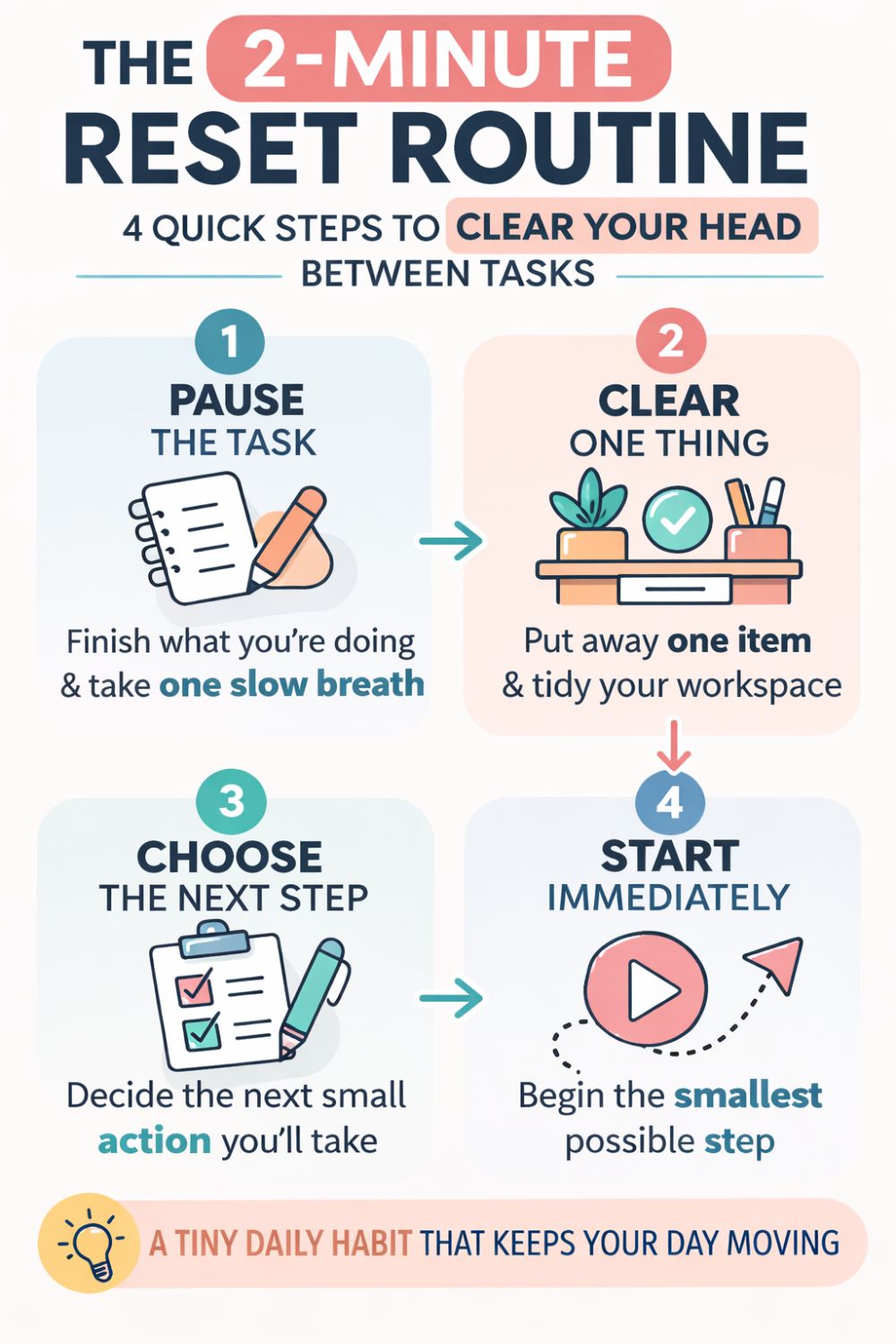
The Two-Minute Reset is a tiny routine that solves this problem.
It’s a short pause you take between tasks to clear space, reset your focus, and begin the next activity with intention. It doesn’t require planning, apps, or a complicated system.
It simply creates a small boundary between one activity and the next.
This matters because small routines are the foundation of daily habits. They create structure without requiring huge amounts of motivation.
Instead of pushing through distraction or chaos, you create a moment of order.
The Two-Minute Reset is also one of the easiest habits for a better life because it fits anywhere. You can use it between work sessions, household chores, creative projects, or even errands.
The routine takes about two minutes, but the effect is larger than it sounds.
You stop carrying the weight of the previous task into the next one.
Over time, these tiny resets become daily habits to improve your life because they help your day feel more intentional and less overwhelming.
And the best part is that it only takes a few small steps.
Need some in depth help with goal settings, motivation or productivity ? Drop on by our directories choc full of productivity coaches, accountability coaches, and goal-setting coaches, and start reaching those goals! Or click here to have us match you to the best.

Step 1: Clear the Physical and Mental Space
The first part of the Two-Minute Reset focuses on clearing the environment around you.
When your space feels cluttered, your brain treats those unfinished details like open loops. Even if you try to ignore them, your attention keeps drifting back.
That’s why the reset begins with a quick physical reset.
Stand up and shift your body: If you’ve been sitting or focused on a task for a while, simply standing up changes your mental state. Roll your shoulders, stretch your arms, or take a small step away from your workspace.
This signals that the previous task is finished.
Clear one small piece of your environment: Don’t aim for a full cleanup. Instead, choose one tiny action like stacking papers, putting away a tool, or moving a dish to the sink.
One small act of order is enough.

Close or organize what you were using: If you were working on a computer, close unnecessary tabs or save your file. If you were cooking or cleaning, wipe the counter or return one item to its place.
This creates closure.
Take one slow breath before continuing: After clearing a small part of your space, pause for a single deep breath. This helps your nervous system slow down before you move forward.
These steps may sound small, but they create a psychological shift.
Instead of rushing into the next task while still carrying mental clutter, you create a clean starting point.
Practicing this regularly strengthens daily habits that support focus and calm transitions.
And over time, this tiny ritual becomes one of those daily habits to improve your life that quietly keeps your day organized.
Step 2: Reset Your Attention Before Starting the Next Task

Once your space is cleared, the second step of the Two-Minute Reset focuses on your attention.
Many people start the next task automatically, without deciding what they’re actually doing. This leads to wandering focus and procrastination.
A brief attention reset solves that.
Decide what the next task is: Instead of thinking vaguely about what comes next, name the action clearly. For example, “write one paragraph,” “reply to two messages,” or “start folding the laundry.”
Clarity reduces hesitation.
Choose the smallest starting point: Large tasks can feel heavy when you’re tired. Instead of focusing on the entire job, focus on the first tiny step.
Opening the document, laying out materials, or gathering supplies is enough.
Create a starting cue: A cue can be anything simple—a timer, a sip of water, or adjusting your chair. When repeated often, this cue becomes a signal that it’s time to begin again.

Start before motivation appears: Motivation often follows action, not the other way around. By starting the smallest step immediately, you bypass the resistance that delays progress.
This moment of focus helps you move forward with purpose.
Instead of drifting through your day, you choose the next action intentionally.
That’s why the Two-Minute Reset supports habits for a better life. It replaces scattered effort with deliberate attention.
When repeated regularly, this small transition becomes one of the most reliable daily habits you can build.
And over time, it becomes a powerful example of daily habits to improve your life because it keeps your day moving forward smoothly.
Step 3: Build the Two-Minute Reset Into Your Day

The real strength of the Two-Minute Reset appears when it becomes a consistent routine.
Instead of using it occasionally, you begin using it between many of your daily activities. Each reset becomes a small checkpoint that keeps your day organized.
Attach the reset to natural transitions: The best way to build the habit is by linking it to moments that already exist. Finishing a work session, completing a chore, or closing your laptop are perfect triggers.
The reset becomes the bridge between tasks.
Keep the routine extremely simple: The entire reset should remain small enough that you never resist it. Stand up, clear one thing, take a breath, and choose the next task.
That’s enough.
Use the same order every time: Repeating the same sequence trains your brain to recognize the routine automatically. Over time, you won’t need to think about it.
The pattern becomes familiar.

Practice it on both calm and busy days: Habits grow through repetition. Even when your day feels easy, running the reset keeps the routine strong.
Eventually, it becomes second nature.
When practiced regularly, this routine strengthens daily habits that support consistency.
Instead of relying on bursts of motivation, you rely on simple systems.
This is exactly how habits for a better life develop. They’re not dramatic changes.
They’re small patterns that make your day run more smoothly.
And the Two-Minute Reset is one of the easiest daily habits to improve your life because it fits naturally into the flow of everyday activities.
Step 4: Turn Tiny Resets Into a Consistency System

The final step is recognizing how powerful these small resets become over time.
One Two-Minute Reset might seem insignificant. But several resets throughout the day create a rhythm that keeps you steady and focused.
Use resets as boundaries between tasks: Instead of letting your day blend into a blur of activity, each reset creates a clear ending and a clear beginning.
This helps your brain transition smoothly.
Prevent tasks from stacking mentally: Many people feel overwhelmed because unfinished tasks pile up in their mind. The reset closes one mental loop before opening another.
That sense of closure reduces stress.
Protect your energy on low-motivation days: When you’re tired, complicated systems fall apart. But the Two-Minute Reset still works because it requires almost no effort.
Standing, clearing one item, and choosing the next step is manageable even on slow days.
Notice the compound effect: Five or ten resets in a single day create multiple moments of clarity. Instead of drifting through tasks, you move through the day with small intentional pauses.
That rhythm adds up.

This is why routines like the Two-Minute Reset become powerful daily habits.
They don’t require perfect discipline. They simply create structure where chaos might otherwise appear.
Over time, these small transitions build habits for a better life because they keep your day calm, focused, and intentional.
And that’s exactly how the simplest daily habits to improve your life begin—with one small reset at a time.
Want to try this at home? No worries! Download a copy of our SMART Goals PDF Worksheet.
*****
Need some in depth help with goal settings, motivation or productivity ? Drop on by our directories choc full of productivity coaches, accountability coaches, and goal-setting coaches, and start reaching those goals! Or click here to have us match you to the best.
The post Two-Minute Reset: The Tiny Routine That Helps You Regain Control Between Tasks appeared first on Life Coach Hub.
Leave a Reply