Most productivity systems revolve around what still needs to be done.
You make a to-do list in the morning, cross off a few tasks, and by the end of the day the list still looks unfinished. Even when you’ve been busy all day, it can feel like you didn’t accomplish enough.
That feeling slowly drains motivation.
A Done List solves this problem by flipping the focus. Instead of tracking what remains unfinished, you record what you actually completed. Every action—big or small—becomes visible proof that you’re moving forward.
This approach changes how you experience your workday.
Instead of ending the day focused on what’s missing, you see evidence of progress. Small actions add up. Momentum becomes visible. Motivation grows naturally.
The best part is how simple the system is.
A Done List takes about five minutes to maintain. There’s no complicated planning system, no elaborate productivity framework, and no pressure to structure your entire day.
You simply capture what you finished.
Over time, this small shift can make a surprising difference in how productive you feel and how consistently you show up for your goals.
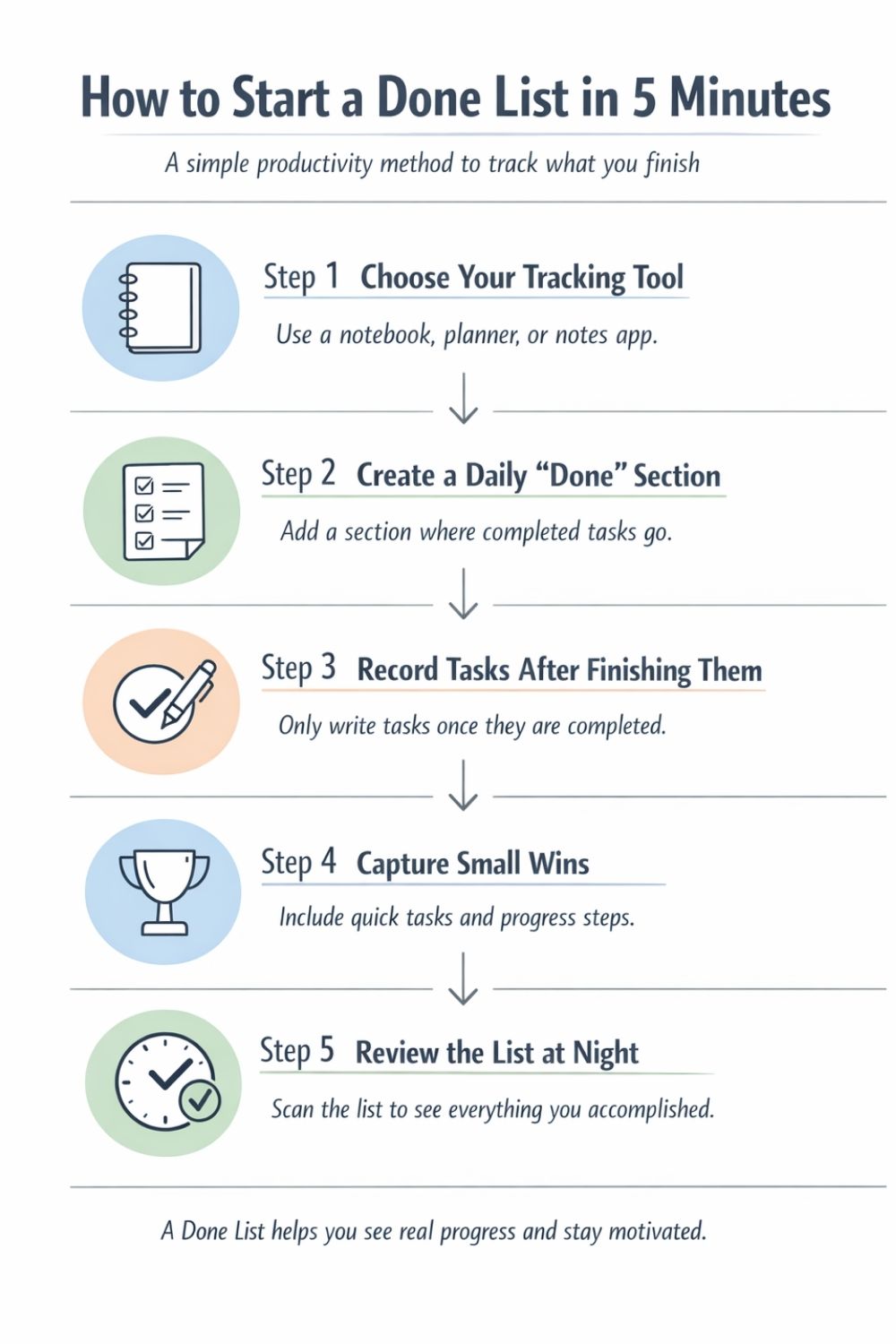
Start a Simple Done List System

The strength of the Done List comes from its simplicity. If the system is too complicated, you’ll eventually stop using it.
The goal is to create something you can maintain every day, even when your energy is low.
Choose a simple place to track it:
Use something you already open regularly. A notebook, planner, notes app, or digital document all work well. The easier it is to access, the more likely you are to maintain the habit.
Create a clear daily section:
At the start of each day, write the date and leave space beneath it. This becomes the area where you’ll record completed tasks throughout the day.
Write tasks down after finishing them:
The Done List works best when entries are recorded only after the action is complete. This prevents the list from turning into another to-do list.

Include both big and small actions:
Finishing a project matters, but so does sending an email, organizing a file, or making a quick phone call. Small actions often move work forward more than we realize.
Keep entries short and specific:
Write tasks clearly so they represent a real action. For example: “Finished client presentation,” “Scheduled meeting,” or “Updated spreadsheet.”
By the end of the day, you’ll have a visible record of your progress.
Even on slower days, the list often reveals that you accomplished far more than you initially thought.
Capture Momentum Throughout the Day

The Done List becomes most powerful when it’s updated throughout the day.
Instead of waiting until the evening, record actions as they happen. This helps reinforce the feeling of progress while you’re still working.
Momentum builds faster when it’s visible.
Write tasks immediately after completing them:
When you finish something, pause for a moment and add it to your list. This small pause reinforces the habit of recognizing progress.
Break larger tasks into visible steps:
Instead of writing something vague like “worked on report,” capture the specific actions. You might list “researched data,” “wrote outline,” and “edited introduction.”
This makes progress easier to see.
Add unexpected tasks you handled:
Many productive actions happen outside your planned schedule. Helping a coworker, fixing a small problem, or responding to an urgent request all count.
Recording them helps your list reflect reality.
Track effort-based work as well:
Some work doesn’t produce immediate results. Brainstorming ideas, researching options, or preparing materials still represent forward movement.
These steps deserve a place on the list.
Let the list grow naturally:
There’s no correct number of entries. Some days might have five items, while others may have twenty.
What matters is that each entry represents a completed action.
Over time, the Done List helps you realize that progress happens in small pieces, not just big milestones.
Use the Done List to Build Motivation

The Done List changes the way your brain interprets productivity.
Instead of focusing on unfinished tasks, it trains you to notice what you’ve accomplished. This small shift has a powerful effect on motivation.
Progress becomes visible.
Review your list at the end of the day:
Take one minute to scan everything you completed. This quick reflection helps close the day with a sense of accomplishment.
Highlight meaningful progress:
Some actions directly support your bigger goals. Circle or mark those entries so they stand out.
Seeing them reinforces that your daily effort matters.

Notice how much you actually handled:
Many people underestimate their productivity because they forget small actions. The Done List captures these moments and shows the full picture.
Celebrate consistency, not perfection:
Some days will be extremely productive while others will be slower. What matters most is that you continue showing up.
Small consistent actions build long-term progress.
Move unfinished tasks forward calmly:
If something remains incomplete, simply move it to your next to-do list. Your Done List ensures the day still feels productive.
Over time, this habit strengthens motivation because you see proof of progress every single day.
Turn Your Done List Into a Weekly Motivation Log

A daily Done List is helpful on its own, but reviewing several days together can reveal even more insight.
At the end of the week, spend a few minutes scanning your previous lists.
Patterns quickly begin to appear.
Review everything you completed during the week:
When you look at five or six days together, the amount of work becomes much more visible. Small daily actions accumulate into meaningful progress.
Group related accomplishments together:
You might notice categories like planning tasks, communication work, creative work, or administrative tasks. These clusters reveal how your time is actually being used.

Identify progress toward bigger goals:
Circle tasks that directly contributed to major projects or personal goals. This shows how daily effort supports long-term progress.
Look for productivity patterns:
You may notice that certain days are naturally more productive. Others might contain more interruptions.
These patterns help you plan your schedule more effectively.
Use the insights to guide the next week:
Instead of guessing where to focus your energy, let your Done List show you what’s already working.
This weekly reflection turns the Done List into more than just a tracking tool. It becomes a record of consistent effort and growth.
Use the Done List on Low-Energy Days

Some days motivation is strong. Other days it’s difficult just to get started.
The Done List works especially well during low-energy periods because it encourages small actions instead of perfection.
Progress stays possible even on difficult days.
Start with the smallest possible task:
Choose something that takes only a few minutes. Reply to one email, organize a document, or review a short note.
Completing one task often breaks the feeling of inertia.
Write down every completed action:
Even tiny accomplishments deserve a place on the list. Recording them reinforces the idea that effort counts.
Small wins build momentum.
Focus on movement rather than perfection:
Low-energy days are not about maximum productivity. They’re about keeping the habit of progress alive.
Small steps still move your goals forward.
Let the list motivate the next step:
Once you see a few completed tasks on the page, it often becomes easier to add another.
Momentum grows naturally.
End the day with visible proof of effort:
Even if the day felt slow, the Done List shows that you kept moving forward.
That simple reminder can make it easier to begin again tomorrow.
The post The Done List: A Simple Way to Build Motivation by Tracking What You Finished appeared first on Life Coach Hub.
Leave a Reply