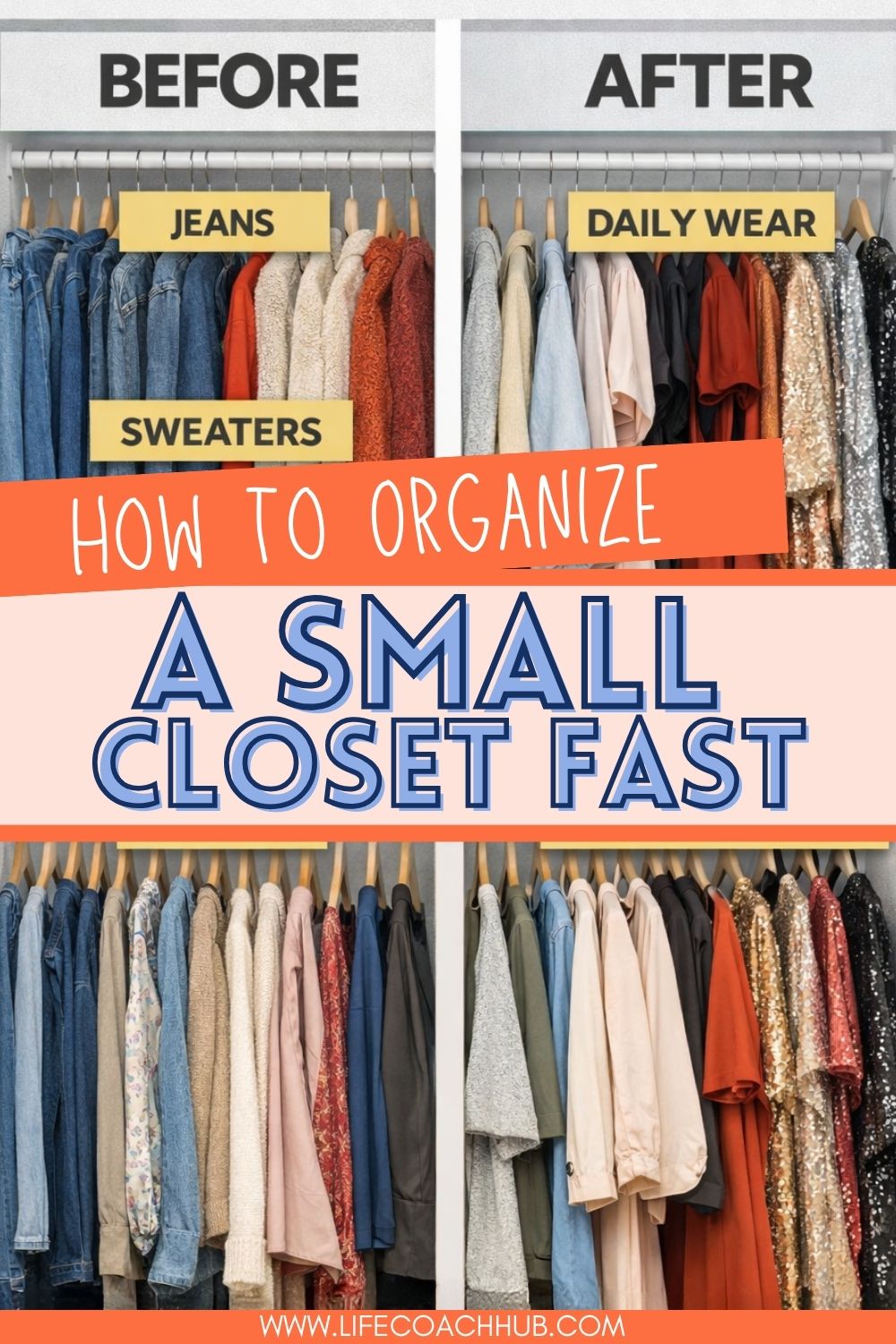

Most people organize a small closet by type: all jeans together, all dresses together, all sweaters in one section. It looks neat at first. But it doesn’t match how you actually get dressed.
If your mornings still feel chaotic even though your closet is technically “organized,” the issue might not be space. It might be your system.
Instead of sorting by clothing type, try organizing by clothing category based on real-life use. This small shift makes a tight closet feel bigger, more functional, and much easier to maintain.
1. Start With How You Actually Get Dressed

Before you move a single hanger, pause and think about your real routine. The goal isn’t a showroom closet. The goal is faster decisions and less friction.
Identify your daily-wear category: Look at what you realistically wear 70–80% of the time. This might include work-from-home outfits, school drop-off basics, errand clothes, or casual staples. Pull these items out and group them together physically so you can see your true “everyday uniform.”
Once you see this pile, you’ll notice patterns. Similar silhouettes. Repeat pieces. Colors you reach for constantly. That’s your primary zone.
Define your occasional category: Now identify what you wear only for specific plans — formalwear, event dresses, travel outfits, seasonal coats, or special pieces. Gather these separately so they’re clearly distinct from your daily rotation.
You’re creating two major clothing categories:
- Daily Wear
- Occasion Wear
This is the foundation of the entire system.
2. Physically Divide the Closet Into Zones

Are you all about style, decor and organization? Download a copy of our Decluttering Workbook.
*****
Now that you’ve identified your categories, it’s time to restructure the space.
Assign one side of the closet to daily wear: Use the most accessible section — eye-level rod space or the side closest to the door. Hang only your daily-wear items here. Leave slight spacing between pieces so you can see each one clearly without crowding.
This becomes your “grab-and-go” zone.
Move occasional wear to a secondary zone: Place special-occasion items on the opposite side, higher shelf, or back rod. Keep them visible but not dominant. If they overwhelm your daily area, they create unnecessary visual noise.
When your closet is divided by use, not type, your brain processes it faster. You stop scanning through gowns when you just need a sweatshirt.
Need some in depth help with organization and productivity ? Drop on by our directories choc full of productivity coaches, minimalist coaches, and work/life balance coaches to get your life organized! Or click here to have us match you to the best.
3. Lightly Sub-Sort Within Each Category

Once your two main zones are set, you can organize within them — but gently. The purpose isn’t perfection. It’s clarity.
Group similar items inside each zone: In your daily-wear section, you can cluster tees together, jeans together, and cardigans together. Do the same inside your occasion zone with dresses, blazers, or coats.
The key is that these mini-groups stay inside their category. You’re not mixing daily tees with formal tops anymore.
Use consistent hangers and spacing: Matching slim hangers instantly reduce bulk and make items align visually. Keep small gaps between pieces instead of packing everything tightly together. Breathing room makes a small closet feel intentional instead of stuffed.
Remember: this is still a small closet. Your organization must support movement and visibility.
4. Remove the “In-Between” Items

The biggest clutter culprit in small closets is the “maybe” piece — the item that isn’t daily but isn’t truly occasional either.
Decide which category each piece supports: If you haven’t worn something in 30–60 days and it doesn’t clearly belong to a specific event category, it may not deserve prime space. Choose its zone intentionally or remove it entirely.
Avoid letting these in-between pieces live in your daily section. They crowd the area and slow down decisions.
Edit with your real lifestyle in mind: Ask yourself if each item supports the life you’re currently living — not the one you imagine or the one you used to have. Your closet should match your real calendar, not a fantasy schedule.
Small closets demand clarity. Ambiguous pieces create visual clutter fast.
5. Maintain the System With a Simple Weekly Reset

This method works beautifully — as long as you maintain the category boundary.
Return items to their correct zone: At the end of the week, take five minutes to move anything that drifted into the wrong section. Daily wear should stay streamlined. Occasion wear should stay contained.
Drift is normal. Quick resets prevent buildup.
Reassess seasonal shifts: When seasons change, swap categories intentionally. Your “daily” zone in summer may look completely different from winter. Update the zones instead of cramming everything together.
A small closet stays organized when the structure stays consistent.
How to Use Visual Cues to Reinforce Categories
Even subtle visual cues help your brain maintain the system automatically.
Use different hanger colors or textures: For example, darker hangers for daily wear and lighter ones for occasion wear. This creates a clear visual boundary without adding labels or clutter.
When you open the closet, your eyes instantly recognize the split.
Create physical spacing between zones: Leave a small empty gap between daily and occasion sections. That “air pocket” acts like a visual divider and prevents items from blending together over time.
Tiny details make a small closet feel structured and intentional.
What to Do If You Share a Small Closet
If two people share a tight closet, category organization becomes even more powerful.
Assign each person their own daily and occasion zones: Instead of mixing everything on one rod, give each person a defined side or section. Within that section, they can use the daily/occasion split independently.
This prevents style overlap and hanger chaos.
Keep visual ownership clear: Different hanger styles, shelf bins, or small labels can make ownership obvious at a glance. The clearer the boundaries, the less likely items are to migrate.
In shared spaces, structure prevents friction.
The Real Benefit of Organizing by Category
Organizing by clothing type makes sense on paper. Organizing by clothing category makes sense in real life.
When your daily wardrobe is separated from your occasional wardrobe:
- You make faster decisions.
- You see what you actually wear.
- Your small closet feels bigger.
The space didn’t change.
The logic did.
And in a small closet, logic is everything.
Are you all about style, decor and organization? Download a copy of our Decluttering Workbook.
*****
Need some in depth help with organization and productivity ? Drop on by our directories choc full of productivity coaches, minimalist coaches, and work/life balance coaches to get your life organized! Or click here to have us match you to the best.
The post How to Organize a Small Closet by Clothing Category (Instead of Type) appeared first on Life Coach Hub.
Leave a Reply