Get a Career Role Model
Find someone who did what you want to do, and do what they did. If you were driving, and someone told you a direct way to get to a […]
Read More

Find someone who did what you want to do, and do what they did. If you were driving, and someone told you a direct way to get to a […]
Read More

Want to try this at home? No worries! Download a copy of our How to Lauch a Profitable Side Hustle in a Weekend.
*****
Does your career need a lift? Looking for a new job? Wanting to grow your business? Unhappy about your career?
THE IMPORTANCE OF BEING IN THE RIGHT CAREER
Given the amount of time you spend in your career, it’s so important to find one that suits you. Finding job satisfaction might be as simple as finding a new position or new inspiration in your current company. Or you may want to change the kind of work you do and transition into a new career.
No matter what you need, get the launch on your new career direction in less time. With a career coach on your side, you can:
A career coach helps you to translate your skills into marketable job information. A career coach also goes beyond these services to offer you vision, direction and purpose.
With your career coach, you will develop your own personalized roadmap to achieve the job you want. You will receive individualized career coaching solutions tailored for your particular needs.
If you want to get more from your life, and are looking for concrete action steps to get you there, check out our
Request a Coach page. It’s a “cut the fence-sitting and take action” way to tackle your issues and actually find success.
To get off the fence and start to take action,
click or tap here.
Need some career guidance? Drop on by our directories choc full of career coaches to bring your career to the next level. Or click here to have us match you to the best.
WHAT IS CAREER COACHING?
Career coaching focuses on issues like personal career development, career changes, career exploration and other career issues.
You and your career coach will work on things like finding your core strengths and skills, removing any blocks in your thinking that may be keeping you from moving ahead, and developing and positioning the best strategy that will help you move forward and present yourself in the best light.
A career coach will also help you leverage your skills to be able to work with a great sense of fulfillment, all the while making a really good living.
WHO BENEFITS FROM CAREER COACHING?
If you are stuck, frustrated, confused or lost, whether you have a job or you are looking for one, you can benefit from a career coach. If you are unhappy with the job you are currently in and would love to have a career that brings you joy then a career coach is just what you need.
Career coaching can help you:
If you want to get more from your life, and are looking for concrete action steps to get you there, check out our
Request a Coach page. It’s a “cut the fence-sitting and take action” way to tackle your issues and actually find success.
To get off the fence and start to take action,
click or tap here.
FIVE GREAT REASONS TO HIRE A CAREER COACH
Here are five great reasons to hire a career coach:
A career coach will help you with all those goals plus much more. They will ask you questions which will stimulate your thinking and help you to move forward.
FINDING A GOOD CAREER COACH
How do you know how to find the right career coach for you, given your unique needs? The most important thing is to find a career coach with a good reputation and who personally resonates with you.
You will want to be sure that you feel confident and comfortable talking to them and that they really “get” you. You want to find someone who you feel is well worth the investment, so take advantage of their free consultation, if they offer one. Talk to them and get a real feel for how they work. This will really help you figure out if they are a perfect match for you and your needs.
*****
Want to try this at home? No worries! Download a copy of our How to Lauch a Profitable Side Hustle in a Weekend.
Need some career guidance? Drop on by our directories choc full of career coaches to bring your career to the next level. Or click here to have us match you to the best.
If you want to get more from your life, and are looking for concrete action steps to get you there, check out our
Request a Coach page. It’s a “cut the fence-sitting and take action” way to tackle your issues and actually find success.
To get off the fence and start to take action,
click or tap here.
If you want to get more from your life, and are looking for concrete action steps to get you there, check out our
Request a Coach page. It’s a “cut the fence-sitting and take action” way to tackle your issues and actually find success.
To get off the fence and start to take action,
click or tap here.

Winter style doesn’t have to mean hiding under heavy sweaters. The right layers can make you look effortlessly pulled together — polished but comfortable, warm without losing your shape. These […]
Read More

My finger pulses over the “buy now” button. Blood rushing to my chest.
I tap the button confidently and my screen changes immediately to an order confirmation page.
Victory!
An ease of satisfaction momentary sates me, before I travel to my email account and refresh it anxiously for tracking and shipping information.
This is an addiction.
The rush, the satisfaction, the anxiety. All the signs are there.
And now for the next 2 days I will glance ever so often (okay, incessantly) to my front porch, and I will refresh my tracking screen more times than I am willing to admit.
Why wouldn’t we though?
You would be hard pressed to NOT find something you want on the internet.
It’s always open, 24/7 and 365… holidays, weekends, middle of the night.
I can order something for my nephew’s birthday and he will have it delivered on time…. without leaving my couch. #auntoftheyear

As you can see I am a firm believer and active participant in online shopping… but I’ve also learned that when shopping is so easy, it also makes it easy to spend more than you should!
Which leads to that nagging, oh-so-not-fun guilty feeling.
But, there is a way to enjoy guilt-free shopping. You can find new ways to save more when online shopping.
You can shop responsibly, try these tricks for shopping online without the guilt or buyer’s remorse.
I get it. budgets are hard! I can’t preach much here because I battle monthly with keeping all my ducks in a row and within a budget.
My way of staying in budget for guilt-free shopping is “pick and stick.” Pick a price range and stick to it!
There are tons of great blog posts out there about online shopping finds under $50 and under $100. It might take some more time to find exactly what you are looking for in your right price range, but who doesn’t love the hunt! And taking the time to look for deals will help you avoid guilt when online shopping.
A great place to find guilt-free online shopping deals is www.dealnews.com and www.hip2save.com. You can find a lot of coupons online. (Can you use coupons on the day they expire?)
Another great way to find guilt free deals and save more is to search for “open box” deals. A lot of major retailers like Best Buy offer this. Check out Amazon’s open box and used electronics deals.
Buying the same product for 30% less can help you feel good when online shopping and stop yourself from overspending.

Credit companies are a profitable business, not a charity. No amount of waived fees, introductory offers or reward points can hide that.
Trust me, I know there are lots of enticing offers out there. What is better than being able to pay just a fraction of a large purchase over times? I GET IT!
I have done it and it seems so easy in my head. But most of the time it’s not just one purchase you put on a card.
And purchases add up. Those “fractions” add up each month and then you put the interest on top. One snowflake can turn into a blizzard VERY QUICKLY!
The good thing about debit cards it you see your money move in real time. You click purchase and the money is out of your account.
Credit cards can be deceiving making us think we have more money than we do! It’s so easy to rack it up and so hard to pay if off… Like really really really hard (I am preaching to myself here too!)
So if you want to experience guilt-free online shopping, don’t use a credit card to make your purchases.

Most shopping sites offer free shipping these days. Maybe not out of the gate but if you spend enough they will ship it for free. I have found my self justifying spending more on stuff I don’t need just to get free shipping.
Also watch out for return charges. Free shipping does not equal free returns! It might not seem like a big deal to lose $7 off an order here or $5 there, but it adds up over time.
Also, some electronic returns require a repackaging fee which can be a percentage of the cost of the product. That also adds up quick. Basically, just read the fine print, and then read it again.
**Quick Tip: Sign up for emails (but then hide them in your junk folder.) Everyday someone is sending me coupon codes or free shipping offers.
One of my favorite guilt-free online shopping tips to save money is to try putting something in your cart and then walking away! It’s funny how many times I put something in my cart and then leave and the next day I have a 20% off coupon in my inbox.
Related: The Advantages and Disadvantages of Budgeting
There are so many great sites out there now that offer gently used items at half the price. Poshmark, eBay, and Shopgoodwill are a few that I have had experience with but there are many more.
Buying a used item is a sure-fire way to avoid guilt when online shopping and increase your savings.
Here is my firsthand experience:
Good for specific things. Recently found a Ballard Designs throw pillow that matched a set I purchased in 2015. It was brand new with tags in the bag!
And at $30 it wasn’t a steal, but it was far cheaper than what I paid for its counterparts a few years ago.
My husband recently bought a set of golf clubs in eBay. It was a high dollar purchase, but they were exactly what he was looking for but at about $500 less than what he would have spent to purchase locally. That is some serious guilt-free online shopping!
** Quick Tip: Negotiate! Send the seller a message and see if they will accept a lower price. We have never paid asking price on eBay!
You can get lost in excess here, but as with eBay if you are specific you can find what you are looking for. I have purchased and sold here with great success.
I would say if you want to sell here stick to “occasion” items. I have had the most luck with selling fancy dresses and designer/brand name items here. And of course, selling items means extra money for guilt-free online shopping!
I would say this is my diamond in the rough. I buy ALL my kid’s practically new North Face winter coats here and have never spent more than $20 a piece. Goodwill is a guilt free store for sure.
I recently bought myself a pair of tall Hunter rainboots that were brand new for $35!!! I’m sure you know, Hunter rainboots are normally like $150. Saving major money like definitely makes for guilt-free online shopping.
The only thing to watch out here is that not everything is labeled correctly so to find exactly what you want you must search multiple ways. (IE: Boys North Face, North Face, North Face Jacket, Kids Jackets.)
** Quick Tip – Shop your closet! Make new outfits from old clothes. It’s amazing what you have hiding in there if you just switch up how you wear it. Invest in basics that last, skip the fads!

Are you saving to buy a house? Planning a vacation? Paying off debt?
Small purchases add up quickly. I have no problem spending $20 on a new headband. Or $30 on that cute top, but that’s already $50 spent within five minutes.
Before you know it, those small purchases have become one large payment. For what you spent on those 10 low-cost items, you could have paid down $100 worth of debt or saved $200 for that beach trip you are dreaming of.
If you need some extra motivation for saving money, think about the big picture and goals you may want to meet.
To avoid guilt when you are online shopping, make sure you have the big picture in mind. If a purchase will interfere with your goals, then don’t make it. Or wait until it goes on sale.
We all have those Target horror stories. Swing by for some toilet paper and walk out with $200 worth of stuff you didn’t really need or maybe even want.
The same thing can happen online. We see a cute outfit on an influencer on Instagram, we follow the link, we find that cute dress and then BOOM you are down the rabbit hole.
Your cart is full and you are broke! Everything is ALWAYS on sale, try and shop only when you need something. Find it, buy it and close that browser!
Remove your credit card info from your shopping account. This is not only a good tip for security reasons but when that late-night shopping bug hits, it’s so easy to press checkout when everything is already there.
But having to get out of bed, go to another room, dig out your card, and insert the numbers might just give you enough of a pause to reconsider.
I have been practicing this for a while now and I promise I have never regretted waiting, if anything, waking up knowing I didn’t make the impulse purchase feels awesome!
There is nothing wrong with a little shopping, but following these tips can help you manage your budget and not end up feeling guilty or broke!
Happy hunting and no regrets!
$30 an Hour is How Much Per Year?
How Much a Year is $15 an Hour?
$18 an Hour is How Much Per Year?
How to Save Money From your Salary
7 Best Credit Repair Companies
How Much is $30 per Hour a Year?
How Much is $20 an hour a Year?
7 Tips for Guilt Free Shopping
40 Cheapest Foods to Buy when You’re Broke
Here are my favorite budgeting and saving apps:
Rakuten for cash back on shopping. Use this link to make a $30 welcome bonus.
Acorns which takes your spare change from purchases and invests it for you to help you make even more money.
Personal Capital for money management. Get a money dashboard, free analysis and personalized wealth advice.

Pat Flynn who started the blog Smart Passive Income is said to make almost $1 million a year in affiliate marketing revenue.
While not every one achieves these results, there are still a ton of opportunities to earn money as an affiliate. Making even an extra $1,000 a month might change your life!
Affiliate marketing is a way to earn money online by promoting other companies’ products or services.
When someone buys through your special tracking link, you earn a commission without creating your own products or handling customer service.
The best thing about it is that you can start this business with just a website or social media account, making it one of the lowest-cost ways to generate income online.
The affiliate marketing industry reached $8.2 billion in the U.S. in 2022 and continues to grow each year. Even just a small piece of that pie might change your finances dramatically.
About 57.75% of affiliates make less than $10,000 yearly, while 16.21% earn between $10,000 and $50,000 annually.
Best of all, you don’t need special skills or a large budget to get started.
Whether you want to build a full-time affiliate marketing business or earn extra money from home on the side, the basic steps are the same.
This beginner’s guide will walk you through everything you need to know to make money as an affiliate marketer.
You’ll learn how the business model works, what kind of affiliate income you can expect, and the exact steps to choose your niche, join programs, and start promoting products that earn commissions.

Affiliate marketing is a revenue-sharing system where you earn commissions by promoting other companies’ products.
Basically a sales commission. You get a special, unique tracking link for a product or service and if anyone clicks through your link and purchases the item, you get a percentage of that sale.
Learn how to start a blog here.
The affiliate marketing model involves three main participants who each play a specific role.
The merchant (also called the advertiser or retailer) owns the product or service being sold.
You, the affiliate marketer, promote these products to your audience through various channels like websites, social media, or email.
The customer completes the transaction by purchasing through your unique affiliate link. When this happens, the merchant tracks the sale back to you and pays your commission.
Each player benefits from this arrangement. Merchants gain additional sales channels without upfront advertising costs.
You earn income without creating products or handling customer service.
Customers discover products through your recommendations and reviews.
You can join affiliate programs and make money online in two main ways.
Individual affiliate programs are run directly by merchants like Amazon Associates or specific software companies. You apply directly to these companies and promote their specific products.
Affiliate networks act as intermediaries that connect you with multiple merchants through one platform.
Networks like ShareASale, CJ Affiliate, and Rakuten handle tracking, reporting, and payments for many different merchants.
This lets you promote products from various companies without managing multiple separate relationships.
Programs typically fall into three categories based on commission structure:
Affiliate marketing works as performance-based marketing, meaning you only earn money when specific actions occur.
You don’t get paid for simply displaying ads or mentioning products.
Your unique affiliate link contains a tracking ID that monitors every click and sale. When someone clicks your link, a cookie gets stored on their device.
This cookie typically lasts 24 hours to 90 days, depending on the program. If the person buys within that timeframe, you receive credit for the sale.
The merchant only pays commissions after verified purchases or actions occur. This makes affiliate marketing low-risk for merchants since they pay for actual results, not just exposure.
For you, this means your earnings directly reflect your marketing effectiveness and the quality of traffic you generate.
The Best Online Courses to Help You Make Money Blogging:
Stupid Simple Blogging : Don’t start a blog without investing in this course on search engine optimization and Pinterest. It will teach you how to make your blog get traffic and traffic means revenue! I wasted a lot of time writing posts the wrong way before I took this course!
Making Sense of Affiliate Marketing: This course is from one of our millionaire bloggers. It teaches you everything you need to know about how to make money from affiliate marketing. Take the course today!

Affiliate income varies widely depending on your experience and effort. Most affiliate marketers earn between $0 and $10,000 per year when starting out.
Full-time affiliate marketers typically make $30,000 to $50,000 annually in net profit after expenses.
The amount you earn depends on several factors. Your chosen niche, traffic volume, and commission structures all play a role in your affiliate earnings.
Common Commission Types:
Commission rates range from 1% to 50% per sale. Amazon pays 1-3% on affiliate products, while software and digital products often pay 20-50%.
Higher commissions lead to more affiliate income from less traffic.
The tracking cookie and cookie duration also affect your earnings. A tracking cookie follows visitors who click your affiliate links.
Cookie duration determines how long you get credit for a sale. Some programs offer 24-hour cookies, while others provide 30, 60, or even 90 days.
Longer cookie durations increase your chances of earning affiliate commissions because customers often research before buying.
If someone clicks your link but purchases a week later, you still earn money with a 30-day cookie but miss out with a 24-hour cookie.
So, the longer cookie duration increase your chance to make money online with a sale.
Some affiliate programs use lifetime cookies that never expire as long as the customer doesn’t click another affiliate’s link.
Your passive income grows as you create more content. Each blog post or video can generate affiliate commissions for months or years.
Some experienced marketers earn over $100,000 annually, though this requires consistent work and quality content creation.
Related reading:
Affiliate marketing creates money through commission-based partnerships where you earn a percentage or fixed amount for driving sales or actions.
Your earnings depend on the commission structure, how long tracking cookies last, and whether you build systems for ongoing revenue.
The most ideal aspect of affiliate marketing is that it is essentially passive income. Once you do the initial work, you can continue to generate money for years to come off one link.
You create reviews, tutorials, or blog posts that continue generating affiliate commissions months or years after publication.
This means you earn money while you sleep as visitors click your affiliate links and make purchases.
Your affiliate earnings grow when you focus on evergreen content. A product review written today can bring in affiliate income for years if it ranks well in search results.
Some affiliates earn $500 to $5,000 monthly from a single well-ranking blog post about popular affiliate products.
Of course, real earnings vary widely based on your traffic and niche.
About 57.75% of affiliates make less than $10,000 yearly, while 16.21% earn between $10,000 and $50,000 annually.
The top 3.7% of affiliate marketers earn over $150,000 per year. But even if you are just making $5,000 a year, that an extra $5,000!!
Digital products often pay higher commissions (up to 50%) compared to physical products (typically 1% to 10%).
You get paid through different commission structures in affiliate marketing as we previously mentioned.
Pay-per-sale (PPS) is the most common model where you earn a percentage or fixed amount when someone buys through your link.
For example, Amazon’s program pays 1% to 10% depending on product categories. It doesn’t pay a huge percentage, but most people buy a lot from Amazon.
And if they get their through your link anything they buy you can get a commission from.
Pay-per-click (PPC) pays you for each click on your affiliate link, regardless of sales. This model might pay $0.20 to $0.50 per click but is less common because merchants take more risk.
Pay-per-lead (PPL) compensates you when someone completes an action like filling out a form or starting a free trial. PPL payments typically range from $5 to $50 per qualified lead. Insurance and software companies often use this model.
Some programs offer recurring commissions where you earn monthly payments as long as the customer stays subscribed.
Web hosting and software services frequently provide this structure, creating long-term affiliate income streams.

Starting affiliate marketing is pretty easy. It just requires a few key steps to get set up. You don’t need a large budget or technical expertise to begin.
You will however need to work on building traffic in order to generate revenue.
1. Select a Platform or Channel
You need a place to share your content and affiliate links. Your options include:
2. Choose a Niche
Pick a specific topic area that interests you and has profit potential. Your niche should be something you can create content about regularly.
Look for affiliate marketing niches that have available programs and products to promote.
3. Create Valuable Content
Focus on producing evergreen content that stays relevant over time. Your content should help your audience solve problems or answer questions.
Create valuable content that genuinely assists people rather than just pushing products.
4. Build Your Audience
Growing your reach takes time and consistency. Post regularly and engage with people who interact with your content. You should also build an email list to communicate directly with interested followers.
5. Join Affiliate Programs
Apply to programs that match your niche and audience. You can actually do this at the same time as step 3 and 4.
Look for merchants with good commission rates and reliable payment terms. Start with a few programs before expanding.
6. Add Affiliate Links
Include your unique affiliate links naturally within your affiliate content. Place them where they make sense and add value to your readers.
Track which links perform best so you can refine your approach over time.
The key is to start small and learn as you go. You’ll improve your skills and results with practice.

Get a free domain name!
Click below to start your blog the easy way by signing up with Blue Host and get your blog domain for free. Blue Host will take you step-by-step through the set-up.
Success in affiliate marketing starts with picking the right niche and growing an audience that trusts your recommendations.
Your niche choice affects everything from your content strategy to your earning potential, while a loyal audience turns clicks into consistent income.
Your first step is finding affiliate marketing niches that match your knowledge with actual buyer demand.
Look for niches where people actively search for solutions and spend money on products.
Strong niches combine three elements: consistent demand throughout the year, real purchasing intent, and manageable competition.
Personal finance, technology, health and wellness, and pet care all meet these criteria. Each of these areas has buyers who regularly purchase products and trust expert recommendations.
You can narrow broad niches into sub-niches to stand out. Instead of “fitness,” you might focus on home workout equipment for small apartments. Instead of “technology,” you could specialize in productivity software for freelancers.
Test your niche idea by checking search volumes and existing affiliate programs.
If companies offer affiliate partnerships in your chosen area and people search for related products, you have a viable niche.
You need to build an audience that sees you as a reliable source before they’ll buy through your links. Start by creating valuable content that solves real problems in your niche.
Share honest product reviews that highlight both benefits and drawbacks.
Your audience will trust you more when you’re transparent about product limitations. Show your personal experience with products when possible.
Engage with your audience through comments, emails, and social media responses. Answer questions and provide helpful advice even when it doesn’t directly promote a product.
Pick affiliate products that genuinely help your audience. Promoting low-quality items for higher commissions damages your reputation and hurts long-term earnings.
Your authority grows when people see that your recommendations actually work.
Evergreen content stays relevant for months or years, bringing you traffic and affiliate income long after you publish it.
Create guides, tutorials, and comparison articles that answer questions people will always have.
A buying guide for running shoes stays useful because new runners constantly search for this information. Software comparison posts remain valuable as long as those tools exist.
Build an email list to connect directly with your audience. Email subscribers are more valuable than social media followers because you own the relationship.
You can send product recommendations, helpful tips, and affiliate content without algorithm changes affecting your reach.
Offer a free resource like a checklist, guide, or template in exchange for email addresses. Send regular emails that mix helpful information with occasional product promotions.
Your open rates and click-through rates will stay higher when you focus on providing value first.
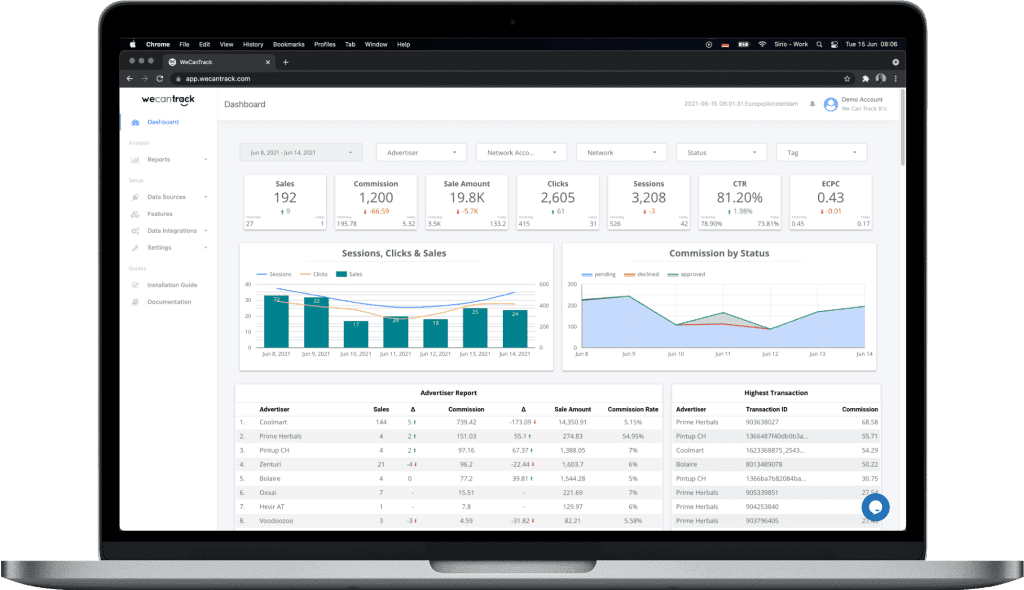
If you want to join the right affiliate programs you should research commission structures, payment terms, and platform reliability.
The best affiliate programs match your audience’s interests while offering fair compensation and dependable payouts.
Start by searching for affiliate programs in your niche using search engines or browsing affiliate networks.
Major affiliate networks like ShareASale, CJ Affiliate, Impact, Awin, and ClickBank host thousands of programs across different industries.
These networks let you browse multiple programs in one place and manage all your partnerships through a single dashboard.
You can also find affiliate programs by visiting websites of products you already use or recommend.
Look for “affiliate program” or “partner program” links in the footer. Many companies run their own programs outside of networks, like Shopify Affiliate and eBay Partner Network.
Join affiliate marketing communities and forums to get recommendations from experienced marketers.
Other affiliates often share which programs pay reliably and which ones to avoid. Industry blogs and comparison articles also highlight top-performing programs with proven track records.
Commission rates vary widely between programs. Some programs pay 1-4% per sale, while others offer 30-70% or more.
Amazon Associates pays 1-10% depending on product category. Software and digital product programs typically pay higher rates than physical products.
Check the minimum payout threshold before you join any affiliate program. This is the amount you must earn before receiving payment.
Common thresholds range from $10 to $200. Amazon Associates requires $10 for direct deposit or Amazon gift cards, but $100 for checks.
Review the payment schedule to understand when you’ll receive earnings. Most programs pay monthly, but some have delays of 30-90 days after the sale month.
Payment methods include PayPal, direct deposit, wire transfer, and checks. Choose programs that offer your preferred payment option.
Amazon Associates is the largest affiliate program with millions of products available. The cookie duration is only 24 hours, but items added to carts remain trackable for about 90 days. You earn 1-10% commission based on product categories.
ShareASale and CJ Affiliate are established affiliate networks with thousands of merchant programs. Both platforms provide reporting tools, regular payments, and access to brands across multiple industries. Cookie durations vary by individual merchant.
ClickBank specializes in digital products and information products with high commission rates of 50-75%.
Impact powers affiliate programs for major brands and offers flexible payment options.
Shopify Collabs connects creators with Shopify merchants for product collaborations and affiliate partnerships.
Each platform has different strengths. Test multiple programs to see which ones convert best with your audience and fit your content strategy.

Success in affiliate marketing depends on how well you promote products to your audience as well as getting a lot of traffic to your blog or social media channels.
The key is creating content that drives clicks and conversions, placing your unique affiliate link strategically, and using multiple platforms to reach more potential buyers.
Your content needs to solve problems and build trust before promoting affiliate products.
Write honest reviews that cover both strengths and weaknesses of products you recommend.
Include real examples of how you use the product and specific results you’ve achieved.
Focus on content types that naturally lead to purchases. Product comparisons help readers make decisions between similar options.
Tutorial content shows people how to use products while demonstrating their value.
A resource page on your site can list your top recommended tools in one place, making it easy for readers to find what they need.
Use clear calls to action that tell readers exactly what to do next.
Instead of vague phrases, write specific instructions like “Click here to get 20% off” or “Start your free trial today.”
Break up long content with subheadings, bullet points, and images to make it scannable.
Address common objections before readers think of them. If a product costs more than competitors, explain why the extra features justify the price.
If setup seems complicated, walk through each step to show it’s manageable.
Place your affiliate link where readers are most likely to click. Put links early in your content for readers who already know they want to buy.
Add links throughout longer articles so readers don’t have to scroll back to find them.
Best Link Placement Locations:
Use tracking parameters with your unique affiliate link to monitor which content drives the most conversions.
Most affiliate programs provide built-in analytics that show clicks, sales, and earnings per link. Test different anchor text and link formats to see what your audience responds to best.
Don’t hide that you’re using affiliate links. Add a brief disclosure statement explaining you earn commissions on purchases. This builds trust and meets legal requirements in most countries.
Each platform offers different ways to monetize your content through affiliate marketing. Using all the available channels will just increase how much money you make!
Your blog allows detailed product reviews and SEO-optimized articles that attract people searching for solutions.
YouTube affiliate marketing works well for product demonstrations, unboxing videos, and comparison content where viewers can see products in action.
Social media platforms have different rules for affiliate links. Instagram requires links in your bio or Stories if you have enough followers.
TikTok allows links in your bio and some creator partnerships include special linking features. Pinterest lets you add affiliate links directly to pins, making it strong for product discovery.
Platform-Specific Affiliate Marketing Strategies:
| Platform | Best Content Type | Link Placement |
|---|---|---|
| Blog | Long-form reviews, tutorials | Throughout content, resource pages |
| YouTube | Product demos, comparisons | Video description, pinned comments |
| Product photos, quick tips | Bio link, Stories (10k+ followers) | |
| TikTok | Short product showcases | Bio link, video captions |
| Product images, infographics | Direct pin links |
Repurpose your content across platforms to maximize reach.
Turn a blog post into a YouTube video, then create short clips for social media. Link all platforms together so followers on one can find your content on others.
This cross-promotion helps you build a larger audience and gives you more opportunities to share affiliate products naturally.
Affiliate marketing is a legitimate business model, but success requires following specific legal requirements and building trust with your audience.
Understanding FTC disclosure rules and avoiding common mistakes separates profitable affiliate marketers from those who fail or face penalties.
Affiliate marketing is a real and legal way to earn money online. You promote products or services and receive affiliate commissions when people make purchases through your unique tracking links.
Major companies like Amazon, Target, and Shopware run affiliate programs that pay millions in affiliate earnings each year.
The business model is straightforward. Companies get customers without upfront advertising costs, and you get paid for successful referrals.
However, the legitimacy of affiliate marketing depends on how you practice it. Promoting products you don’t believe in or using deceptive tactics will damage your reputation and could lead to legal issues.
Your audience can tell when you’re only chasing affiliate income instead of providing genuine value.
Success requires treating affiliate marketing as a real business.
This means selecting products that align with your audience’s needs, being transparent about your partnerships, and following all applicable laws and regulations.
The Federal Trade Commission requires you to disclose your affiliate relationships clearly. This isn’t optional—it’s a legal requirement that protects consumers from hidden advertising.
Your FTC disclosure must be clear and conspicuous. Place it where people will actually see it, not buried in fine print or hidden in hashtags.
For blog posts, put the disclosure at the top of your content. For videos, include both a verbal mention at the beginning and a written statement in the description.
Effective disclosure examples:
Avoid vague phrases like “Thanks to [Brand]” that don’t clearly explain your financial relationship. The disclosure should appear before affiliate links, not after.
Different platforms require different approaches. Instagram and TikTok disclosures need to appear in captions, not just hashtags.
YouTube requires disclosures in both video content and descriptions. Email marketing should include disclosures in each message containing affiliate links.
Building sustainable affiliate income requires patience and strategic planning.
Most people who take an affiliate marketing course expect instant results, but successful affiliates typically spend months creating content and building trust before seeing significant earnings.
Key strategies that work:
Search engine optimization provides free, long-term traffic but takes time to build.
Paid traffic delivers faster results but requires upfront investment and testing. Most successful affiliates use both methods.
Common pitfalls to avoid:
Your affiliate marketing tips should come from real experience, not just theory. Test products before recommending them.
Share honest opinions, including limitations. This builds credibility that translates into higher conversion rates and repeat visitors who trust your recommendations.
Starting with affiliate marketing brings up many practical questions about costs, methods, and realistic earnings.
The answers below cover everything from getting started without spending money to promoting products through different platforms and maximizing your commission potential.
You need to pick a specific topic area that you know about or want to learn. Choose something narrower than a broad category.
For example, instead of “fitness,” focus on “home workout equipment for small apartments.”
Next, decide where you’ll share your content. A website works well because you can use search engine optimization to get steady traffic over time.
YouTube and social media platforms are other options depending on what fits your skills.
Find companies that offer affiliate programs in your chosen area. You can search Google for “[your topic] + affiliate program” to find options.
Many companies list their programs on their websites, usually in the footer.
Create helpful content that solves real problems for your audience. Write detailed reviews of products you’ve actually used. Answer common questions people have in your topic area.
Add your unique affiliate links naturally within your content. Put them where they make sense based on what you’re discussing.
Drive people to your content through search engines, email lists, or paid ads. Search engine traffic takes time to build but costs nothing except your effort.
You can start affiliate marketing without spending money upfront. All you need is a free platform to share your content and affiliate programs that don’t charge signup fees.
Use free platforms like Medium, YouTube, TikTok, or Instagram to post your content. These platforms already have built-in audiences you can reach. You can also start a free blog on WordPress.com or Blogger.
Join free affiliate programs like Amazon Associates, which accepts most applicants and offers products in almost every category. Many software companies also run free affiliate programs with good commission rates.
Focus on search engine optimization for your free blog or website. Learn the basics through free resources and apply them to your content. This brings organic traffic without ad costs.
Build an email list using free tools like Mailchimp’s free tier. Collect email addresses from your audience and send them updates about new content and product recommendations.
Create content on social media platforms and include affiliate links in your bio or posts where allowed. TikTok and Instagram let you share product recommendations through short videos.
The main cost is your time. You’ll need to spend hours creating content, learning about your topic, and building an audience before seeing significant income.
Earning $100 per day requires either high traffic to low-paying offers or modest traffic to high-paying offers. The math is straightforward once you understand your conversion rates.
If you promote products that pay $50 per sale, you need two sales per day. If you convert 2% of your visitors and each visitor has a 50% chance of clicking your link, you need about 400 visitors daily.
Target keywords that show buying intent. People searching “best running shoes for flat feet” are closer to buying than those searching “what are running shoes.” Focus your content on these buying-focused searches.
Join higher-paying affiliate programs in business software, web hosting, or financial products. These often pay $50 to $200+ per sale compared to Amazon’s typical $1 to $3 per item.
Build multiple income streams across different affiliate programs. Don’t rely on one product or company. Promote 5-10 different products that your audience actually needs.
Create email sequences that promote your best affiliate offers. Once someone joins your list, send them a series of helpful emails that include your affiliate recommendations.
Scale what works by analyzing which content drives the most sales. Create more content around those topics and products.
Double down on the affiliate programs that convert best for your audience.
Amazon Associates works for almost any niche because they sell everything. You earn up to 10% commission and get credit for anything the customer buys within 24 hours, not just your recommended product.
ClickBank focuses on digital products like courses and ebooks. Commission rates often hit 50% or higher because there are no manufacturing costs. The products can be lower quality though, so review them carefully.
CJ Affiliate (Commission Junction) partners with major brands like GoPro, Home Depot, and Priceline. The platform is more complex but offers access to well-known companies with proven products.
Awin includes many international brands. They’re particularly strong in fashion, travel, and retail categories.
Individual company programs often pay better than networks. Companies like Bluehost, ConvertKit, and HubSpot run their own affiliate programs with high commissions because they want to control the relationship directly.
Software affiliate programs typically offer recurring commissions. You earn money every month the customer stays subscribed, not just on the initial sale.
You can manage most affiliate marketing tasks from your phone using the right apps. Instagram, TikTok, and YouTube all have full-featured mobile apps for creating and posting content.
Write short-form content directly on your phone. Medium and LinkedIn both have mobile apps that work well for typing articles. Use voice-to-text features to write faster.
Create videos using your phone’s camera. TikTok and Instagram Reels are designed for phone-shot vertical videos. You don’t need expensive equipment to make content that performs well.
Track your affiliate earnings through mobile apps or browser versions of your affiliate dashboards. Most major programs like Amazon Associates have mobile-friendly interfaces.
Respond to comments and messages from your phone to keep your audience engaged. Quick responses help build relationships with your followers.
The main limitation is that detailed SEO work and website building are harder on a phone.
You’ll probably want a computer for setting up your initial website, doing keyword research, and analyzing detailed performance metrics.
Screen recording videos work well for software and digital product reviews. You can show the product in action while explaining features through voiceover narration.
Create text-based content like blog posts, articles, and reviews. Your writing speaks for you without any need for photos or videos of yourself.
Use stock photos, product images, or graphics in your social media posts. Pair these with helpful captions that include your affiliate links.
Animation and whiteboard videos let you explain concepts visually without appearing on camera. Tools like Canva and Doodly help create these types of videos.
Podcast hosting lets you share your voice without your face. You can discuss products and include affiliate.
Affiliate marketing is a fantastic way to make money online. It doesn’t require a lot of up-front investment and has incredible earning potential.
It is absolutely worth giving it a shot, so get started today!

Even if you actualize your dream, it won’t necessarily be sunshine, lollipops, and rainbows. This is one of the great drawbacks of the notion of the “American Dream.” Once you […]
Read More


Want to try this at home? No worries! Download a copy of our Career Change Exit Checklist.
*****
There is a particular kind of career confusion that can make every workday feel heavier than it should.
You might wake up already tired. You might stare at your calendar and wonder how this became your life. You might feel guilty because the job looks good on paper, pays the bills, or took years to build, but something inside you keeps asking, “Is this still right for me?”
That question can be scary because it feels like it could change everything.
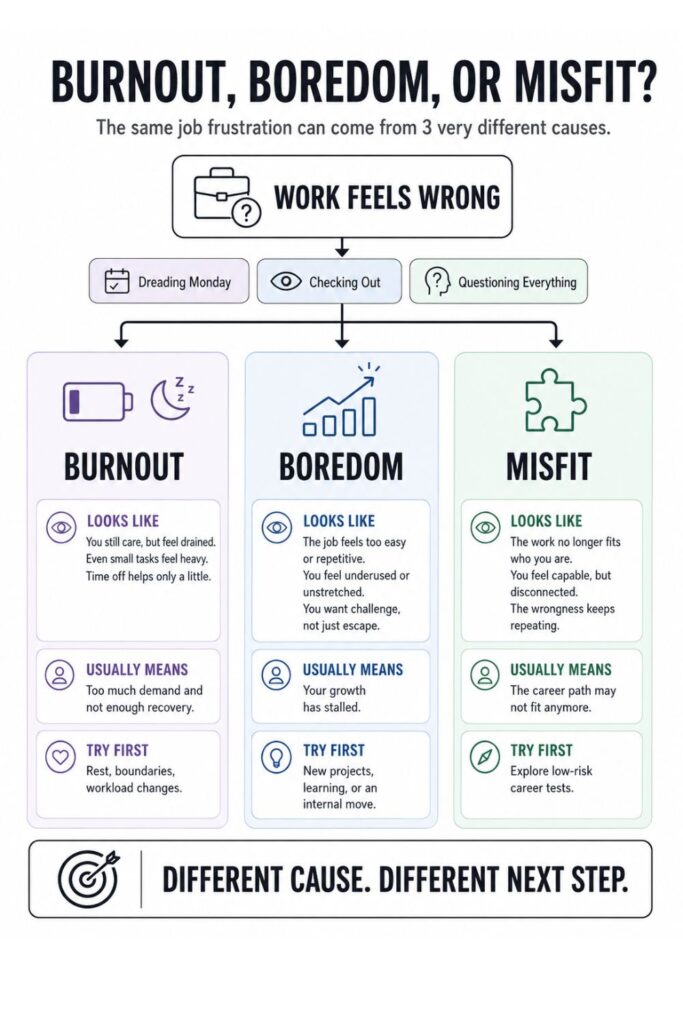
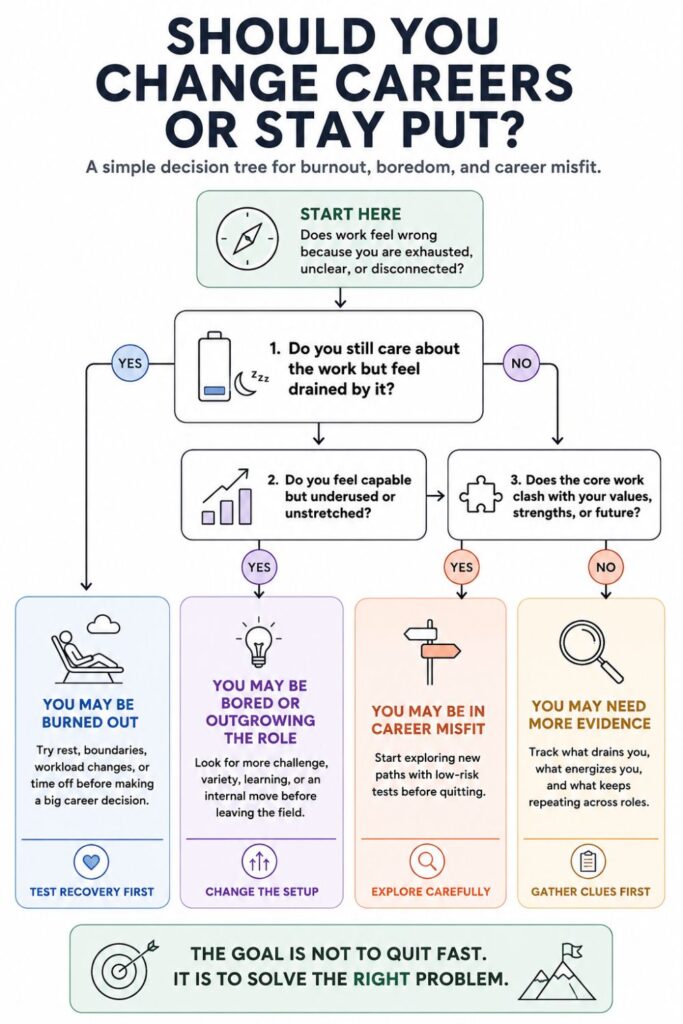
But before you decide you need a whole new career, it helps to slow down and name what is actually happening. Burnout, boredom, and misfit can feel very similar from the inside. They can all make you dread Monday. They can all make you fantasize about quitting. They can all make you scroll job listings late at night, hoping one title will suddenly make your future clear.
The problem is that they do not require the same solution.
Burnout may mean you need rest, boundaries, workload changes, or a healthier role. Boredom may mean you need more challenge, variety, learning, or responsibility. Misfit may mean your current career path no longer matches your values, strengths, personality, or long-term direction.
The goal is not to force yourself to stay. It is also not to rush yourself into leaving.
The goal is to make the right move, not just the fastest one.
In this article, you will walk through a practical decision framework that helps you separate a fixable bad season from a true career mismatch. You will look at what is draining you, what still feels possible, what keeps repeating, and what kind of change would actually solve the problem.
By the end, you should have a clearer sense of whether you need to fix your current situation, adjust your role, or start planning a more intentional career change.
Need some career guidance? Drop on by our directories choc full of career coaches to bring your career to the next level. Or click here to have us match you to the best.
When work feels wrong, it is tempting to treat every bad feeling as proof that you need to leave. But “I hate this” is not always a complete diagnosis. It is a starting point.
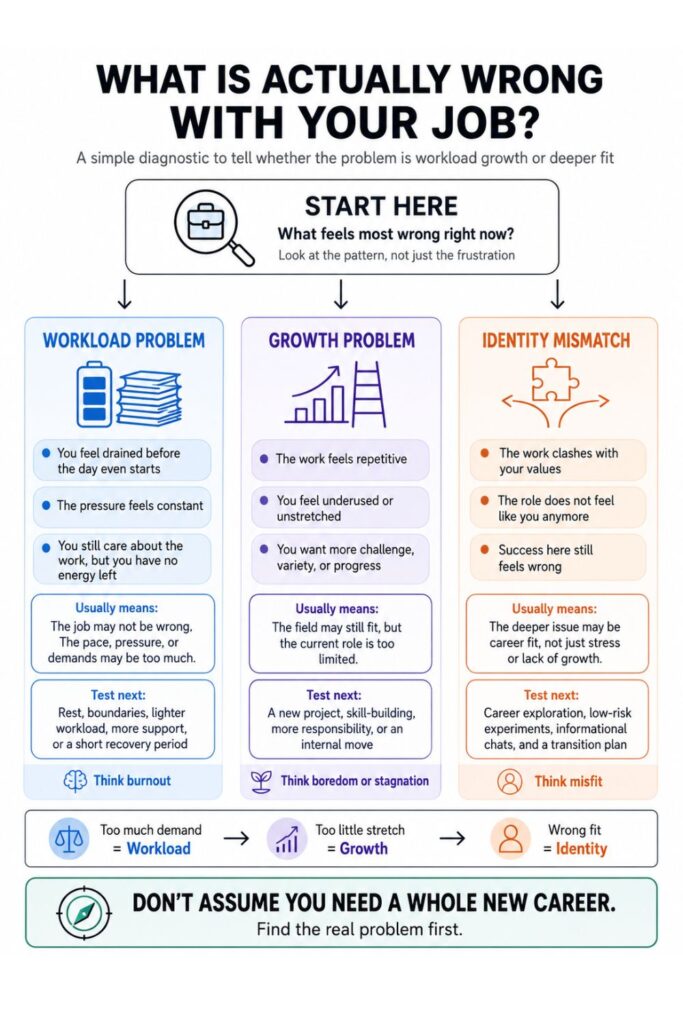
The first step is to sort your experience into three possible categories: burnout, boredom, or misfit. You may have more than one happening at once, but usually one is leading the others.
Burnout often feels like depletion. You may still care about the work, but you have no energy left for it. You feel used up, resentful, foggy, or unable to recover between workdays.
Boredom often feels like restlessness. You are not necessarily overwhelmed. You may simply feel underused, unstretched, or tired of repeating the same tasks with no real growth.
Misfit often feels like a deeper wrongness. The work may not align with your values, strengths, lifestyle, personality, or the kind of future you want to build.
Use these steps to begin sorting it out:
That sentence matters because it gives your confusion shape. “I am tired” is different from “I am bored” or “I do not believe in this work anymore.”
Once you know which problem you are solving, your options become clearer. You are no longer asking, “Should I blow up my career?” You are asking, “What kind of change would actually fix this?”
That is a much more useful question.
Burnout can make even a good career feel unbearable. It can distort your view of your job, your skills, your future, and yourself. When you are burned out, every option can feel too hard. Staying feels impossible, but changing careers also feels exhausting.
That is why burnout needs to be tested before you treat your entire career as the problem.
Start by looking at your energy. Are you only tired during certain projects or busy seasons, or do you feel drained all the time? Do you still enjoy parts of your work when the pressure drops, or does everything feel flat and heavy?
Burnout often shows up outside work too. You may stop doing things that usually help you feel like yourself. You may avoid friends, struggle to focus, lose patience quickly, or spend your evenings recovering from the day instead of actually living your life.
Use these steps to test whether burnout is driving the career crisis:
This does not mean burnout is not serious. It is serious. It also does not mean you should tolerate a workplace that keeps harming your health or well-being.
It means the first decision may not be “new career or no new career.” The first decision may be, “How do I reduce the pressure enough to see clearly?”
If you recover and the work starts to feel meaningful again, your career may not be the issue. If you recover and still feel deeply mismatched, you have stronger evidence that the problem goes beyond burnout.
That evidence is worth getting before you make a life-changing move.
Boredom can be sneaky because it does not always feel like boredom. Sometimes it feels like irritability, procrastination, low motivation, or a constant urge to start over.
You may tell yourself you are lazy, ungrateful, or impossible to satisfy. But sometimes the real issue is that you have stopped growing.
This is especially common if you once loved your work. The role may have challenged you at first, then slowly became too familiar. You learned the systems, solved the interesting problems, and reached a level where the work now feels repetitive.
That does not always mean the career is wrong. It may mean the current version of the career is too small.
Use these steps to find out:
Boredom often becomes more painful when you feel trapped by success. Maybe you are good at what you do, but being good at it has turned into a cage. People keep giving you the same work because you are reliable, even though that work no longer stretches you.
In that case, the question is not only “Should I leave?” It is also “What would make this work feel alive again?”
A career change might be right. But before you assume that, see whether the issue is the entire field or just the lack of progression inside your current setup.
Sometimes you do not need to abandon the path. You need a harder, richer, more interesting version of it.
Career misfit is different from having a bad boss, a heavy season, or a role that has gone stale. Misfit runs deeper. It is the feeling that the work asks you to operate in ways that consistently clash with who you are, what you value, or how you do your best work.
A true misfit may look like success from the outside. You may perform well, earn praise, or have a respectable title. But inside, you feel like you are constantly forcing yourself into a shape that does not fit.
This is why misfit can be so confusing. The external signs may say, “This is working.” Your inner life may say, “This is costing me too much.”
Use these steps to spot a deeper mismatch:
For example, someone might think they hate their job because their company is stressful. But after moving companies, they may realize they still dislike the core tasks. Another person might assume they need a new career, then discover they love the work when they are in a healthier environment.
That distinction matters.
Misfit is not always dramatic. It can be quiet. It can sound like, “I can do this, but I do not want to keep doing this.” Or, “I am capable here, but I do not feel connected to the work.” Or, “This career rewards things I do not want to keep prioritizing.”
If that pattern keeps showing up after rest, role changes, and honest reflection, it may be time to explore a more meaningful shift.
Not because you failed. Because you are finally telling the truth about what fits.
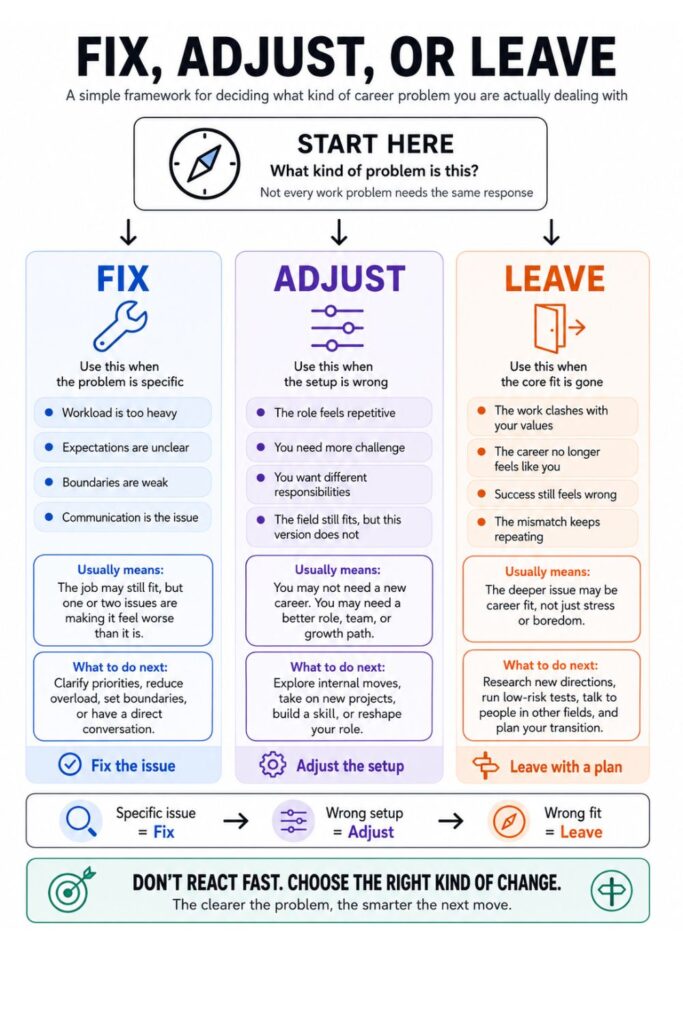
Once you have looked at burnout, boredom, and misfit, the next step is to turn your insight into a decision. That is where the “fix, adjust, or leave” filter helps.
This filter keeps you from treating every work problem like it needs the same solution. Some problems need a conversation. Some need a role change. Some need a careful exit plan.
The goal is to choose the smallest honest move that matches the size of the problem.
Use these steps:
For a fix, your next step might be asking your manager to clarify priorities, renegotiating deadlines, setting availability boundaries, or requesting support on a difficult project.
For an adjustment, your next step might be exploring an internal transfer, shifting your responsibilities, applying for a related role, or building a skill that opens a better lane in the same field.
For leaving, your next step might be researching new paths, mapping transferable skills, setting a financial runway, or talking to people already doing the kind of work you are considering.
The filter works because it reduces panic. You do not have to decide your entire future in one afternoon. You only need to decide which category your next move belongs to.
If the problem is fixable, fix it. If the setup is wrong, adjust it. If the career no longer fits, plan your way out with care.
That is how you move forward without confusing urgency with clarity.
If you suspect you need a career change, it can feel exciting and terrifying at the same time. A new field may look like freedom from the outside. But before you leap, you need to know whether the new path works in real life, not just in your imagination.
A low-risk test helps you gather evidence before making a major move. It gives you a way to explore without immediately quitting, enrolling in an expensive program, or announcing a dramatic reinvention before you understand the path.
This is not about talking yourself out of change. It is about making the change stronger.
Use these steps:
For example, if you think you want to become a project manager, do not only read inspiring career-change stories. Study real job postings. Talk to project managers about their daily work. Ask what they love, what they find draining, and what surprised them about the role.
If you think you want to move into coaching, writing, design, tech, teaching, operations, or entrepreneurship, test the work in a small way. See what the daily tasks require. Notice whether you enjoy the process, not just the identity attached to it.
This matters because escape fantasies are often vague. Real career direction is more specific.
A good test can confirm that you are on the right track. It can also save you from jumping into a new version of the same problem.
The best career changes are not built on panic. They are built on evidence, timing, and honest self-knowledge.
Career decisions are emotional, but they are also practical. You may know you want a change, but that does not automatically mean quitting tomorrow is the wisest move.
This is where money, timing, and risk come in. Not to scare you. To protect you.
A thoughtful plan gives you more freedom, not less. When you understand your runway and options, you can make a career move from a place of steadiness instead of desperation.
Use these steps:
This step can feel frustrating if you are eager to leave. But practical planning does not mean you are stuck. It means you are taking your desire for change seriously enough to support it.
For some people, the best move is a slow pivot. They keep their current role while testing new directions, saving money, or building skills. For others, the current environment is damaging enough that leaving sooner may be necessary. Even then, a basic plan can reduce the fallout.
Think about what you need to feel grounded during the transition. Do you need three months of savings? A certification? Ten informational interviews? A lower-cost lifestyle? A bridge job? A clear deadline for when you will reassess?
A career change does not become less brave because it is planned. It often becomes more possible.
The point is not to remove every risk. That rarely happens. The point is to understand the risks you are taking and decide how to carry them wisely.
That is how you protect both your future and your nervous system while you move toward something better.
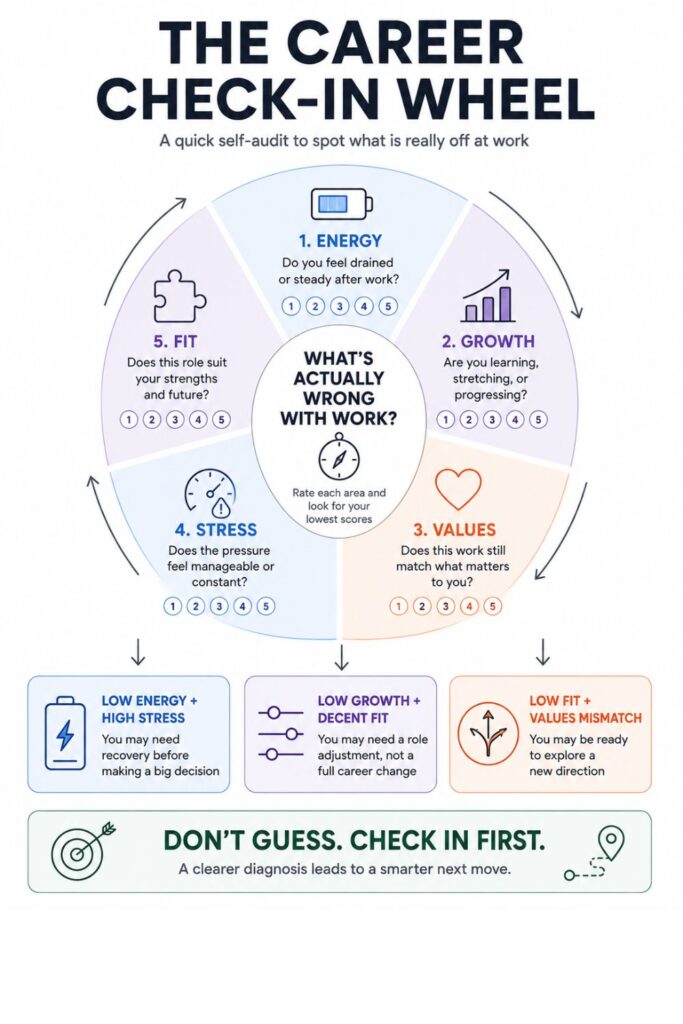
When you are deep inside career confusion, it can be hard to see the pattern. Your thoughts may loop between “I should be grateful,” “I cannot keep doing this,” “Maybe I am just tired,” and “What if I make the wrong move?”
A career coach can help you slow that loop down and sort the pieces.
This does not mean a coach tells you what to do. A good coach helps you hear yourself more clearly, test your assumptions, and make decisions based on evidence instead of panic, guilt, or fear.
Use these steps to understand where coaching can help:
This can be especially helpful if you are someone who overthinks decisions or feels responsible for everyone else’s comfort. You may know you need change, but keep talking yourself out of it. Or you may be so exhausted that every option feels equally impossible.
A coach can also help you prepare for practical moments, such as talking to your manager, naming transferable skills, rebuilding confidence, updating your direction, or deciding what kind of role would fit you better.
Career confusion often gets worse when it stays abstract. Coaching makes it more concrete.
Instead of “What am I doing with my life?” the conversation becomes, “What evidence do I have? What options are realistic? What do I want to test first? What would make this decision feel more grounded?”
That shift matters.
You do not need a coach to make a good career decision. But if you feel stuck, scattered, or unable to trust your own read on the situation, support can help you move from emotional fog to practical clarity.
Before you decide whether to stay, adjust, or leave, give yourself a better set of questions. The quality of your questions affects the quality of your decision.
Many people ask, “Should I quit?” too early. That question can create pressure because it sounds like there are only two choices: leave everything or tolerate everything.
A better question is, “What problem am I actually trying to solve?”
From there, you can ask questions that reveal whether the situation is repairable, adjustable, or truly wrong for you.
Use these prompts:
You can also ask yourself:
Write your answers down. Career confusion tends to spin in your head, but it becomes easier to understand on paper.
Do not pressure yourself to produce perfect clarity immediately. The goal is to notice what your answers keep pointing toward.
If every answer is about needing rest, start there. If every answer is about needing growth, explore that. If every answer is about a deeper mismatch, honor that signal.
Your next move does not have to be dramatic to be meaningful. It just has to be honest.
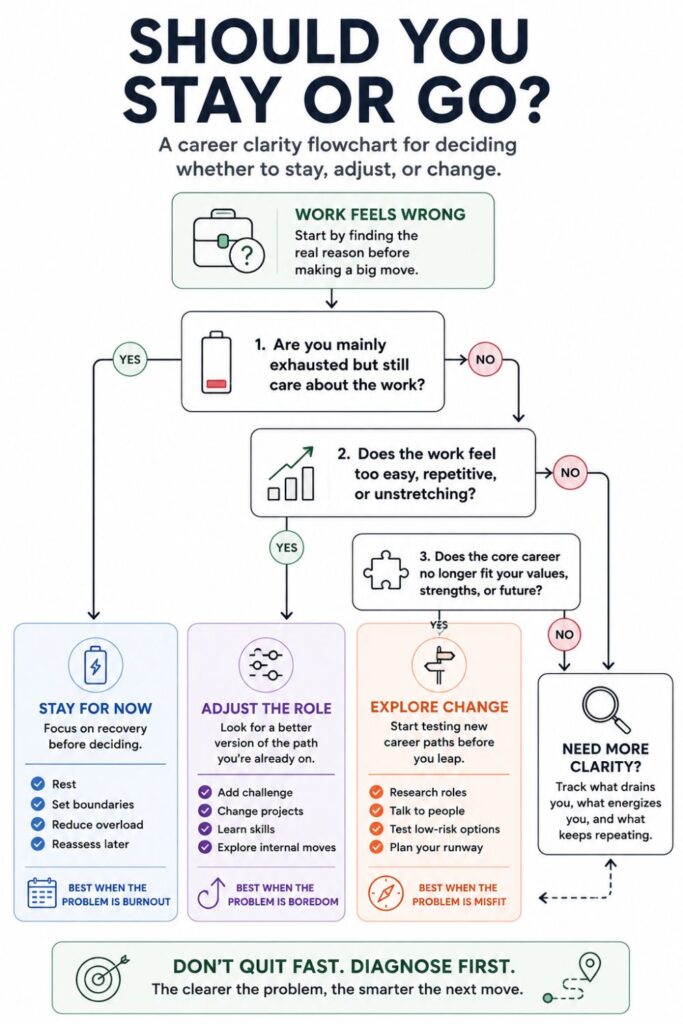
Sometimes you really do need to leave. But it is still worth checking whether you are making a clear decision or a rushed one.
Rushed decisions often happen when discomfort becomes unbearable. You want relief, and quitting starts to look like the only door out. That instinct is understandable, especially if you have been unhappy for a long time.
But relief is not the same as direction.
Use these steps to check whether you are rushing:
Other red flags include applying to random jobs just because they are different, romanticizing an industry you have not researched, ignoring financial realities, or assuming one bad season means your entire professional identity is wrong.
Again, this does not mean you should stay somewhere harmful. If your workplace is unsafe, abusive, or damaging your health, you may need to prioritize getting out. But even then, a simple plan can help you leave with more protection.
The key is to create a pause between the feeling and the decision.
That pause might be one weekend of honest reflection. It might be a week of tracking what drains you. It might be one conversation with a trusted person. It might be a month of testing a possible new path while you prepare financially.
A rushed decision says, “I need out.” A clear decision says, “I know what problem I am solving, and I know my next step.”
That difference can save you from trading one confusing situation for another.

Changing careers is not a failure. Staying is not automatically settling. Adjusting your role is not avoidance.
The right move depends on the problem you are actually solving.
If you are burned out, you may need recovery, boundaries, support, or a healthier work environment before you can think clearly. If you are bored, you may need growth, challenge, variety, or a role that uses more of your abilities. If you are in a true misfit, you may need to begin planning a career change that reflects who you are now, not who you were when you chose the path.
The mistake is treating all three problems the same.
Use these final steps to move forward:
You do not need to solve your entire career in one decision. Most meaningful changes happen through a series of honest next steps.
The important thing is to stop making career decisions from fog.
When you know whether you are dealing with burnout, boredom, or misfit, you stop asking vague, frightening questions like “What if my whole life is wrong?” You start asking better ones.
What can be repaired? What needs to change? What no longer fits? What evidence do I need? What would a steady next step look like?
That is where clarity begins.
Not with panic. Not with forcing yourself to stay. Not with quitting just to feel free for a moment.
With the courage to understand what is really wrong, and the patience to choose the move that actually helps.
*****
Want to try this at home? No worries! Download a copy of our Career Change Exit Checklist.
Need some career guidance? Drop on by our directories choc full of career coaches to bring your career to the next level. Or click here to have us match you to the best.
The post Should You Change Careers or Stay Put? A Decision Framework for Burnout, Boredom, and Misfit appeared first on Life Coach Hub.
Why Career Elites Rely on Outfit Formulas, Not Guesswork Career elites don’t spend their mornings wondering what to wear. Not because they love fashion more than everyone else—but because they […]
Read More

Living paycheck-to-paycheck is not fun. In fact it is miserable!
But, you can change your financial life and work towards financial freedom. One first step to changing your financial ife is to educate yourself.
Learn from others who have achieved wealth and practice what they preach. There may be ideas you haven’t thought of, steps you can take that you didn’t realize.
The point is, reading about what other successful people have done can help you find success as well.
The money books below will give you the maps, blueprints and tips on how to change your financial life.
These financial literacy books cover everything from how to manage your money, to how to invest it to build wealth.
But they all give you knowledge and tools you need to start changing your finances and your bank account.
Best of all, if you feel like you don’t have time to read, you can get these books in audio format and listen on your drive to work!
Are you looking to take control of your finances, change your money habits and start building wealth? It starts with education!
From practical advice on budgeting money to strategies for investing and building wealth, these books about money will help you change your life.
Check out our roundup of the best financial literacy books. You can also check out these best books about passive income.

If you’re looking to improve your financial literacy and how you approach money, Rich Dad Poor Dad by Robert T. Kiyosaki is a must-read. And probably one of the most popular personal finance books around.
Rich Dad Poor Dad: 20th Anniversary Edition is a book that teaches you how to think like the rich and challenges conventional financial wisdom.
Kiyosaki uses personal life stories to explain complex financial concepts, making it easy for anyone to understand.
He explains how you should view money by talking about growing up seeing how his dad, “poor dad” and his best friend’s dad, “rich dad” differed in their approach to money.
Kiyosaki breaks down how and why his dad never had enough money even though he worked hard all his life. And, what he learned from watching his best friend’s dad who lived a much richer life than they did.
He teaches you how to use money as a tool to make more money and not live your life paycheck-to-paycheck.
My favorite key takeaway from the book is that Robert says that rich people acquire assets whereas the poor and middle class get liabilities that they think are assets. Changes how you think about things!
Probably one of the most well known books about money out there, it will give you some ideas on how to start reaching financial independence.
It might be considered by some to be old school as it has been around for so long, but it is still a personal finance gem.
For anyone looking to improve their financial literacy, Rich Dad Poor Dad: 20th Anniversary Edition is a great place to start.
Check out this full review of the book.

If you’re looking for a book that explores the complex relationship between people and money, “The Psychology of Money” by Morgan Housel is a great choice.
It is a great book for anyone who wants to gain a deeper understanding of their relationship with money. The book is actually a collection of short stories, designed to show how people think about money.
The author explores topics like the importance of time, the role of luck, and the dangers of greed, all of which are important for anyone who wants to achieve financial freedom.
Overall, “The Psychology of Money” is a highly recommended read for anyone who wants to gain a better understanding of their relationship with money and how it affects their life.

Written in 2007 by Timothy Ferris this is one of the more popular books about passive income.
It was on the NY Times Best Seller list for 7 years! The whole point of the book is to help you learn how to live more and work less.
You can find financial freedom and only work 4 hours a week if you want to!
Tim explains how he went form working 40 hours per week and making $40,000 a year, to making $40,000 a month working only 4 hours per week!
There are also case studies from readers and practical tips that you can leverage. The book gives you tips about running your life in general, not just your professional life which makes it a game-changer.

If you’re looking for a comprehensive guide to help you take control of your finances, then “Get Good with Money” by Tiffany the Budgetnista Aliche is definitely worth checking out.
Tiffany has her on story on how she fell into a financial hole and the steps she used to get out which she shares.
In this book, she details how she learned about money and gives you a 10 step proven path to getting financially whole.
The book comes with additional resources like checklists and worksheets to help you with your personal financial planning. In addition, it features helpful advice from other experts.
Overall, if you’re looking for a practical and accessible guide to help you take control of your finances, Get Good with Money is definitely worth a read (or listen).
Earn Interest on Your Money
CIT Bank: Make money while you sleep with a high yield Platinum Savings account. *
*For complete list of account details and fees, see our Personal Account disclosures

As the title indicates, this book will give you a lot of helpful money tips. If you’re looking to achieve financial freedom, “Pillars of Wealth” by David M Greene is a great resource to have in your library.
This book is packed with valuable information on how to make, save, and invest your money to start living the life you want.
David Greene, the author, is well-known in the real estate investing world, and he brings his expertise to the table in this book.
It is also worth noting that the book is published by Bigger Pockets which is a well-known podcast by experienced investor Brandon Turner.
The Bigger Pockets website is definitely worth looking at if you want to learn more about creating money. It has educational blog posts, books, webinars and even an investment analyzer tool.
The “Pillars of Wealth” covers a lot of ground, including topics like budgeting, saving, and investing.
However, the book’s main focus is on real estate investing and how to make more money using it. If you are interested in real estate investing, this book is a must-read.
David Greene breaks down the process in an attainable way, making it easy to understand and follow along.
He also provides practical guidance on the processes involved in real estate investing, which is incredibly helpful for those just starting out.

This book by Frank Coles shows you how you can start pulling in passive income each month in a continuous stream. It tells you everything you need to know about the options out there.
It tells about 101 different businesses and passive income ideas you can start, which can all be started for less than $1,000. The business are all given a risk score, launch and operations costs, difficulty and profit potential.
Some of the ideas include peer-to-peer lending, eBook publishing and blogging, but you can pick the best fit for you.
Combining his business ideas can help you escape the rat race and find financial freedom!

If you’re looking for a practical guide to help you achieve financial independence, “The Black Girl’s Guide to Financial Freedom” is a great choice.
This book can help you learn how to build wealth, retire early, and live the life of your dreams. Paris Woods, the author, shares her own journey to financial independence and provides actionable steps that readers can take to achieve their own financial goals.
In the book, Woods emphasizes the importance of eliminating debt and building wealth through smart investments. And also how financial freedom changed her life.
She also offers advice on how to negotiate for higher pay and do things like start a side hustle to make more money. In addition, the book details how to create a budget that works for you and gives tips to save money.
Overall, The Black Girl’s Guide to Financial Freedom is a great choice for anyone looking for practical advice and motivation to achieve financial freedom.

If you’re looking to quit your job and change your financial future through real estate investing, this book by Michael Blank is definitely worth reading.
If you’re a beginner looking to make money with real estate investing, this book is an excellent resource.
It provides a comprehensive step-by-step path to achieving financial independence through real estate, even if you have no prior experience or cash to invest.
The book is packed with actionable advice and practical wisdom, and includes an online companion course as a bonus.
Here are some things you will learn from the book:
One potential downside of the book is that some readers may find the content overwhelming, as there is a lot of information to absorb.
Additionally, the book focuses primarily on multi-family investing and may not cover other types of real estate investing in depth.
However, if you’re looking to get started with multi-family investing specifically, this book is a worthwhile purchase.

Make the Most of Your Money
Empower: Get the money management tool to help you control your personal finances. Net worth, future plans, savings planner, and investments, all in one award-winning dashboard.

This passive income book was actually written by the staff of Entrepreneur Media and Nightingale-Conant, the world leader in self development.
Designed to get you out of the office cubicle for good, it will help you create a wealth-building plan that is long term.
It will help you identify multiple passive income streams and time-for-money models you can leverage. It helps you find a strategy for your goals to achieve a six-figure income.
If you are looking for a way out of the 9-5, this is one of the best passive income books to help you start planning.

Pam Brantley tells her personal story in this book about how she built wealth investing in residential real estate.
She gives advice on how you can become a real estate investor yourself and find financial independence. The book is not a get-rich-scheme but instead helps you find a long term approach to success.
Some of the tactics you will learn about include short and long-term investing, wholesaling properties, and building a portfolio of rental properties.
She even includes property management advice for more tactical information. Plus, Ms. Brantley details her own story on how she found financial success.

“The Millionaire Next Door” is a must-read for aspiring millionaires. This book by Thomas J. Stanley provides valuable insights into the habits and characteristics of millionaires in America.
It reveals that many millionaires are just ordinary people who live frugally and invest wisely. My favorite quote from the book which is eye-opening is “Wealth is not the same as income.”
If you’re willing to put in the time and effort to learn about creating wealth, The Millionaire Next Door is an excellent resource.
The book covers a ton of helpful topics, from the importance of saving and investing to the value of living below your means.
One of the strengths of The Millionaire Next Door is that it challenges common misconceptions about the lifestyle of millionaires.
The authors show that many millionaires drive used cars, live in modest homes, and avoid flashy purchases. And in some cases they got rich slowly.
This perspective can be eye-opening for anyone who believes that wealth is all about material possessions.
While some of the information in the book may be outdated, the core principles of generating wealth are still relevant.
The Millionaire Next Door emphasizes the importance of hard work, discipline, and smart financial decisions. If you’re looking for a practical roadmap to financial independence, this book is well worth your time.

If you’re looking for a beginner’s guide to personal finance that will help you eliminate financial stress, build wealth, and live the life you’ve always wanted, the “Personal Finance QuickStart Guide” is a great option.
It even comes with budget spreadsheets and other helpful financial digital tools. Written by Morgan Rochard who is a certified financial advisor.
The book teaches about many lessons about financial subjects including:

Everyone knows by now who Dave Ramsey is! A well-known speaker and New York Times bestselling author, he is a respected financial coach.
Dave Ramsey has his own personal story about how he lost everything but worked his way back into financial freedom. The New York Times bestselling author now has a net worth of $200 Million! You can read his full story here.
The book helps you learn the right way to approach money management. It is not so much about how to make money, but more how to handle it the right way.
And, Dave Ramsey is very focused on not get getting yourself into debt. Maybe too focused as some experts use debt to make money as you can see in the real estate investment examples of others.
Here are some lessons you’ll learn if you reach this book cover to cover:

If you’re a young adult who wants to learn about financial literacy, the “Financial Literacy for Young Adults Simplified” book might be a good choice for you.
The author Raman Keane book uses real-life examples and practical tips to help you manage your money effectively.
It covers topics like budgeting, saving, investing, and debt management. All the usual accepted wisdom on personal finance.
Each chapter includes clear explanations and practical examples to help you apply the concepts to your own life.
One thing I like about the book is that is also emphasizes the importance of setting goals, staying motivated, and surrounding yourself with supportive people.
I wish I had learned about money when I was a young adult! I wasted a lot of time and a lot of precious years I could have used to change my financial situation.

If you’re looking for a comprehensive guide to achieving financial freedom, this book by Grant Sabatier is an excellent read.
Author Grant Sabatier is certainly one to take advice from as he has proved he knows how to make it. At the age of 24, he only had $2.26 in his bank account!
But 5 years later he has a net worth of $1.2 Million and CNBC began calling him the “Millennial millionaire.”
The book specifically teaches that spending decades working and retiring at the normal age is not something you have to do.
Not only does he teach you how to make more money, but also teaches some basics like how to save money.
From inspiring stories to practical tips, these money books are packed with helpful, life-changing information about how to manage your money.
Start educating yourself about personal finance today and don’t waste any more time (or money!)
Want to try this at home? No worries! Download a copy of our SMART Goals PDF Worksheet.
****
You know that annoying moment when you want to get moving, but your brain is just… not cooperating?
Maybe you opened the laptop and immediately started doing everything except the thing you meant to do. Maybe you have a task that would probably take five minutes, but somehow it has become a whole emotional event. Or maybe you fell off track and now restarting feels weirdly harder than starting did in the first place.
So what actually helps when you’re stuck like that?
Not a huge plan. Not a lecture about discipline. And definitely not another to-do list that makes you feel behind before you even begin.
What usually helps is one tiny move that makes the next step feel less heavy.
That’s what these quick motivation boosters are for. They’re small, doable tricks for getting yourself back into motion when you feel distracted, resistant, overloaded, or just plain not in the mood. Pick the one that sounds most like your current situation, try it for five minutes, and give yourself a real chance to get a little momentum back.
Need some in depth help with goal settings, motivation or productivity ? Drop on by our directories choc full of productivity coaches, accountability coaches, and goal-setting coaches, and start reaching those goals! Or click here to have us match you to the best.
You know how one messy task can somehow follow you into the next one? You finish the call, but you’re still thinking about the call. You answer one email, but now five other things are buzzing in your head. The Two-Minute Reset is for that exact “my brain is still carrying everything” feeling.
What I like about this one is that it does not ask you to overhaul your routine. It gives you a tiny transition point. Stand up, clear one small thing, breathe, choose what comes next. That’s it. Sometimes that little pause is enough to make the next task feel less chaotic.
Try the Two-Minute Reset when your day starts running together.
When you’re already tired, “just get started” can feel weirdly insulting. Started how? With what energy? With what magical version of yourself? The One-Tiny-Task Promise makes starting feel much more realistic because you only have to finish one very small thing.
The best part is that the tiny task counts. You are not secretly committing to the whole project. You are choosing one small action, finishing it, and letting that be enough. And honestly, that’s often what gets the door open.
Use the One-Tiny-Task Promise when starting feels bigger than doing.

Blank pages are rude. They just sit there looking clean and judgmental while your brain suddenly forgets every thought it has ever had. This writing warm-up is for the moment when you need to write something, but the pressure to make it good is stopping you from writing anything at all.
This is especially helpful if you tend to edit before you’ve even written a sentence. The goal is not to produce polished work immediately. It is to get words moving, loosen the grip a little, and remind yourself that writing can start messy and still turn into something useful.
Try this five-minute writing warm-up when the page keeps winning.
Sometimes you are not stuck because you’re lazy. You’re stuck because your brain is trying to solve twelve steps at once. The Next Obvious Step Rule pulls you out of that swirl by asking a much kinder question: what is the next thing that would move this forward?
This one feels refreshing because it does not require you to be perfectly clear about the whole plan. You only need enough clarity for the next step. That makes it a lot easier to stop circling and actually do something.
Use the Next Obvious Step Rule when your brain keeps freezing.
A regular to-do list can make you feel like you’ve failed before the day is even over. You look at everything still sitting there and forget that you actually handled a lot. The Done List flips that around by helping you track what you finished instead of only staring at what is left.
This is one of those ideas that sounds almost too simple until you try it. Writing down what you completed gives your brain proof that you are moving. And on low-energy days, that proof can matter a lot.
Start a Done List when your progress feels invisible.
Some goals stay foggy because they only exist inside your head. You can quietly mean to do them forever. This accountability buddy message helps you make one small commitment visible without turning it into a big, awkward production.
The nice thing here is that accountability does not have to mean pressure. Sometimes it just means letting one supportive person know what you’re trying to do, then checking in with something small and honest.
Send the 5-minute accountability message when you need a little outside structure.
You probably already know the part where you get excited about a goal. The harder part is knowing where that goal usually starts to fall apart. The Project Pre-Mortem helps you look ahead and spot the most likely quitting point before it quietly takes over.
This one is really validating because it does not treat inconsistency like a character flaw. It asks what usually gets in the way, then helps you build around that. That can make a goal feel less fragile from the beginning.
Use the Project Pre-Mortem before motivation starts fading.
Falling off track has a way of making everything feel more dramatic than it needs to be. One missed day becomes “I ruined the whole thing.” One messy week becomes “I guess I’m starting over.” The 24-Hour Goal Restart gives you a much better way back in.
The most useful part is that you are not trying to fix the entire goal in one burst. You are just choosing what would make the next 24 hours feel like progress again. That is a much easier door to walk through.
Try the 24-Hour Goal Restart when you need to return without guilt.
You know when you are about to start, and then your brain suddenly has a whole legal case for why now is not the right time? The 3-2-1 Countdown Start is for interrupting that negotiation before it gets too convincing.
This trick works because the first move is often the hardest part. Not the whole task. Just that tiny moment where you stop thinking about starting and actually begin. Counting down gives that moment a little structure.
Use the tiny countdown trick when your brain keeps talking you out of starting.
If you put things off because the first version might be bad, awkward, visible, messy, or not “good enough,” this one is going to feel very familiar. The Practice Round Trick takes the pressure off by letting the first attempt be exactly that: practice.
This reframe is simple, but it can be a big relief. You are not performing. You are rehearsing. You are allowed to try the move before you master the move. That can make starting feel a lot safer.
Try the Practice Round Trick when the first step feels too high-stakes.
A big pep talk can feel good for a minute, but then you still have to do the thing. And if the thing still feels vague, heavy, or emotionally loaded, the pep talk wears off fast.
Tiny motivation boosters work because they give you something to do right now. Not a whole transformation. Not a new identity. Just one small action that changes the moment you are in.
That might mean clearing one object from your desk. Writing one messy sentence. Sending one message. Naming one next step. Tracking one finished task. These moves seem small because they are small. That is exactly why they are useful when your energy is low.
Most people do not stay motivated in one clean, perfect line. They drift. They pause. They avoid things. They get distracted. They lose the thread and have to find it again.
So the real skill is not “never fall off track.” That is not how actual life works.
The real skill is learning how to come back without making it a whole thing.
That is what all of these quick boosters have in common. They make restarting feel less dramatic. They give you a tiny way back into motion before the stuck feeling gets bigger than the task itself.
Choose the one that fits today’s version of stuck.
Not the one that sounds most impressive. Not the one you think you “should” need. Pick the one that makes you think, “Okay, I could actually do that.”
****
Want to try this at home? No worries! Download a copy of our SMART Goals PDF Worksheet.
Need some in depth help with goal settings, motivation or productivity ? Drop on by our directories choc full of productivity coaches, accountability coaches, and goal-setting coaches, and start reaching those goals! Or click here to have us match you to the best.
Then give it five minutes. A little momentum counts.
The post Ten 5-Minute Motivation Boosters (That Work) appeared first on Life Coach Hub.