There’s a moment most people recognize.
You know what you should be doing. The task is clear. The goal matters. But somehow you’re still not starting.
You open a tab, check something small, rearrange your desk, or promise yourself you’ll begin “in a minute.” Before you realize it, the delay becomes a pattern.
Procrastination rarely happens because the task is impossible. It usually happens because starting feels mentally heavy.
When your brain sees a large task, it interprets it as effort, pressure, and commitment. That creates resistance. And resistance leads to avoidance.
The 2-Minute Start solves this problem by shrinking the beginning of any task into something incredibly small.
Instead of committing to the entire project, you only commit to the first two minutes.
Two minutes of writing.
Two minutes of organizing.
Two minutes of planning.

That tiny commitment lowers the psychological barrier that usually stops people from beginning.
Once you start moving, something interesting happens. The task often feels easier than you expected. Your brain switches from resistance to engagement.
Momentum replaces hesitation.
This is why many productivity experts consider starting the most important moment of any task. Action creates energy. Movement builds motivation.
If you want to be more productive, build self motivation, and use practical productivity hacks that work even on low-energy days, the 2-Minute Start is a simple framework that can change how you approach work.
You don’t have to feel ready.
You just have to begin.
The 2-Minute Start Framework

Why starting small breaks procrastination
Most people assume procrastination comes from laziness or lack of discipline.
In reality, procrastination is usually a response to mental overload.
When a task feels too big or undefined, your brain searches for ways to delay it. The larger the project appears, the stronger the resistance becomes.
The 2-Minute Start works because it removes that pressure.
Instead of focusing on the entire project, you only focus on the smallest possible action.
The brain sees a small task very differently from a large one.
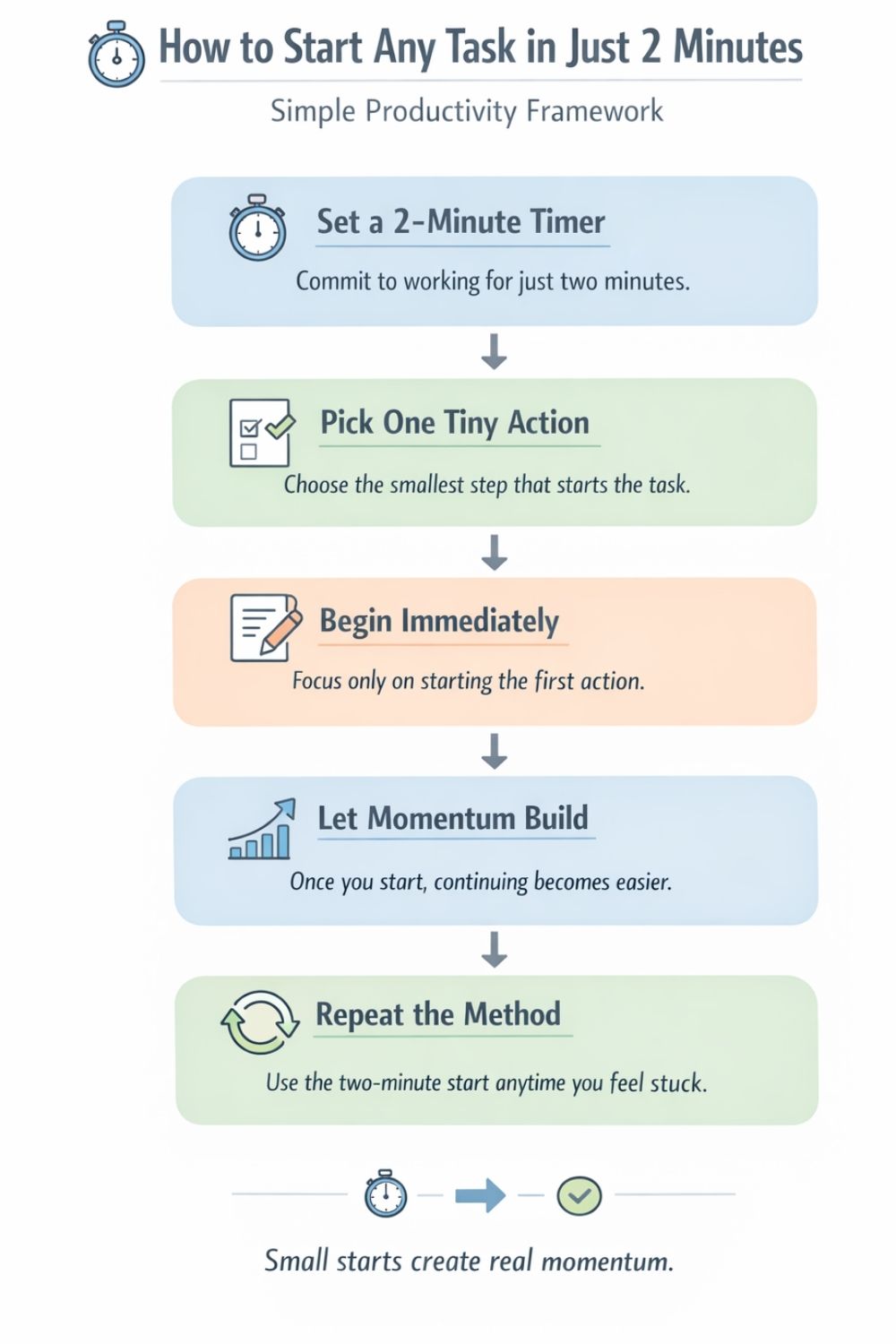
Shrink the task to the smallest possible action:
Take the project you’ve been avoiding and reduce it to something you can begin immediately. If you need to write an article, your two-minute action might be opening the document and writing one sentence. If you need to organize your workspace, your two-minute action might be clearing one small area.
Set a simple two-minute timer:
Use a timer to make the commitment clear. Two minutes feels manageable, even on days when energy is low. Knowing the session is short helps remove internal resistance.

Focus only on the first visible step:
Do not think about the entire project. Ignore the outcome and focus only on the next action in front of you. This keeps your attention simple and manageable.
Allow momentum to develop naturally:
Once the timer ends, decide whether you want to continue. Many times you will keep working because the hardest part—the start—is already done.
Repeat the method when you stall again:
If resistance returns later, restart the system. Choose another two-minute action and begin again.
This framework transforms starting from something intimidating into something simple and repeatable.
How to Turn the 2-Minute Start Into a Daily Productivity Habit

Making small starts part of your routine
The real power of the 2-Minute Start appears when it becomes part of your daily workflow.
Instead of waiting for motivation to appear, you use small starts as your default strategy for beginning tasks.
Over time, this trains your brain to associate work with ease rather than pressure.
Identify your most common starting blocks:
Notice where procrastination tends to appear in your day. It might happen when you sit down to begin work, start a creative project, reply to emails, or tackle a large goal. These moments are perfect opportunities to use the two-minute rule.
Create a “start list” for your tasks:
Instead of writing large tasks like “finish report” or “clean office,” write the smallest first action required to begin. This could be “open the spreadsheet,” “outline three ideas,” or “clear the desk surface.”

Start before motivation shows up:
One of the biggest productivity myths is that you need motivation before you begin. In reality, motivation often appears after action starts. The two-minute commitment helps you bypass the waiting stage.
Reward the act of starting:
Most people only celebrate completed work. Instead, acknowledge the moment you begin. Starting consistently builds trust in yourself and strengthens self motivation.
Use the rule across different areas of life:
The 2-Minute Start works for writing, studying, organizing, exercising, planning, and creative projects. Any goal becomes easier when the entry point is small.
As you repeat this pattern daily, starting becomes automatic.
You stop negotiating with yourself and begin moving forward.
Using the 2-Minute Start When Your Energy Is Low

Beginning even when you feel mentally drained
Some days the challenge isn’t procrastination.
It’s exhaustion.
When energy is low, even simple tasks can feel overwhelming. Your brain wants to conserve effort, which makes starting feel difficult.
The 2-Minute Start is especially useful on these days because it reduces the amount of energy required to begin.
Instead of forcing yourself through a long work session, you only focus on the smallest possible action.
Choose the lowest-effort entry point:
When energy is low, adjust your starting step. Instead of aiming for productivity perfection, choose the easiest version of the task. Brainstorm ideas instead of writing a full page. Review notes instead of building a complete plan.

Prepare your environment first:
Small environmental adjustments can make starting easier. Open the document you need, clear your desk, or place materials within reach. These small changes remove friction from the beginning of the task.
Focus on movement instead of results:
On low-energy days, the goal is not maximum output. The goal is motion. Even small progress keeps the task alive and prevents it from becoming overwhelming later.
Let the work session grow naturally:
Sometimes the two-minute start turns into a longer work session. Other times you may stop when the timer ends. Both outcomes are productive because you honored the commitment to begin.
Use the system to restart stalled days:
If your day feels off track, a two-minute action can reset momentum. Starting one task often unlocks the motivation to continue with the next.
Small actions are surprisingly powerful when your energy is limited.
They keep progress moving forward.
Combining the 2-Minute Start With Other Productivity Hacks

Turning tiny actions into meaningful progress
The 2-Minute Start is powerful on its own, but it becomes even more effective when paired with other productivity strategies.
Once the starting barrier is removed, you can build additional structure that keeps momentum moving.
Extend the start into a focused time block:
After your two minutes are complete, consider expanding the session into a short focus block. Many people move into a 15 or 25 minute work period once they’re already engaged.
Use momentum to complete quick wins:
Once you’ve started working, look for small tasks that can be finished quickly. Completing these builds confidence and reinforces the feeling of progress.
Stack multiple two-minute starts together:
You can use the method across several tasks in one work session. Start the email draft, outline your report, organize a document, and review your calendar. Several small starts can move your entire day forward.
Track small progress throughout the day:
Recording small wins helps you see how much work you actually accomplish. Even simple actions contribute to larger goals over time.
Prepare tomorrow with a two-minute finish:
Before ending your day, spend two minutes setting up your first task for tomorrow. Open the document, write a note, or outline the next step. This makes it easier to begin the next morning.
The secret to productivity isn’t working harder.
It’s making starting easier.
And sometimes, two minutes is all it takes to turn hesitation into momentum.
The post The 2-Minute Start: A Simple Way to Begin When You Feel Stuck appeared first on Life Coach Hub.
Leave a Reply