Most people try to improve their lives by making big, dramatic changes. They set huge goals, design complicated routines, and expect motivation to carry them through.
But lasting progress rarely works that way.
The 1% Better Rule is a simple idea: instead of trying to transform everything at once, you focus on the smallest improvement you can repeat every day. One tiny upgrade. One small action. One simple habit that nudges you forward.
This approach works because consistency beats intensity. Small actions feel manageable even when energy is low. And when those actions repeat daily, they slowly compound into real progress.
You may have heard similar ideas in discussions about atomic habits, where the focus is on small systems rather than dramatic change. The difference with the 1% Better Rule is its simplicity. You’re not trying to optimize your entire life.
You’re just getting a little better today than you were yesterday.
That tiny improvement might be reading one page, organizing one item on your desk, walking for two minutes, or writing one sentence toward a goal. It may feel insignificant in the moment, but repetition turns it into momentum.
Over time, these small actions create powerful daily habits to improve your life. They reduce overwhelm, build confidence, and help you follow through consistently.
Instead of waiting for the perfect plan or the perfect mood, you simply begin with the smallest possible step.
And that’s where real change begins.
Choose the Smallest Possible Improvement

Most people struggle with habits because they start too big. They try to redesign their entire routine overnight, which quickly leads to frustration and burnout.
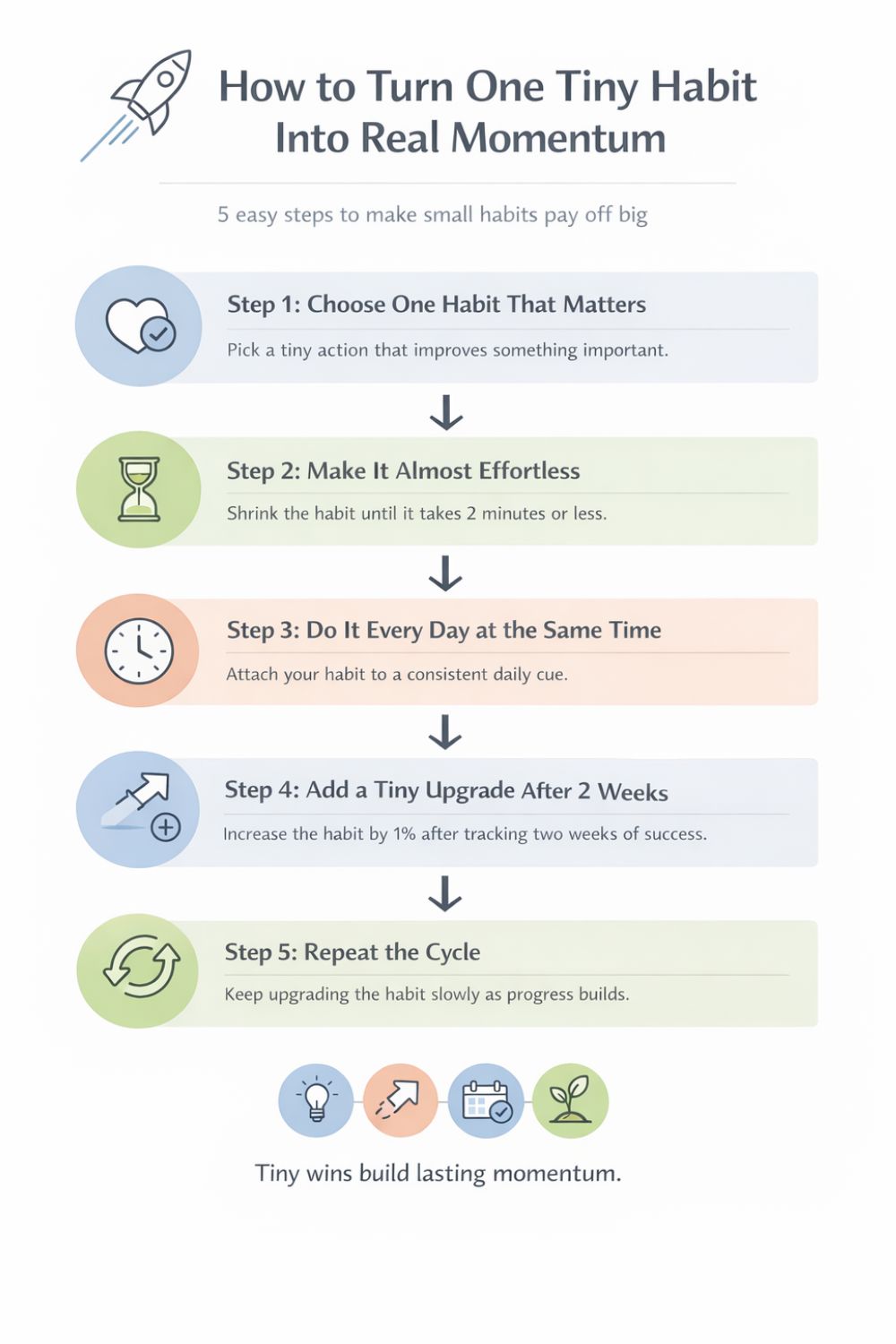
The 1% Better Rule begins with shrinking the habit until it feels almost effortless.
Pick a micro-upgrade: Identify the smallest possible action that moves you in the right direction. If your goal is to read more, start with one page. If you want to improve your health, begin with one stretch or one minute of movement.
Make the habit easy to repeat: A habit should feel so manageable that you can do it even on your busiest day. The goal is not intensity. The goal is repetition.

Connect the habit to something you already do: Attach the improvement to an existing routine. For example, write one sentence in your journal after opening your laptop each morning or review one task on your to-do list after pouring your coffee.
Lower the barrier to starting: Remove anything that slows you down. Keep the book on your desk, the notebook open, or the habit tracker visible.
Stop before it feels difficult: Ending while the habit still feels easy increases the chances you’ll repeat it tomorrow.
This approach may feel almost too simple, but that’s exactly why it works.
When habits are small, the brain doesn’t resist them. They don’t trigger the same internal pushback as major life changes.
Instead, they quietly slip into your routine.
And once a habit becomes part of your day, it becomes far easier to build on it.
Turn Tiny Actions Into Automatic Habits

Once you choose your small improvement, the next step is turning it into something automatic.
Habits become powerful when they stop requiring constant decisions.
Instead of relying on motivation every day, you build a simple system that guides your behavior.
Create a clear trigger: Every habit needs a cue. This could be a time of day, a location, or an existing action. For example, begin your habit right after opening your work computer.
Keep the action extremely short: Tiny habits are easier to repeat because they don’t drain energy. Even a two-minute action can build momentum.
Track your consistency: Use a habit tracker, calendar, or checklist. Marking each completed day reinforces progress and helps you stay aware of your streak.
Celebrate completion quickly: A simple checkmark or small acknowledgment tells your brain the habit is rewarding.

Focus on one improvement at a time: Trying to build several habits simultaneously often leads to inconsistency. One habit practiced daily is far more powerful than five habits attempted occasionally.
Over time, your brain begins to expect the routine.
You sit down at your desk and automatically review your task list. You finish breakfast and naturally open your notebook. You end your workday and take a short walk without thinking about it.
This is how strong habits for a better life are formed.
They stop feeling like tasks and start feeling like part of your normal rhythm.
And once a habit becomes automatic, maintaining it requires very little effort.
Let Small Wins Compound Over Time

The real strength of the 1% Better Rule comes from compounding.
One small action may not seem impressive today, but daily repetition creates remarkable results over time.
Trust gradual progress: Tiny habits accumulate quietly. One page a day becomes multiple books per year. One short walk becomes hours of movement across a month.
Allow the habit to grow naturally: Once the habit feels effortless, expansion often happens on its own. One page becomes three. One push-up becomes five.
Use momentum to increase effort slowly: When the routine feels stable, add a small upgrade. The key is gradual improvement rather than sudden leaps.
Protect your streak whenever possible: Missing a day occasionally is normal. But try not to miss two days in a row, which can interrupt the rhythm.
Focus on identity instead of output: Every repeated habit reinforces the identity of someone who follows through.
Instead of asking, “Did I accomplish something big today?” you begin asking, “Did I keep my promise to myself?”
That shift in perspective is powerful.
Over time, the habit stops being something you’re trying to maintain. It becomes part of who you are.
And that identity shift is where real transformation begins.
Where to Apply the 1% Better Rule First

The best place to start using the 1% Better Rule is in an area that already matters to you.
Choose something meaningful, but keep the improvement extremely small.
Morning routines: Add one tiny action that improves the start of your day, such as drinking water, writing one intention, or reviewing your top priority.
Work productivity: Improve your workflow by clearing one item from your inbox or organizing one document each day.
Learning and skill-building: Read one page, practice a skill for two minutes, or watch a short educational video daily.
Health habits: Stretch for one minute, take a brief walk, or do a single mobility exercise.
Home organization: Put away one item, wipe one surface, or tidy one small area each day.
Starting with small improvements reduces resistance.
You’re not trying to completely redesign your schedule. You’re simply creating a small pattern of progress.
As that pattern repeats, the habit becomes easier to maintain.
And once a habit feels normal, expanding it requires very little effort.
The key is remembering that the smallest action counts.
Consistency matters far more than size.
How the 1% Rule Prevents Burnout

Many self-improvement systems fail because they demand too much energy.
People start with excitement but quickly become exhausted trying to maintain ambitious routines.
The 1% Better Rule avoids this problem entirely.
Tiny habits require minimal effort: Even on difficult days, a small improvement is manageable.
Consistency builds confidence: Each completed habit strengthens your sense of reliability.
Momentum replaces motivation: Instead of waiting to feel inspired, you simply follow the routine.
Progress feels calm rather than stressful: Small improvements create steady movement without emotional pressure.

Your identity slowly changes: Over time, you begin to see yourself as someone who follows through.
This is one of the most powerful benefits of the 1% approach.
You no longer rely on bursts of motivation or strict discipline. Your progress becomes quieter and more sustainable.
Even on days when energy is low, the habit remains possible.
And when those small actions repeat consistently, they build a foundation of steady growth.
That’s the quiet power behind the 1% Better Rule.
Tiny improvements may seem insignificant at first. But over time, they transform the way you live, work, and move toward your goals.
The post The 1% Better Rule: The Tiny Habit That Quietly Changes Everything appeared first on Life Coach Hub.
Leave a Reply