Some days the hardest part of productivity isn’t the work itself. It’s starting.
When a task feels big, complicated, or mentally heavy, the brain tends to delay it. You might open a document, stare at it, and suddenly feel the urge to check email, scroll your phone, or reorganize your desk instead.
This isn’t laziness. It’s friction.
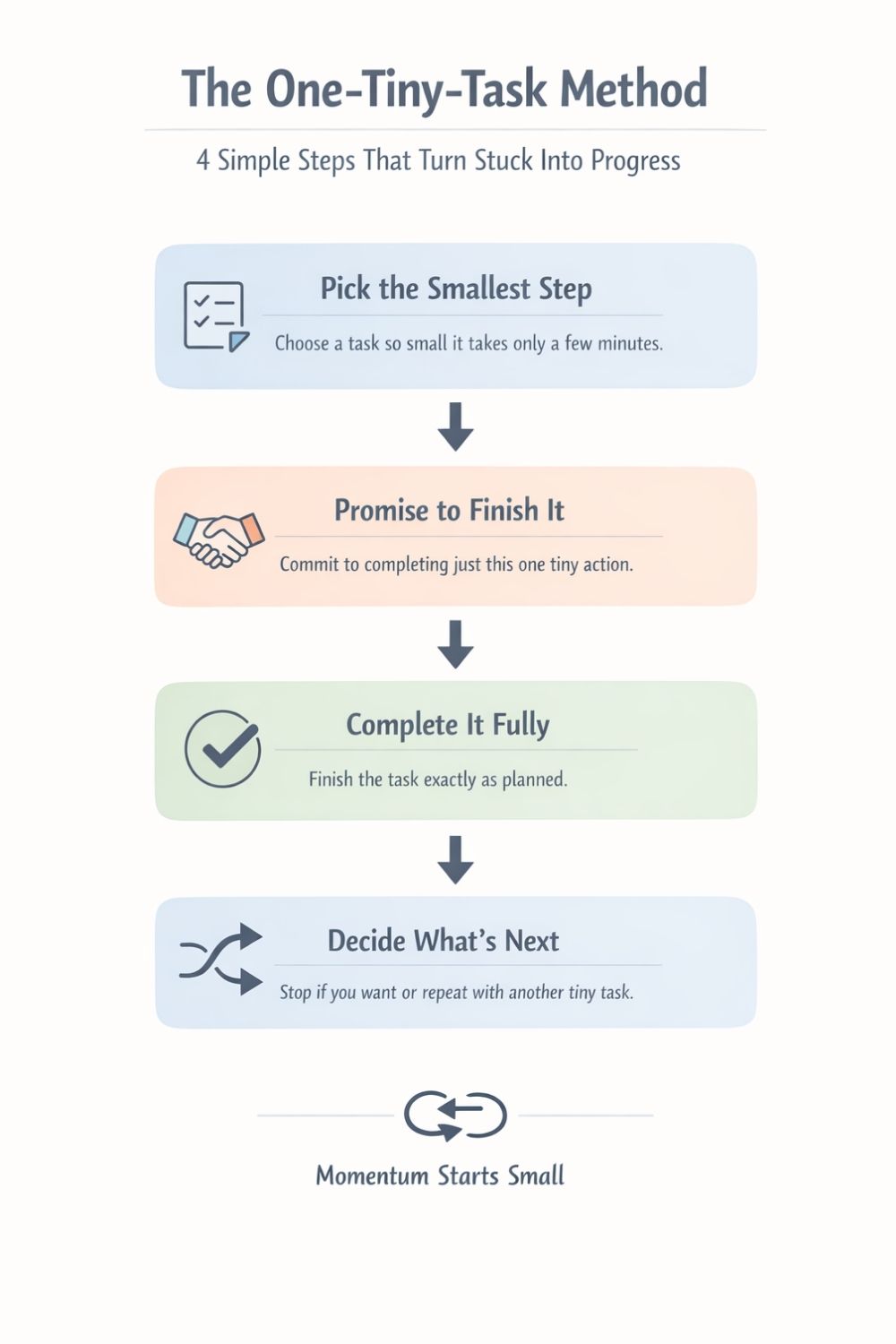
The One-Tiny-Task Promise is a simple framework designed to reduce that friction. Instead of trying to complete a full project or even a full work session, you commit to finishing just one extremely small task.
Not ten tasks.
Not an hour of work.
Just one tiny step.
This works because the brain responds strongly to completion. Finishing something—even something small—creates a feeling of progress that can break the mental freeze that stops many people from starting.
The beauty of this method is that it works even on low-energy days. When motivation is low and your focus feels scattered, a tiny task is still manageable.
Once the first task is complete, you can decide whether to continue. Sometimes momentum kicks in and you keep going. Other times you stop, and that’s still a success because you kept your promise.
Over time, this approach builds something powerful: self-trust. When you repeatedly follow through on small promises to yourself, starting becomes easier.
Instead of relying on motivation, you rely on a simple system.
And that system begins with choosing the smallest possible step.
Define the Smallest Possible Task

The first step of the One-Tiny-Task Promise is choosing a task so small that resistance almost disappears.
Most productivity struggles happen because people start with tasks that are still too large. “Work on the project” or “clean the office” sounds manageable on paper, but the brain interprets these as big commitments.
The solution is to shrink the task dramatically.
Shrink the task until it feels almost trivial: Take the larger goal and reduce it to a single tiny action. Instead of “write the report,” your first step might be opening the document and writing one sentence.
Small tasks remove the emotional weight that normally blocks action.
Make the step finishable in five minutes or less: A tiny task should have a very short time horizon. When the brain knows the task will end quickly, it’s far easier to begin.

Even something as small as writing three bullet points can work.
Choose a step with a clear finish line: Vague tasks create hesitation. Instead of “review notes,” choose something concrete like highlighting three key ideas or organizing one section.
Clear endings help the brain recognize progress.
Write the task in simple, specific language: When the task is written clearly, it becomes easier to start. A note that says “draft one paragraph” feels much more actionable than “work on writing.”
The goal of this stage isn’t productivity yet.
The goal is simply removing the barrier to starting.
Once the task is small enough, beginning no longer feels overwhelming.
Make a Simple Promise to Finish One Task

The power of this framework comes from the promise itself.
Instead of telling yourself that you will “work hard today” or “be productive,” you make a single clear commitment: you will finish one tiny task.
This dramatically reduces pressure.
Commit to completing only one small action: Your responsibility is limited to the one step you selected. You are not committing to an hour of work or finishing the entire project.
The promise stays intentionally small.
Remove the expectation that you must continue: This is one of the most important parts of the method. You are allowed to stop after completing the task.
Knowing that continuation is optional lowers resistance.

Start immediately once the promise is made: Avoid preparing or overthinking the step. As soon as the task is chosen, begin working on it.
Momentum begins with action, not planning.
Treat the promise as meaningful: Even though the task is small, finishing it still matters. Every time you follow through on a promise to yourself, you reinforce the habit of execution.
Many people struggle with productivity because they make promises that are too large to keep.
The One-Tiny-Task Promise solves that problem by making the commitment extremely achievable.
Keeping small promises consistently builds confidence.
And confidence makes future tasks easier to start.
Finish the Task Completely

Once you start the tiny task, the next step is simple: finish it fully.
Completion is what creates the psychological reward that fuels momentum.
When the brain experiences a finished action, it releases a sense of progress and closure. That small reward often encourages you to keep going.
Focus on finishing exactly what you promised: Avoid expanding the task or adding extra steps. If the promise was to write one sentence, then writing one sentence is the goal.
The power of the method comes from finishing.
Remove distractions for a few minutes: Since the task is short, give it your full attention. Silence notifications, close extra tabs, and complete the action without interruption.
This helps the task finish quickly.
Mark the task as complete: Crossing something off a list or checking a box reinforces the feeling of accomplishment. Visual confirmation strengthens the sense of progress.
Even tiny completions matter.
Pause briefly to acknowledge the win: Many people rush straight to the next task without noticing the completion. Taking a moment to recognize the finished step reinforces motivation.
This small recognition helps the brain associate action with reward.
The goal here isn’t perfection or productivity.
The goal is completion.
Finishing even the smallest task tells your brain something important: progress is happening.
And once progress begins, it becomes easier to continue.
Decide Whether to Continue or Stop

After completing the tiny task, you reach an important moment: the decision point.
This is where the One-Tiny-Task Promise becomes powerful.
Because you only promised to finish one step, everything after that is optional.
Check in with your energy and focus: Ask yourself whether you feel like doing another tiny task. Sometimes the answer is yes because momentum has started to build.
Other times the answer will be no.
Both outcomes are fine.
Choose another small step if you want to continue: If you decide to keep going, simply repeat the same process. Select another tiny task and complete it fully.
Momentum often grows naturally when tasks stay small.
Allow yourself to stop without guilt: If you finish the task and feel done, you can stop. You kept your promise.
That alone is a win.
Use momentum when it appears: On many days, the hardest part of work is simply beginning. Once you’ve started, it becomes easier to continue.
You may find yourself completing several tiny tasks in a row.
The method works either way.
Even one completed task creates forward movement.
And forward movement is how momentum begins.
Turning the One-Tiny-Task Promise Into a Daily Habit

Once you start using this framework, it can easily become part of your daily routine.
Instead of waiting for motivation, you simply return to the same starting point: one tiny task.
This creates consistency without requiring large bursts of energy.
Begin your day with one small completion: Starting the day with a quick win can create early momentum. Even a simple action like outlining a few notes can help shift your brain into work mode.
The goal is to start moving.
Use the method whenever you feel stuck: When you notice procrastination or hesitation, return to the One-Tiny-Task Promise. Choose a small step and complete it.
This resets your focus.
Apply the system to different goals: The framework works for writing, learning, organizing, planning, or creative work. Any large project can be broken into tiny starting points.
The method adapts to almost any situation.
Track your tiny wins over time: Keeping a small list of completed actions can reveal how much progress comes from small steps. Over weeks and months, those tiny tasks accumulate into meaningful results.
Consistency matters more than intensity.
And the easiest way to stay consistent is to make starting simple.
Examples of One-Tiny-Task Promises

Understanding what counts as a tiny task can make the system easier to apply.
The key idea is simple: reduce the starting step until it feels quick and achievable.
Writing project: Write one sentence or create three bullet points outlining your idea.
Even this small step begins the writing process.
Email inbox: Reply to one email instead of trying to clear the entire inbox.
A single reply creates progress.
Work project: Open the project file and list the next three actions needed.
This small step clarifies what comes next.
Learning something new: Read one paragraph of a book or watch a two-minute portion of a tutorial.
Short learning sessions can still move knowledge forward.
Organization task: Clear one small area of your desk rather than cleaning the entire workspace.
Tiny improvements still count as progress.
These examples show how almost any task can be reduced to a small, manageable starting point.
Once the first action is complete, the next step often feels easier.
And sometimes, that one tiny task is all it takes to get momentum moving again.
The post One-Tiny-Task Promise: How to Start Anything by Finishing the Smallest Possible Task appeared first on Life Coach Hub.
Leave a Reply